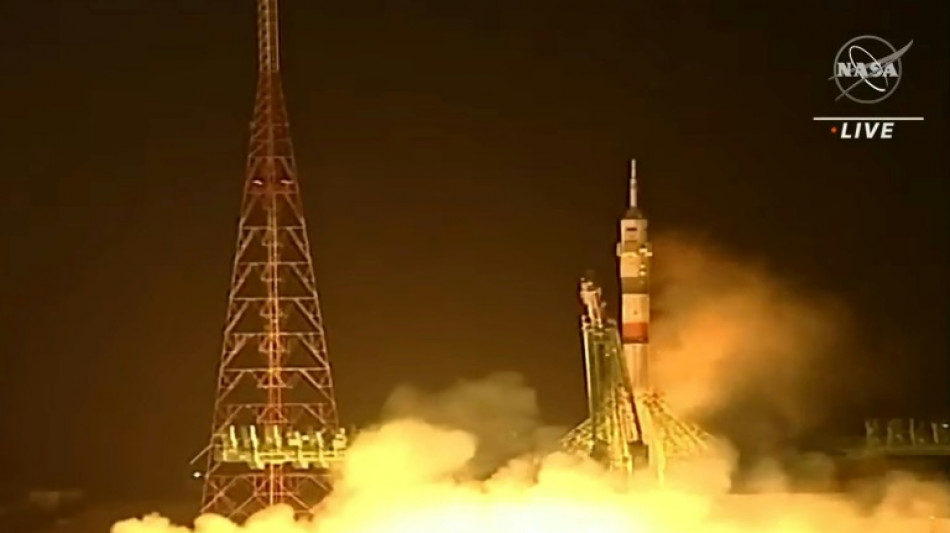
Russia launches empty ship to ISS to replace damaged capsule / Photo: - - NASA TV/AFP
 Aston Villa Defy History With Rare Victory at Old Trafford

 Crowds Gather at San Francisco Park for Elizabeth Holmes Lookalike Tournament

 Making Your Home Safer for Aging Parents: Accessibility Renovations That Add Value

 iPS Cell Research Accelerates Drug Discovery for ALS and Spinal Cord Injury

 Rene Eyre Revisits Autobiographical Performance 'Say A Little Prayer' in London

 UAE's HCT Holds Record Graduation and Announces Major Training Expansion

 NASA Awards $10B Lunar Contract Framework to SpaceX, Blue Origin

An uncrewed Russian Soyuz capsule took off early Friday from Kazakhstan for the International Space Station to eventually bring home three astronauts whose return vehicle was damaged by a tiny meteoroid.
The Soyuz MS-23 vessel lifted off successfully from the Russian-operated Baikonur Cosmodrome, live video broadcast by ISS-partner NASA showed.
Though the capsule is scheduled to dock with the ISS early Sunday Moscow time, it is not expected to bring home US astronaut Frank Rubio and Russian cosmonauts Dmitry Petelin and Sergei Prokopyev until September.
The three arrived at the ISS last September aboard MS-22, and were originally only supposed to stay about six months, until the end of March.
But their capsule began leaking coolant on December 14 -- shortly before Russian cosmonauts were to begin a spacewalk -- after being hit by what US and Russian space officials believe was a tiny space rock.
MS-23 was initially scheduled to launch in mid-March with two cosmonauts and an astronaut on board who would eventually take over for Rubio, Petelin and Prokopyev.
Without replacements however, the three will now spend almost a year on the ISS.
After delivering humans to the ISS, capsules stay attached to the orbiting research lab throughout the duration of missions, in case of any emergencies and to ferry the crew home.
The damage caused by the suspected tiny meteoroid to the MS-22's cooling system raised fears that there could be problems during reentry, when the capsule experiences extreme temperatures.
A similar leak in mid-February also affected the Russian Progress MS-21 cargo ship, which had been docked to the ISS since October.
That uncrewed ship left the space station last week.
In addition to the three crew awaiting the arrival of MS-23, there are also four others currently on the ISS, who arrived on a SpaceX Dragon capsule last October as part of the Crew-5 mission.
They are scheduled to be joined next week by members of the Crew-6 mission -- two Americans, an Emirati and a Russian -- who will also arrive aboard a SpaceX capsule expected to launch Monday from Florida.
After a few days of overlap, Crew-5 will then return to Earth.
Space has remained a rare venue of cooperation between Moscow and Washington since the start of the Russian offensive in Ukraine and ensuing Western sanctions on Russia.
The ISS was launched in 1998 at a time of increased US-Russia cooperation following the Cold War "Space Race."
Russia has been using the ageing but reliable Soyuz capsules to ferry astronauts into space since the 1960s.
J.Williams--AMWN

