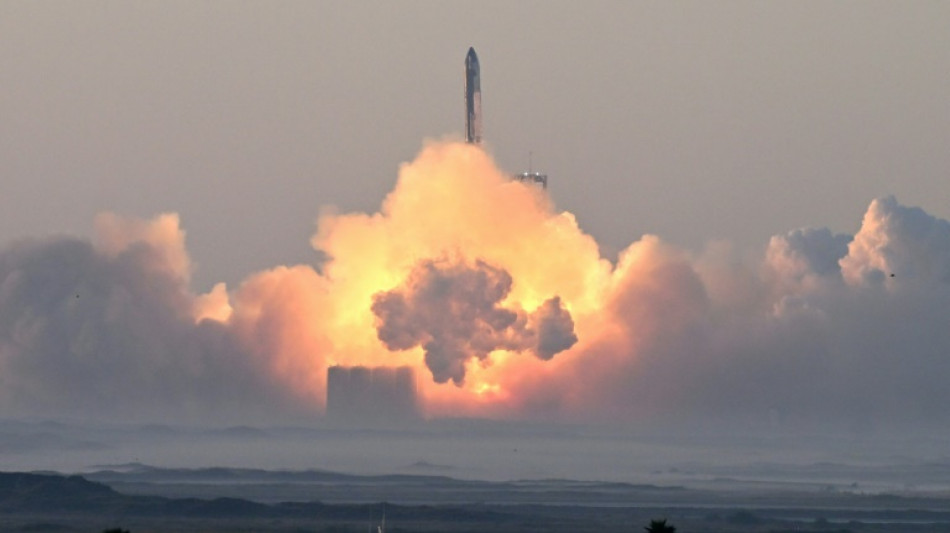
SpaceX eyes March 14 for next Starship test launch / Photo: TIMOTHY A. CLARY - AFP/File
 Brussels Education Unions Schedule Major November Protest Over Funding and Reforms

 iPS Cell Research Accelerates Drug Discovery for ALS and Spinal Cord Injury

 Rene Eyre Revisits Autobiographical Performance 'Say A Little Prayer' in London

 UAE's HCT Holds Record Graduation and Announces Major Training Expansion

 NASA Awards $10B Lunar Contract Framework to SpaceX, Blue Origin

 Katy Perry Tells Fans Ex-Husband Russell Brand 'Should Be in Jail' During UK Concert

Elon Musk's SpaceX on Wednesday announced it was eyeing March 14 as the earliest date for the next test launch of its giant Starship rocket, with which it hopes to one day colonize Mars.
Two previous attempts have ended in spectacular explosions, though the company has adopted a rapid trial-and-error approach in order to accelerate development.
"The third flight test of Starship could launch as soon as March 14, pending regulatory approval," SpaceX posted on X, the social media platform also owned by Musk.
A statement on its website said the rocket, to launch from Boca Chica, Texas, would splash down in the Indian Ocean.
NASA's plans to return US astronauts to the Moon in 2026 hinge on a modified version of Starship being certified and ready for use as a lander.
When the two stages of Starship are combined, the rocket stands 397 feet (121 meters) tall -- beating the Statue of Liberty by a comfortable 90 feet.
Its Super Heavy Booster produces 16.7 million pounds (74.3 Meganewtons) of thrust, almost double that of the world's second most powerful rocket, NASA's Space Launch System (SLS) -- though the latter is now fully operational.
SpaceX was forced to blow up Starship during its first test flight four minutes after launch in April 2023, because the two stages failed to separate.
The rocket disintegrated into a ball of fire and crashed into the Gulf of Mexico, sending a dust cloud over a town several miles (kilometers) away.
The second test in November 2023 fared better: the booster separated from the spaceship, but both then exploded over the ocean.
The Federal Aviation Administration closed a probe into the incident last month after identifying 17 corrective actions SpaceX would be required to take before it can receive its next greenlight.
SpaceX's "rapid iterative development" strategy has paid off for the company in the past and its other rockets have come to be heavily relied upon by NASA and the private sector.
But the clock is ticking down for Starship to be ready for NASA's Moon missions, and the United States risks falling behind rival China which is aiming to land humans there in 2030.
Not only does SpaceX need to show it can launch, fly and land Starship safely. It will eventually also need to show it can send multiple "Starship tankers" into orbit to refuel, at supercooled temperatures, a main Starship holding in Earth orbit for the onward journey to the Moon.
F.Dubois--AMWN

