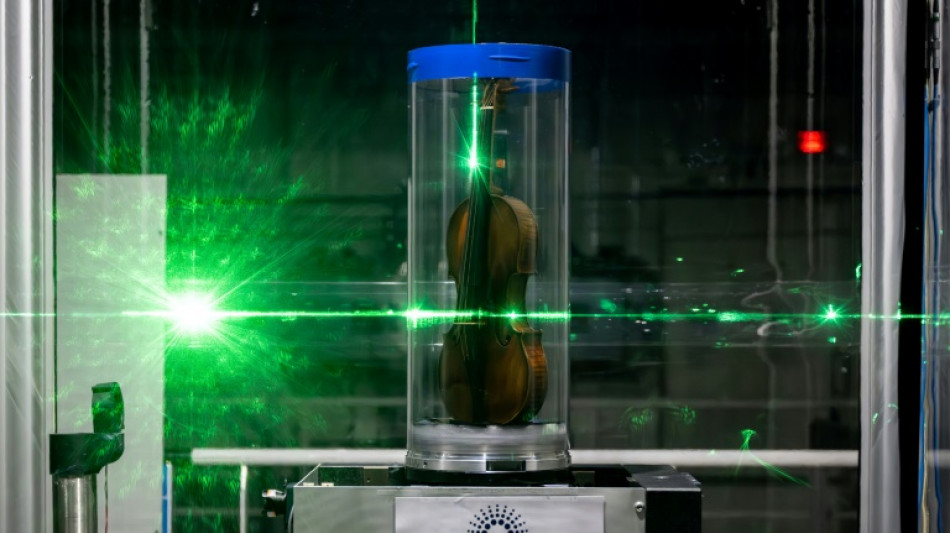
French experts X-ray violin to uncover Paganini's secret / Photo: JEAN-PHILIPPE KSIAZEK - AFP
 Brussels Education Unions Schedule Major November Protest Over Funding and Reforms

 iPS Cell Research Accelerates Drug Discovery for ALS and Spinal Cord Injury

 Rene Eyre Revisits Autobiographical Performance 'Say A Little Prayer' in London

 UAE's HCT Holds Record Graduation and Announces Major Training Expansion

 NASA Awards $10B Lunar Contract Framework to SpaceX, Blue Origin

 Katy Perry Tells Fans Ex-Husband Russell Brand 'Should Be in Jail' During UK Concert

French experts fired X-rays at a 18th-century violin worth millions this weekend hoping to discover the secret of its magical sound, they said Monday.
The violon, dubbed "Il Cannone" (the cannon), was Italian composer and violin virtuoso Niccolo Paganini's favourite.
The musician from the Italian city of Genoa played it for decades before it became the property of his home city after his death in 1840.
The violin, made by instrument maker Giuseppe Bartolomeo Guarneri del Gesu in 1743, is now only brought out from time to time for the world's best to play.
The European Synchrotron Radiation Facility (ESRF), a particle accelerator in the southeastern city of Grenoble, scanned the instrument down to the cellular structure of its wood.
The idea is to create a 3D model of the violin in and out of which people can zoom, down to a micron, or millionth of a metre.
"The first goal is conservation," said Paul Tafforeau of the ESRF.
"If ever any flaws need repairing, we will have all the details."
But they also hoped the "non-destructive analysis" would help shed light on why it plays so beautifully.
"It's an exceptional instrument in terms of its sound qualities," Tafforeau said.
"With this data, we hope to better understand why."
Luigi Paolasini, who was in charge of the project at the ESRF, said the violin had been insured for a value of 30 million euros ($32 million) to travel from Genoa to Grenoble.
S.Gregor--AMWN

