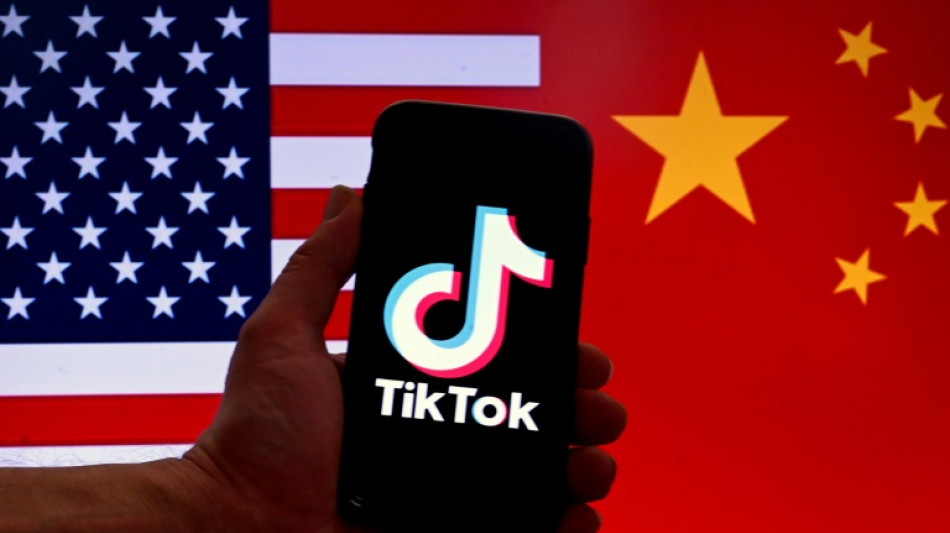
US ambassador says Beijing stance on TikTok ban 'supremely ironic' / Photo: OLIVIER DOULIERY - AFP/File
 Brussels Education Unions Schedule Major November Protest Over Funding and Reforms

 iPS Cell Research Accelerates Drug Discovery for ALS and Spinal Cord Injury

 Rene Eyre Revisits Autobiographical Performance 'Say A Little Prayer' in London

 UAE's HCT Holds Record Graduation and Announces Major Training Expansion

 NASA Awards $10B Lunar Contract Framework to SpaceX, Blue Origin

 Katy Perry Tells Fans Ex-Husband Russell Brand 'Should Be in Jail' During UK Concert

The US ambassador to China said Friday that Beijing's position on a potential TikTok ban in the United States was "supremely ironic" given the ruling Communist Party's censorship of online platforms within its borders.
The US House of Representatives overwhelmingly approved a bill on Wednesday that would force the wildly popular short-video app to break with its Chinese parent company or face a nationwide ban.
China has sharply criticised the approval, slamming what it called Washington's "bandit" mentality and accusing lawmakers of "unjustly suppressing foreign companies".
US ambassador Nicholas Burns offered a rebuke on Friday, saying Beijing's stance was unjustified given it blocks many Western web platforms from operating in the country.
"I find it supremely ironic that government officials here in China... have been criticising the United States for the debate we're currently having on TikTok," Burns said during an online seminar held by the East-West Center, a US-based research organisation.
"They won't even let TikTok be available to 1.4 billion Chinese," he said in response to a question about the avenues for American public diplomacy in China.
China's government tightly controls the spread of information online and scrubs out social media content it deems politically sensitive.
Many Western platforms, including Google, Facebook and Instagram, are blocked from operating in the country.
TikTok's Chinese parent company ByteDance also runs a separate version of the app inside China called Douyin.
Some Western governments have voiced concern about TikTok's soaring popularity, alleging that the app's ownership makes it subservient to Beijing -- a claim TikTok denies.
The bill, which has also been criticised by TikTok creators and users, is expected to face a tougher challenge in the US Senate.
The White House has indicated that President Joe Biden would sign the bill into law if it reaches his desk.
D.Moore--AMWN

