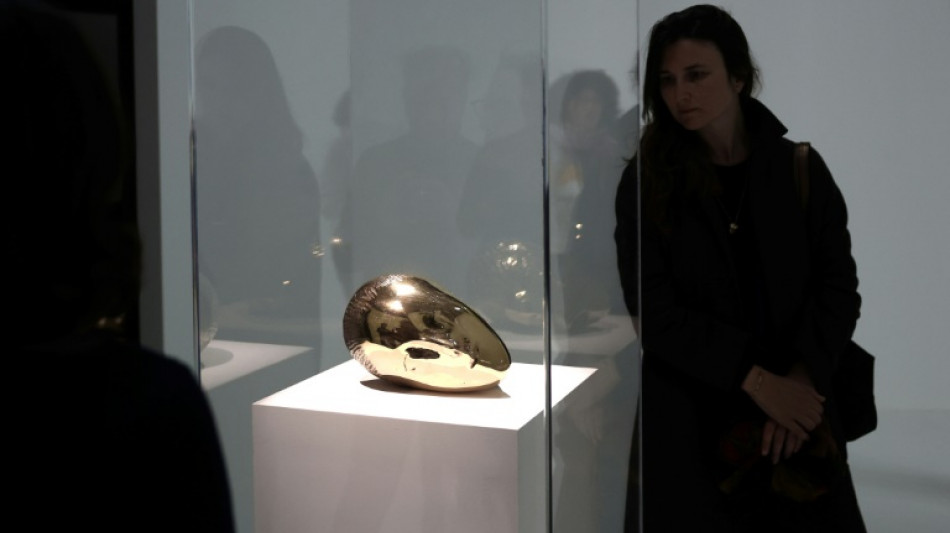
Rare exhibition for revolutionary sculptor Brancusi in Paris / Photo: Emmanuel DUNAND - AFP
 Brussels Education Unions Schedule Major November Protest Over Funding and Reforms

 iPS Cell Research Accelerates Drug Discovery for ALS and Spinal Cord Injury

 Rene Eyre Revisits Autobiographical Performance 'Say A Little Prayer' in London

 UAE's HCT Holds Record Graduation and Announces Major Training Expansion

 NASA Awards $10B Lunar Contract Framework to SpaceX, Blue Origin

 Katy Perry Tells Fans Ex-Husband Russell Brand 'Should Be in Jail' During UK Concert

A rare retrospective of artist Constantin Brancusi, who revolutionised sculpture in the early 20th century but whose works can be extremely tricky to transport, opens in Paris on Wednesday.
Born in Romania in 1876, Brancusi arrived in Paris at age 28 and soon after joined the workshop of another historic sculptor, Auguste Rodin.
"Nothing grows in the shadow of large trees," Brancusi reportedly said after spending just three months with the creator of "The Kiss" and "The Thinker".
Working directly with wood and marble, and without using moulds, Brancusi launched a radical new approach to sculpture that sought to purify human forms into abstract shapes.
"It is such a pity to have to spoil a beautiful material by hollowing out little holes for eyes, hair, ears," he said.
More than 120 sculptures and hundreds of sketches, paintings and documents are exhibited at the Pompidou Centre until July 1 -- the first retrospective on this scale in almost 30 years.
That is because many of his key works -- particularly the plaster towers balanced precariously on a small base -- cannot be transported without enormous insurance costs.
The last retrospective in 1995 was also at the Pompidou, which inherited Brancusi's nearby workshop and entire personal collection.
Visitors can explore how his work evolved through different versions of his best-known work, "The Sleeping Muse", or a celebrated bust of a child, or his birds and seals.
Brancusi "crosses all the movements of the 20th century," said exhibition curator Ariane Coulondre.
"He can be considered one of the fathers of abstract art, without being abstract at all. He never wanted to be part of any movement," she added.
Tirelessly reworking his sculptures in search of a pure style, Brancusi gave hardly any interviews and refused to have an agent, selling directly to buyers who had to visit his workshop.
Then in 1945, he abruptly stopped work, considering he had nothing more to add.
He made no more sculptures in his final 12 years, instead spending the time rearranging his workshop and selling remaining pieces -- but having already transformed the world of sculpture.
P.M.Smith--AMWN

