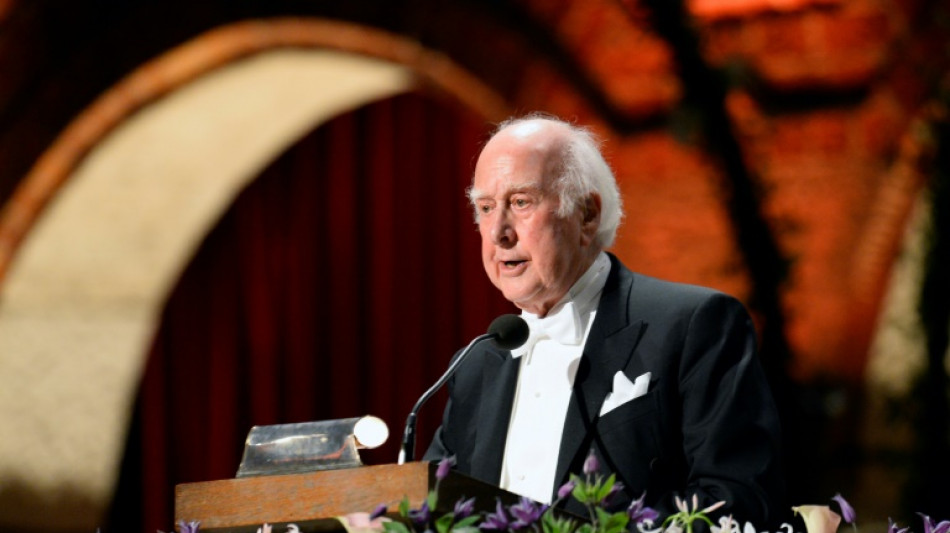
Nobel-winning 'God particle' physicist Higgs dies aged 94 / Photo: Jonathan NACKSTRAND - AFP/File
 Brussels Education Unions Schedule Major November Protest Over Funding and Reforms

 iPS Cell Research Accelerates Drug Discovery for ALS and Spinal Cord Injury

 Rene Eyre Revisits Autobiographical Performance 'Say A Little Prayer' in London

 UAE's HCT Holds Record Graduation and Announces Major Training Expansion

 NASA Awards $10B Lunar Contract Framework to SpaceX, Blue Origin

 Katy Perry Tells Fans Ex-Husband Russell Brand 'Should Be in Jail' During UK Concert

British physicist Peter Higgs, whose theory of a mass-giving particle -- the so-called Higgs boson -- jointly earned him the Nobel Prize for Physics, has died aged 94, the University of Edinburgh announced on Tuesday.
"He passed away peacefully at home on Monday 8 April following a short illness," the Scottish university, where he had been a professor for nearly five decades, said in a statement.
It called him "a great teacher and mentor, inspiring generations of young scientists".
"His family has asked that the media and public respect their privacy at this time," the university added.
Higgs used ground-breaking theoretical work to help explain how the Universe has mass, thus resolving one of the greatest puzzles in physics and earning him a place alongside Albert Einstein and Max Planck in textbooks.
His 1964 theory of a mass-giving particle, which became known as the Higgs boson or the "God particle", won him and Belgian physicist Francois Englert the 2013 physics Nobel Prize.
That followed experiments at the Large Hadron Collider at the European Organization for Nuclear Research (CERN) finally confirming the theory the previous year, nearly half a century on.
"Peter Higgs was a remarkable individual -- a truly gifted scientist whose vision and imagination have enriched our knowledge of the world that surrounds us," Peter Mathieson, Vice Chancellor of the University of Edinburgh, said.
"His pioneering work has motivated thousands of scientists, and his legacy will continue to inspire many more for generations to come."
L.Miller--AMWN

