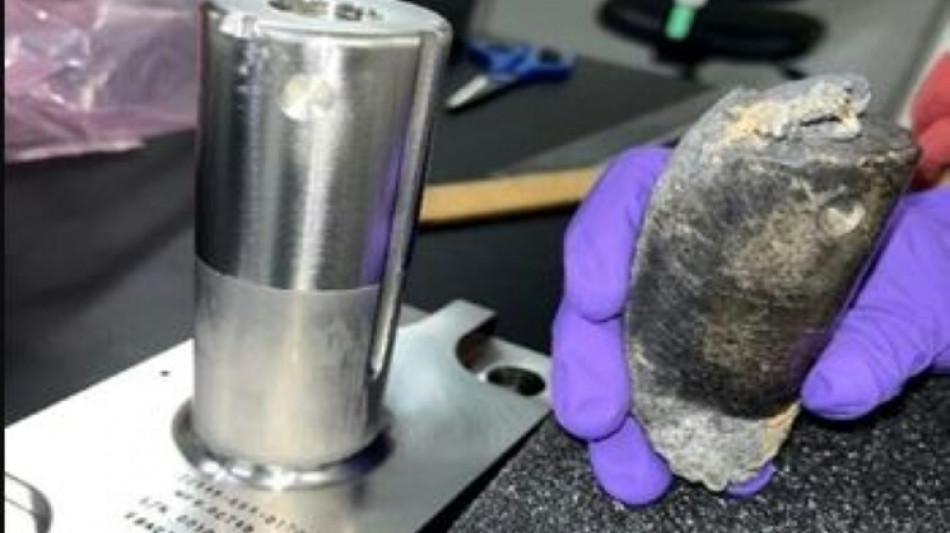
NASA confirms space station debris hit Florida man's home / Photo: Handout - NASA/AFP
 Brussels Education Unions Schedule Major November Protest Over Funding and Reforms

 iPS Cell Research Accelerates Drug Discovery for ALS and Spinal Cord Injury

 Rene Eyre Revisits Autobiographical Performance 'Say A Little Prayer' in London

 UAE's HCT Holds Record Graduation and Announces Major Training Expansion

 NASA Awards $10B Lunar Contract Framework to SpaceX, Blue Origin

 Katy Perry Tells Fans Ex-Husband Russell Brand 'Should Be in Jail' During UK Concert

An object that crashed from the sky into an American man's home was a hunk of debris ejected from the International Space Station, NASA confirmed Monday.
The strange tale came to light last month when Alejandro Otero of Naples, Florida posted on X that a metallic item "tore through the roof and went (through) 2 floors" of his house, almost striking his son, on March 8.
It occurred at a time and location that closely matched official predictions for the atmospheric burn-up of a cargo pallet fragment carrying old batteries that was jettisoned from the orbital outpost in 2021, making it a likely match, according to space watchers.
NASA, which subsequently collected the object from Otero for analysis, confirmed in a new blog post that the predictions were true.
"Based on the examination, the agency determined the debris to be a stanchion from the NASA flight support equipment used to mount the batteries on the cargo pallet," it said.
"The object is made of the metal alloy Inconel, weighs 1.6 pounds (0.7 kilograms), is 4 inches (10 centimeters) in height and 1.6 inches in diameter."
The US space agency also pledged to investigate how the debris survived being fully destroyed in the atmosphere, adding it would update its engineering models accordingly.
"NASA remains committed to responsibly operating in low Earth orbit, and mitigating as much risk as possible to protect people on Earth when space hardware must be released," it said.
A report by specialist news outlet Ars Technica last month said that while the batteries were owned by NASA, they were attached to a pallet structure launched by Japan's space agency -- potentially complicating liability claims.
Past examples of manmade human space debris hitting Earth include part of a SpaceX Dragon capsule landing on an Australian sheep farm in 2022. Skylab, the United States' first space station, fell on Western Australia.
More recently, China has been criticized by NASA for allowing its giant Long March rockets to fall back to Earth after orbit.
A.Jones--AMWN

