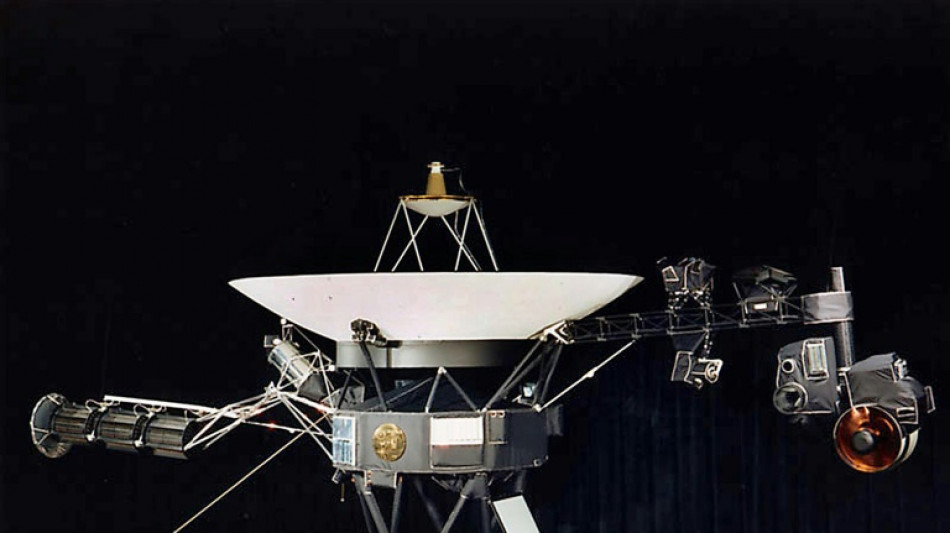
NASA's Voyager 1 phones home after months / Photo: NASA - NASA/AFP/File
 Brussels Education Unions Schedule Major November Protest Over Funding and Reforms

 iPS Cell Research Accelerates Drug Discovery for ALS and Spinal Cord Injury

 Rene Eyre Revisits Autobiographical Performance 'Say A Little Prayer' in London

 UAE's HCT Holds Record Graduation and Announces Major Training Expansion

 NASA Awards $10B Lunar Contract Framework to SpaceX, Blue Origin

 Katy Perry Tells Fans Ex-Husband Russell Brand 'Should Be in Jail' During UK Concert

NASA's Voyager 1 probe -- the most distant man-made object in the universe -- is returning usable information to ground control following months of spouting gibberish, the US space agency announced Monday.
The spaceship stopped sending readable data back to Earth on November 14, 2023, even though controllers could tell it was still receiving their commands.
In March, teams working at NASA's Jet Propulsion Laboratory discovered that a single malfunctioning chip was to blame, and devised a clever coding fix that worked within the tight memory constraints of its 46-year-old computer system.
"Voyager 1 spacecraft is returning usable data about the health and status of its onboard engineering systems," the agency said.
"The next step is to enable the spacecraft to begin returning science data again."
Launched in 1977, Voyager 1 was mankind's first spacecraft to enter the interstellar medium, in 2012, and is currently more than 15 billion miles from Earth. Messages sent from Earth take about 22.5 hours to reach the spacecraft.
Its twin, Voyager 2, also left the solar system in 2018.
Both Voyager spacecraft carry "Golden Records" -- 12-inch, gold-plated copper disks intended to convey the story of our world to extraterrestrials.
These include a map of our solar system, a piece of uranium that serves as a radioactive clock allowing recipients to date the spaceship's launch, and symbolic instructions that convey how to play the record.
The contents of the record, selected for NASA by a committee chaired by legendary astronomer Carl Sagan, include encoded images of life on Earth, as well as music and sounds that can be played using an included stylus.
Their power banks are expected to be depleted sometime after 2025. They will then continue to wander the Milky Way, potentially for eternity, in silence.
Y.Nakamura--AMWN

