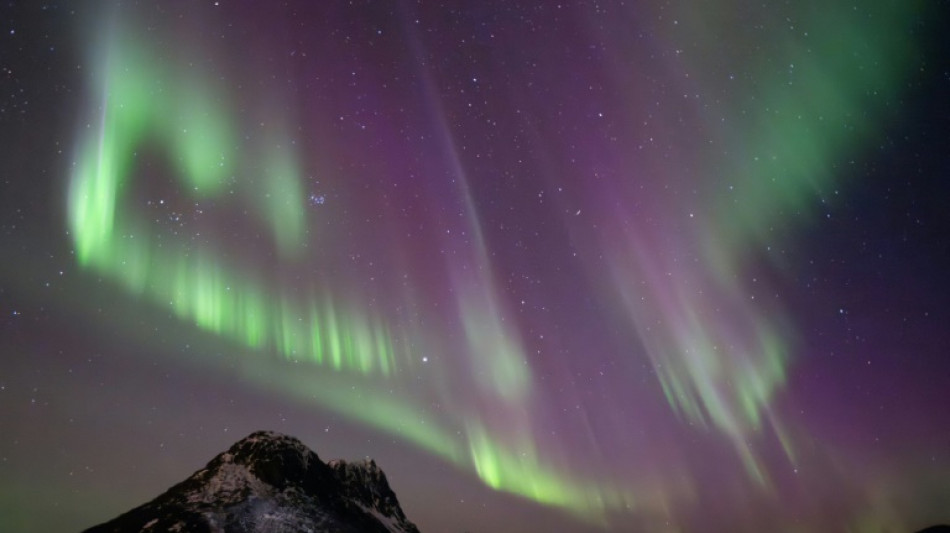
Solar storm could bring auroras, power and telecoms disruptions / Photo: Olivier MORIN - AFP
 Afghanistan war victims left 'without justice', UN says

 Iran president offers US olive branch before Putin meeting

 China-Nepal flood toll tops 1,000 as tunnel rescue offers last hope

 Japan to relax overtime regulation under workaholic PM
 Thwarted Niger mutiny exposes junta's Russia dependence
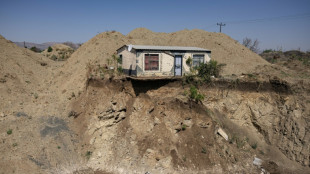 Illegal mining ravages S.Africa's economic hub

 Nepal's wall of missing offers last hope after Himalayan flood

 US to press G20 on light-touch AI regulation

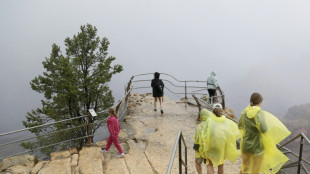 2 die in Grand Canyon flash flood, only 1 person unaccounted for

 US Army Secretary Driscoll submits resignation: White House
 Oil extends gains, stocks drop as Trump issues fresh Iran warning

 Tsitsipas says Kyrgios's positive cocaine test 'kind of expected'

 In Japan's mountains, a different way to manage bears

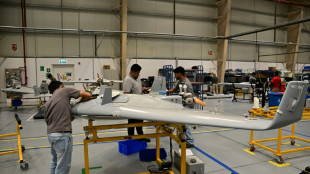 Middle East war a boon for UAE defence giant with global ambitions

 Former gang member found guilty of murdering Tupac Shakur

 Connecting Excellence Group PLC Announces Treasury up By 10 BTC to 72.941 & £655,999 Raised

 InterContinental Hotels Group PLC Announces Transaction in Own Shares - September 01

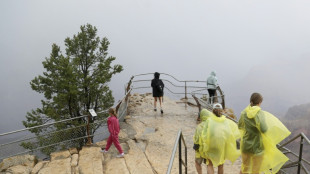 Heavy rain at Grand Canyon after flood kills 2, dozen missing

 Kushner blames soccer power struggle for World Cup plan collapse

 Buoyant Alcaraz shakes off nerves to advance at US Open

 US draws European pushback with Russia G20 finance invite

 Jury begins deliberations in Tupac Shakur murder trial

 US Supreme Court allows Trump ballroom project to proceed

 Trump says US reviewing position on Falkland Islands

 Saka strikes as flawless Arsenal punish troubled Villa

A huge solar storm is heading for Earth, supercharging auroras and bringing possible disruptions to satellites and power grids as early as Friday evening, US officials say.
Coronal mass ejections (CMEs) -- large expulsions of plasma and magnetic fields from the Sun -- are predicted to arrive late Friday to early Saturday US time, the Space Weather Prediction Center of the National Oceanic and Atmospheric Administration (NOAA) said.
The new storm, which is expected to persist through the weekend, comes with the Sun approaching the peak of an 11-year cycle that brings heightened activity.
"We have notified all of our infrastructure operators that we coordinate with, such as satellite operators, communication folks... and of course, the power grid here in North America," space weather forecaster Shawn Dahl told reporters.
The US Federal Aviation administration, however, said Friday in a social media post that "we do not anticipate any significant impacts to the national airspace system due to the potential geomagnetic storm."
Unlike solar flares, which travel at the speed of light and reach Earth in around eight minutes, CMEs travel at a relatively more sedate pace, with officials putting the current average at 800 kilometers (500 miles) per second.
There are at least seven CMEs in transit, emanating from a sunspot cluster that is 16 times wider than our planet. Forecasters expect to have a better idea of just how impactful they will be once they are around a million miles away.
Fluctuating magnetic fields associated with geomagnetic storms induce currents in long wires, including power lines, which can potentially lead to blackouts.
In October 2003, geomagnetic storms rated as "extreme" led to blackouts in Sweden and damaged power transformers in South Africa. Impacts are also possible on high-frequency radio communication, GPS, spacecraft and satellites.
- Auroras -
They could also bring auroras -- also known as "Northern lights" or "Southern lights," depending on the hemisphere -- to night skies where such phenomena aren't normally visible. In the United States, this could be as far south as Northern California and Alabama.
NOAA's Brent Gordon encouraged the public to try to capture the night sky with their cell phone cameras even if they can't see auroras with their naked eyes.
"Just go out your back door and take a picture with the newer cell phones and you'd be amazed at what you see in that picture versus what you see with your eyes."
Officials said people should have the normal backup plans in place for power outages, such as having flashlights, batteries and weather radios at hand.
The most powerful geomagnetic storm in recorded history, known as the Carrington Event, occurred in September 1859, named after British astronomer Richard Carrington.
Excess currents on telegraph lines at that time caused electrical shocks to technicians and even set some telegraph equipment ablaze.
F.Dubois--AMWN