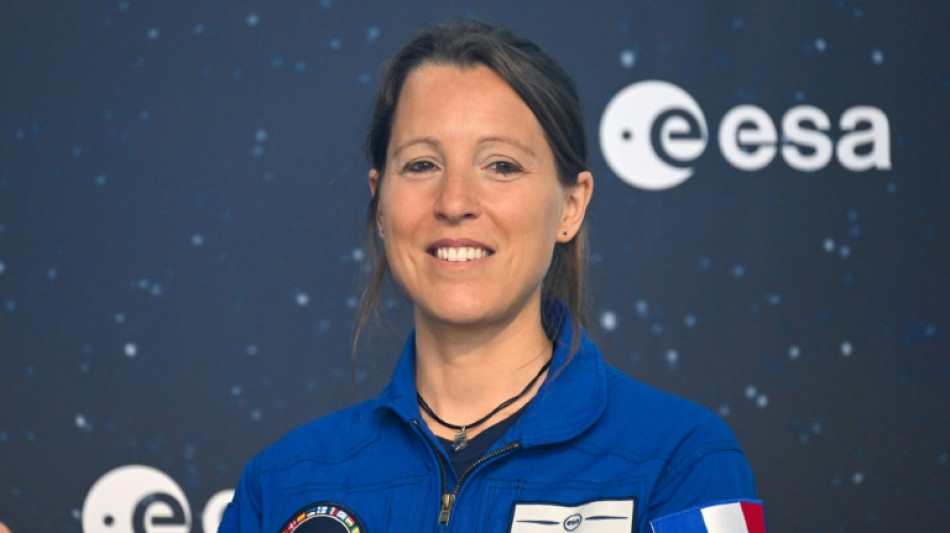
French, Belgian astronauts named next Europeans to fly to ISS / Photo: Ina FASSBENDER - AFP/File
 Brussels Education Unions Schedule Major November Protest Over Funding and Reforms

 iPS Cell Research Accelerates Drug Discovery for ALS and Spinal Cord Injury

 Rene Eyre Revisits Autobiographical Performance 'Say A Little Prayer' in London

 UAE's HCT Holds Record Graduation and Announces Major Training Expansion

 NASA Awards $10B Lunar Contract Framework to SpaceX, Blue Origin

 Katy Perry Tells Fans Ex-Husband Russell Brand 'Should Be in Jail' During UK Concert

France's Sophie Adenot and Belgium's Raphael Liegeois will be the first two from a new class of European astronauts to blast off to the International Space Station, the European Space Agency said Wednesday.
Adenot will join the crew onboard the ISS, around 400 kilometres (250 miles) above Earth, in 2026 for a six-month mission, after which she will be replaced by Liegeois.
The pair were among five new European Space Agency (ESA) astronauts selected in 2022 out more than 20,000 applicants.
"I am very happy to fly first," Adenot told AFP in an interview from NASA's Johnson Space Center in Houston.
The 41-year-old engineer and helicopter pilot will become the second French woman onboard the ISS, after Claudie Haignere in 2001.
"Claudie inspired me lot -- we are in contact often, she gives me advice," Adenot said.
French Higher Education Minister Sylvie Retailleau said it was "a real source of pride".
"Sophie Adenot is a model of scientific commitment for all our young girls," she told AFP.
Liegeois, a 36-year-old Belgian-Luxembourg balloon pilot with a background in neuroscience, said in a statement that he "simply cannot wait to tackle this new upcoming challenge".
The pair -- along with Switzerland's Marco Sieber, the UK's Rosemary Coogan and Spain's Pablo Alvarez Fernandez -- officially graduated as astronauts in April following a year of basic training in Germany.
ESA chief Josef Aschbacher told AFP that including the seven astronauts from the 2009 class, the previous graduation year, it will be "the largest number we've ever had at one time".
The five newly minted astronauts will "all be flying 2030, which is good news," he added.
Adenot said the group got along well, united by suffering through brutal survival courses in the Pyrenees mountains at temperatures below minus 10 degrees Celsius (14 Fahrenheit).
Now in Houston, she says she is keen to "really get stuck into the nitty gritty of training", including preparing for six months of weightlessness on board the ISS.
Aschbacher said that "sending two newly graduated ESA astronauts to space is a crucial stepping-stone in the path of preserving European knowhow, ensuring Europe's long-term participation in ongoing programmes such as Artemis," NASA's upcoming Moon programme.
So does Adenot dream of setting foot on the Moon?
She admitted to thinking about it, but said she preferred to proceed "in stages" and currently has her sights set on the ISS.
For one, she is getting ready to take in Earth from the viewpoint of space.
"Experienced astronauts tell that it is a total wonder -- beyond imaginable," Adenot said.
A.Rodriguezv--AMWN

