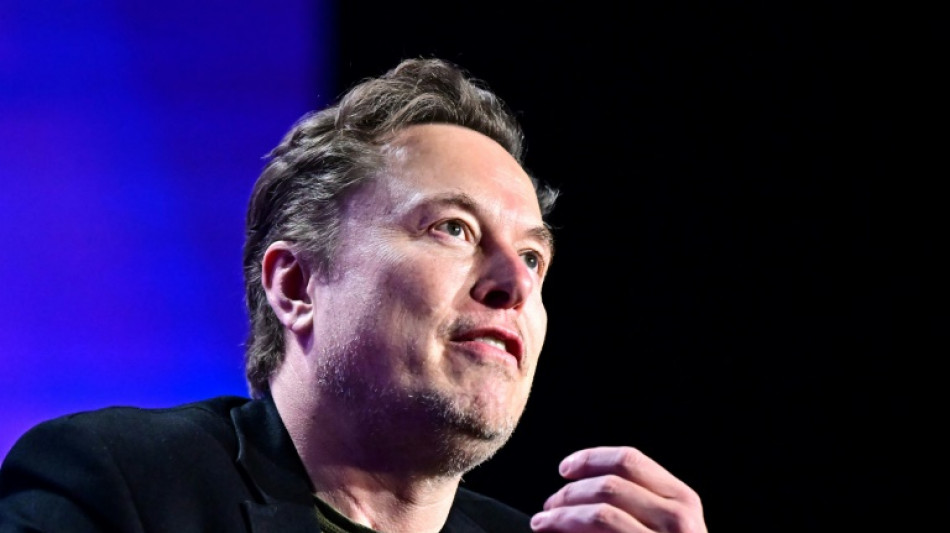
Musk plans largest-ever supercomputer for xAI startup: report / Photo: Frederic J. BROWN - AFP/File
 Brussels Education Unions Schedule Major November Protest Over Funding and Reforms

 iPS Cell Research Accelerates Drug Discovery for ALS and Spinal Cord Injury

 Rene Eyre Revisits Autobiographical Performance 'Say A Little Prayer' in London

 UAE's HCT Holds Record Graduation and Announces Major Training Expansion

 NASA Awards $10B Lunar Contract Framework to SpaceX, Blue Origin

 Katy Perry Tells Fans Ex-Husband Russell Brand 'Should Be in Jail' During UK Concert

Billionaire tech mogul Elon Musk has told investors he plans to build a supercomputer dubbed "gigafactory of compute" to support the development of his artificial intelligence startup xAI, an industry news outlet reported Saturday.
Musk wants the supercomputer -- which will string together 100,000 Nvidia chips -- operational by fall 2025, and "will hold himself personally responsible for delivering it on time," The Information said.
The planned supercomputer would be "at least four times the size of the biggest GPU clusters that exist today," such as those used by Meta to train its AI models, Musk was quoted as saying during a presentation to investors this month.
Since OpenAi's generative AI tool ChatGPT exploded on the scene in 2022, the technology has been an area of fierce competition between tech giants Microsoft and Google, as well as Meta and start-ups like Anthropic and Stability AI.
Musk is one of the world's few investors with deep enough pockets to compete with OpenAI, Google or Meta on AI.
xAI is developing a chatbot named Grok, which can access social media platform X, the former Twitter which is also owned by Musk, in real time.
Musk cofounded OpenAI in 2015 but left in 2018, later saying he was uncomfortable with the profit-driven direction the company was taking under the stewardship of CEO Sam Altman.
He filed a lawsuit against the company in March, accusing it of breaking its original non-profit mission to make AI research available to all.
OpenAI argues that Musk's lawsuit, as well as his embrace of open source development, is little more than a case of sour grapes after leaving the company.
O.Norris--AMWN

