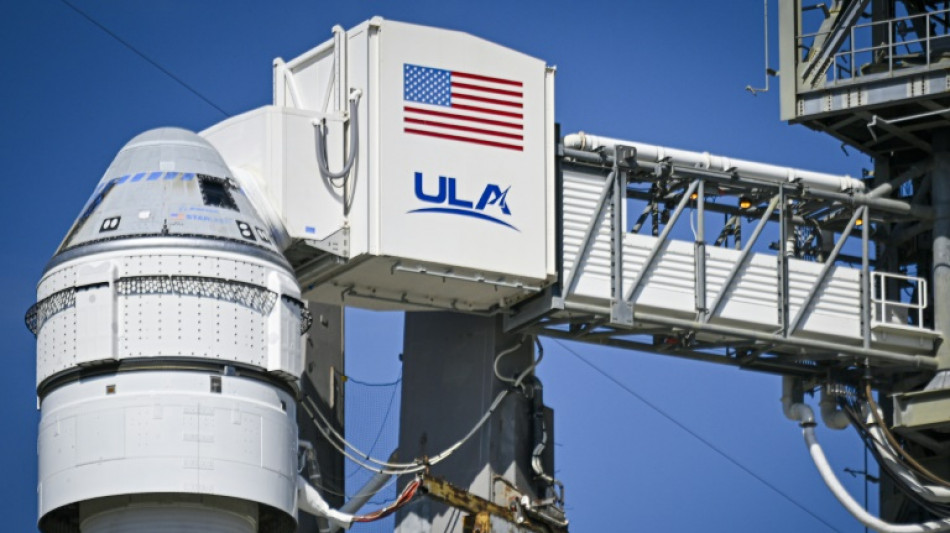
Boeing will try to launch its first crew on Starliner, again / Photo: Miguel Rodriguez - AFP
 Brussels Education Unions Schedule Major November Protest Over Funding and Reforms

 iPS Cell Research Accelerates Drug Discovery for ALS and Spinal Cord Injury

 Rene Eyre Revisits Autobiographical Performance 'Say A Little Prayer' in London

 UAE's HCT Holds Record Graduation and Announces Major Training Expansion

 NASA Awards $10B Lunar Contract Framework to SpaceX, Blue Origin

 Katy Perry Tells Fans Ex-Husband Russell Brand 'Should Be in Jail' During UK Concert

Troubled aerospace giant Boeing will try once more to fly its first crew to the International Space Station aboard a Starliner spaceship on Saturday, after the last attempt was scrubbed hours before liftoff.
Following checks by engineering teams, NASA astronauts Butch Wilmore and Suni Williams are "go" for launch atop a United Launch Alliance rocket at 12:25 pm (1625 GMT) from the Cape Canaveral Space Force Station in Florida on Saturday. Weather is so far highly favorable.
"We are excited for launch, and we have every confidence in this mission," astronaut Mike Fincke, the backup crew member for the mission, told reporters in a press conference.
The US space agency is looking to certify Boeing as a second commercial operator to ferry crew to the orbital outpost -- something Elon Musk's SpaceX has already been doing since 2020.
Both companies received multi-billion-dollar contracts in 2014 to develop their gumdrop-shaped and autonomously piloted crew capsules, following the end of the Space Shuttle program in 2011 that left the US temporarily reliant on Russian rockets for rides.
Boeing, with its 100-year history, was heavily favored over its then-upstart competitor, but its program has faced years of delays and safety scares that mirror the myriad problems afflicting its commercial airline division.
Wilmore and Williams were strapped in and ready to blast off on May 6 when a faulty rocket valve forced ground teams to call off that launch.
- Urine pump -
Since then, a small helium leak located in one of the spacecraft's thrusters came to light -- but rather than replace the seal, which would require taking Starliner apart in its factory, NASA and Boeing officials declared it's safe enough to fly as is.
Final checks on the leak will take place in the hours before launch.
A successful flight would help Boeing dispel some of the reputational damage sustained by successive failures over the years -- from a software bug that put the spaceship on a bad trajectory on its first uncrewed test, to the discovery the cabin was filled with flammable electrical tape after the second.
It's also important for more immediate reasons: the Urine Processor Assembly on the ISS, which recycles water from the astronauts' urine, suffered a failure this week and its pump needs to be replaced, Dana Weigel, NASA's ISS program manager, told reporters.
This mission will thus be tasked with carrying spare equipment, which weighs around 150 pounds (70 kilograms). To make way for it, two astronauts' suitcases containing clothes and toiletries had to be pulled off, meaning they'll need to rely on backup supplies kept on the station.
If all goes according to plan, the Starliner should dock with the ISS on Sunday and remain there eight days as the crew carry out tests, including simulating whether the ship can be used as a safe haven in the event there is a problem on the ISS.
It would then undock, reenter the atmosphere and carry out a parachute and airbag-assisted landing in the western United States on June 10.
S.F.Warren--AMWN

