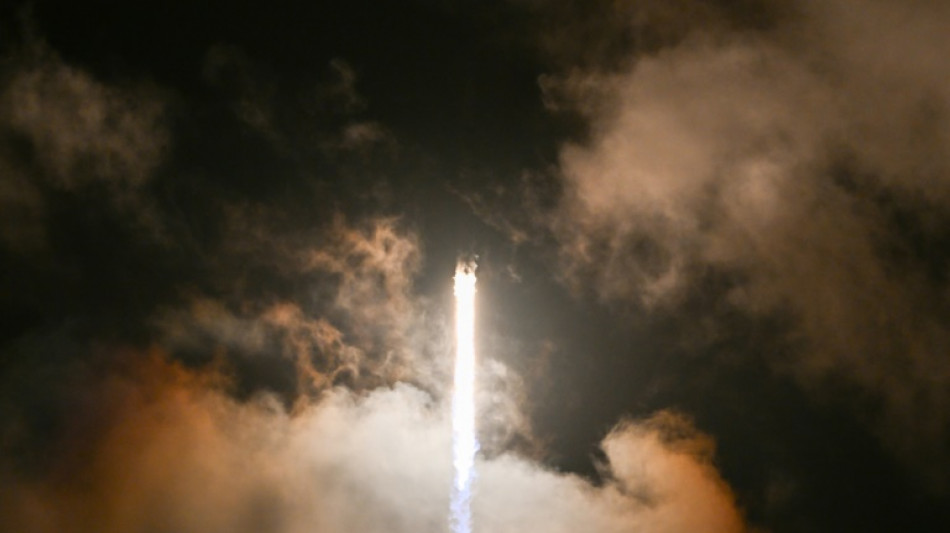
SpaceX launches all-civilian crew for first private spacewalk / Photo: CHANDAN KHANNA - AFP
 Crowds Gather at San Francisco Park for Elizabeth Holmes Lookalike Tournament

 Central Tokyo Apartment Rents Forecast to Rise 11% by 2030

 London Museum Granted 24/7 License Ahead of November Opening

 Dana White Confirms Flight to Washington for Trump Meeting on Press Secretary Role

 Dengue Fever Expands Into High Himalayas as Climate Change Warms Nepal

 IoT Refrigerator Hacks Disrupt Blood Labs and Supermarkets Across Europe and US
SpaceX launched its daring Polaris Dawn mission on Tuesday, a multiday orbital expedition carrying a four-member civilian crew for the first spacewalk by non-professional astronauts.
The crew, led by Shift4 Payments CEO Jared Iscaacman, is also aiming to fly deeper into space than any other manned mission in more than half a century, reaching a peak altitude of 870 miles (1,400 kilometers).
"Liftoff of Polaris Dawn!" SpaceX said on X, alongside a photo of the take-off.
The highlight of the mission will be the first spacewalk composed entirely of non-professionals, who are wearing sleek, newly developed SpaceX extravehicular activity (EVA) suits outfitted with heads-up displays, helmet cameras and an advanced joint mobility system.
Applause broke out across the mission control center as the Dragon capsule separated successfully from the main engine and the first glimpses of Earth came into view.
"The Polaris Dawn crew is now in Zero-G!" SpaceX wrote on X minutes later, as the crew experienced their first taste of zero-gravity.
On the first day of their mission, the craft will travel so high that it will briefly enter the Van Allen radiation belt, a region teeming with high-energy charged particles that can pose health risks to humans over extended periods.
The mission was delayed several times, initially due to a technical issue with the launch tower and then because of weather constraints.
The Crew Dragon capsule will not dock with the International Space Station, which is why the weather had to be favorable during both the launch and splashdown phase, around six days after liftoff.
- Two years' preparation -
Isaacman has declined to reveal his total investment in the project, though reports suggest he paid around $200 million for the SpaceX Inspiration4 mission in September 2021, the first all-civilian orbital mission.
Rounding out the team are mission pilot Scott Poteet, a retired US Air Force lieutenant colonel; mission specialist Sarah Gillis, a lead space operations engineer at SpaceX; and mission specialist and medical officer Anna Menon, also a lead space operations engineer at SpaceX.
The quartet underwent more than two years of training in preparation for the landmark mission, logging hundreds of hours on simulators as well as skydiving, centrifuge training, scuba diving, and summiting an Ecuadoran volcano.
Polaris Dawn is set to be the first of three missions under the Polaris program, a collaboration between Isaacman, the founder of tech company Shift4 Payments, and billionaire Elon Musk's SpaceX.
Also on their to-do list are testing laser-based satellite communication between the spacecraft and Starlink, SpaceX's more than 6,000-strong constellation of internet satellites, in a bid to boost space communication speeds, and conducting 36 scientific experiments.
Among these are tests with contact lenses embedded with microelectronics to continuously monitor changes in eye pressure and shape.
P.Martin--AMWN

