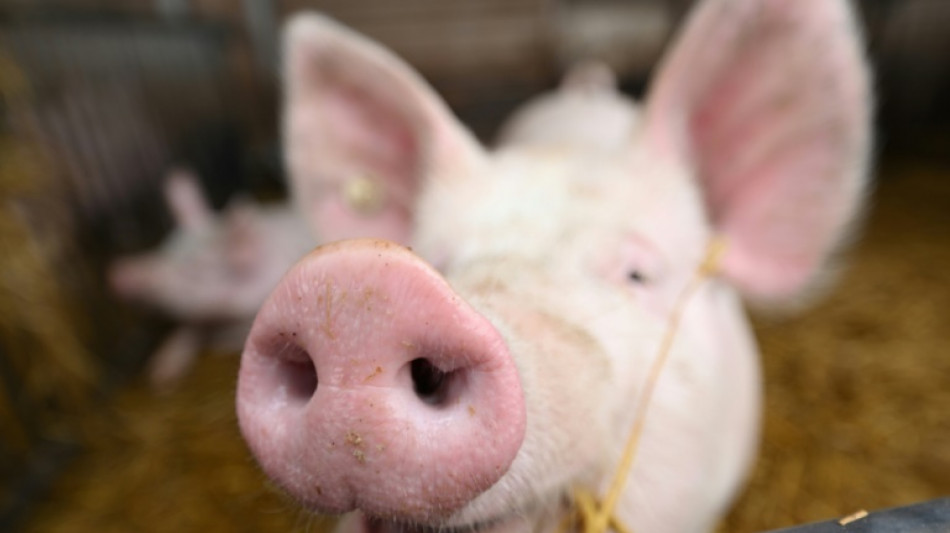
Chinese doctors implant pig liver in human for first time / Photo: Ina FASSBENDER - AFP/File
 German AfD's love for Simson mopeds dismays Jewish family behind brand

 Two trapped tunnel workers rescued in Nepal 'miracle'

 Ex-Pakistan coach Gillespie tells Javed 'look in the mirror' over sackings

 Monfils falls to Tien in US Open in Grand Slam farewell

 Arsenal brace for Chelsea test as Spurs seek spark

 Efficient Rybakina reaches US Open third round

 Taiwan boxer Lin considered 'graceful exit' after Paris Games gold

 'I miss my home': Cambodians displaced by conflict start over

 Ailing Auger-Aliassime falls at US Open as Swiatek, Osaka and Gauff advance

 Tesla launches self-driving 'Cybercab' in Texas
 'Wallace & Gromit' creators turn 50 with spook-tacular Shaun yarn

 New York's Muslims reclaim their city after 9/11 backlash

 Premier League transfer windfall a lifeline for ailing French clubs

 Chile protesters see shades of Pinochet in new security plan

 Carreras reverts to fullback as Argentina change four for Australia Test

 Wilson back to lead Australia as Kiss rotates team for Argentina

 Yen surges on new intervention talk, US stocks rally

 Japan's Ueda fires Lille top of Ligue 1 on debut

 Arsenal chief executive reveals 'dynasty' ambition

 Spanish PM says no 'solid proof' Morocco planned migrant rush

 Iran war is not a war, US VP Vance says

 Khachanov stuns third-seeded Auger-Aliassime in US Open second round

 Bordeaux facing sixth-tier football after French federation upholds relegation

 Stoic Verstappen looking beyond 'painful' Monza weekend

 OpenAI begins rollout of new powerful AI model GPT-6 Astra

Chinese doctors said Wednesday that they had transplanted a liver from a genetically modified pig into a brain-dead human for the first time, raising hopes of a live-saving donor option for patients in the future.
Pigs have emerged as the best animal organ donors, with several living patients in the United States having received pig kidneys or hearts in the last few years.
Livers have proved trickier -- and had not previously been tested out inside a human body.
But with a huge and growing demand for liver donations across the world, researchers hope that gene-edited pigs can offer at least temporary relief to seriously ill patients on long waiting lists.
Doctors at the Fourth Military Medical University in Xi'an, China, announced the field's latest breakthrough in a study in the journal Nature.
A liver from a miniature pig, which had six edited genes to make it a better donor, was transplanted into a brain-dead adult at the hospital on March 10, 2024, according to the study.
The trial was terminated after 10 days at the request of the family, the doctors said, adding that they had followed strict ethical guidelines.
- 'Bridge organ' -
The patient, whose name, gender and other details were not revealed, still had their original liver, receiving what is called an auxiliary transplant.
The hope is that this kind of transplant can serve as a "bridge organ" to support the existing liver of sick people waiting on a human donor.
Over the 10 days, the doctors monitored the liver's blood flow, bile production, immune response and other key functions.
The pig liver "functioned really well" and "smoothly secreted bile" as well as producing the key protein albumin, study co-author Lin Wang of the Xi'an hospital told a press conference.
"It's a great achievement" that could help people with liver problems in the future, he added.
Other researchers also hailed the breakthrough but emphasised that this early step could not confirm whether the pig organ would work as a replacement for human livers.
Transplants of livers have proved difficult because they carry out several different functions -- unlike hearts, for example, which simply pump blood, Lin said.
Livers filter the body's blood, breaking down things like drugs and alcohol, as well as producing bile that carries away waste and breaks down fats.
The pig liver produced far smaller amounts of bile and albumin than a human liver could achieve, Lin said.
More research is needed -- including studying the pig liver for more than 10 days, he added.
Next, the doctors plan to trial the gene-edited pig liver in a living human.
- 'Impressive' -
Oxford University transplantation professor Peter Friend, who was not involved in the study, said the results were "valuable and impressive".
However, "this is not a replacement for liver transplantation from human donors (at least in the near-term)," he told AFP in an email.
"This is a useful test of the compatibility of genetically modified livers with humans and points to a future in which such livers can provide support for patients in liver failure."
Lin emphasised that collaboration with US researchers was crucial.
"To be frank, we have learned quite a lot from all the research performed and investigated by the United States doctors," he said.
Last year, scientists at the University of Pennsylvania attached a pig liver to a brain-dead patient -- but instead of being transplanted, the organ remained outside the body.
Both US recipients of pig heart transplants died.
But Towana Looney, 53, is back home in Alabama after receiving a pig kidney on November 25, 2024.
D.Moore--AMWN