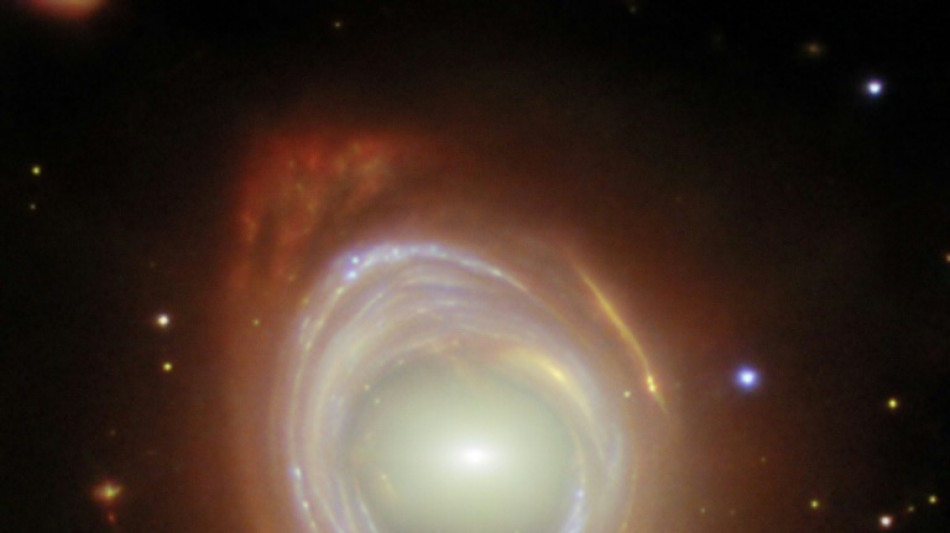
Universe dying quicker than thought, says new research / Photo: Handout - ESA/Webb, NASA & CSA, G. Mahler/AFP
 Kolbe breaks jaw and shoulder injury sidelines Savea

 US military strikes oil tankers as Iran vows tougher reprisals

 Zheng rallies to stun Keys, Anisimova out in US Open third round

 Bayern held to draw by stubborn Schalke

 Lens lose again ahead of Champions League date

 Olympic champion Zheng storms home to reach US Open last 16

 Big-spending Spurs must make better attacking decisions, says De Zerbi

 South Africa dominate New Zealand in second half to lead series

 Kiefer Sutherland still in action, but ibuprofen lending helping hand

 'Are we ready?' Oasis film captures band's frosty reunion

 Commemoration held for late Bosnian Serb war criminal Ratko Mladic

 Haaland keeps new-look Man City perfect in Premier League, blunt Spurs held

 Alpine's Gasly takes shock pole for Italian Grand Prix

 Nwaneri helps Dortmund to comeback win on Bundesliga debut

 US military says destroys Iranian oil tankers after missile attacks

 US envoys in Moscow for Ukraine war negotiations

 Commemoration held for late Serbian war criminal Ratko Mladic

 Russell on top ahead of Hamilton in final Italian GP practice

 Motorsport governing body rejects Alpine boss's claims of impartiality

 Flick hoping Barca's Yamal can face Valencia after knock

 Trump envoys land in Moscow for Russia-Ukraine peace push

 Russia hits Kyiv airports as Trump peace envoys awaited

 Nepal tunnel rescue revives hopes 10 days after flood

 Indonesia rescues second orangutan mother and baby from wildfire

 Box office magnet Robert Pattinson appears in paedophile thriller

The universe is poised to die much faster than previously thought, according to new research by Dutch scientists.
But there's no great need to panic. We still have 10 to the power of 78 years before it happens -- that's a one with 78 zeroes.
However, that is a major revision from the previous estimate of 10 to the power of 1,100 years, notes the research paper from Radboud University, published in the Journal of Cosmology and Astroparticle Physics.
"The final end of the universe is coming much sooner than expected but fortunately it still takes a very long time," said lead author Heino Falcke.
A trio of scientists at Radboud set out to calculate when the most "durable" celestial bodies -- white dwarf stars -- would eventually die out.
They based their calculations on Hawking radiation, named after celebrated British physicist Stephen Hawking.
Hawking postulated in the mid-1970s that black holes leak radiation, slowly dissolving like aspirin in a glass of water -- giving them a finite lifetime.
The Radboud scientists extended this to other objects in the universe, calculating that the "evaporation time" depends on density.
This enabled them to calculate the theoretical dissolution of the longest-lasting body, the white dwarf.
"By asking these kinds of questions and looking at extreme cases, we want to better understand the theory, and perhaps one day, we can unravel the mystery of Hawking radiation," said co-author Walter van Suijlekom.
Humankind needn't worry too much about the end of the universe. Unless we escape planet Earth, we'll be long gone.
Scientists think that our Sun will be too hot for life in about a billion years, boiling our oceans.
In about eight billion years, our star will eventually expand towards the Earth, finally gobbling up our by-then barren and lifeless planet and condemning it to a fiery death.
P.Costa--AMWN