Oldest known lizard ancestor discovered in England / Photo: Marty MELVILLE - POOL/AFP/File
 British family bids to row back against suicide taboo

 China's teenage 223cm basketball player 'just a little girl'

 Tokyo's Shinjuku to ban more than half of vacation rentals

 Australian Rules limits contact training to reduce concussion

 Germany's Merz under pressure from far-right election triumph

 Nepal tunnel rescues face 'unprecedented' challenge

 Mourinho's Real Madrid European revival bid starts with Inter reunion

 Solomons PM survives attempt to oust government

 Ohtani 'unlikely' to pitch again this season, says Dodgers manager

 Driver thanks 'superhero' rival for saving him from flaming race car

 Can dogs sniff cancer? AI joins the hunt in India

 Shelton steams into US Open quarter-final clash with Alcaraz

 25 years on, America seeks to keep 9/11 memories alive

 'Trumpapalooza' tests Republican bet on unpopular US president

 Pegula tops Cirstea to reach US Open quarter-finals

 Australians could opt out of social media algorithms under new law

 Genflow Biosciences PLC Announces Appointment of Investor Relations Adviser

 Enjoying the moment: Alcaraz steps it up to reach US Open quarter-finals

 Five dead, five injured after Amazon cargo plane overshoots Miami runway

 La Rochelle half-backs lead fightback against Toulouse

 US envoys have 'more effective proposals': Ukraine official

 Defending champion Alcaraz powers into US Open quarter-finals

 Amazon cargo plane overshoots Miami runway, hits vehicles, catches fire

 Toll from Yemen clashes passes 300 as civilians flee homes

 Sabalenka books US Open quarter-final clash with Noskova

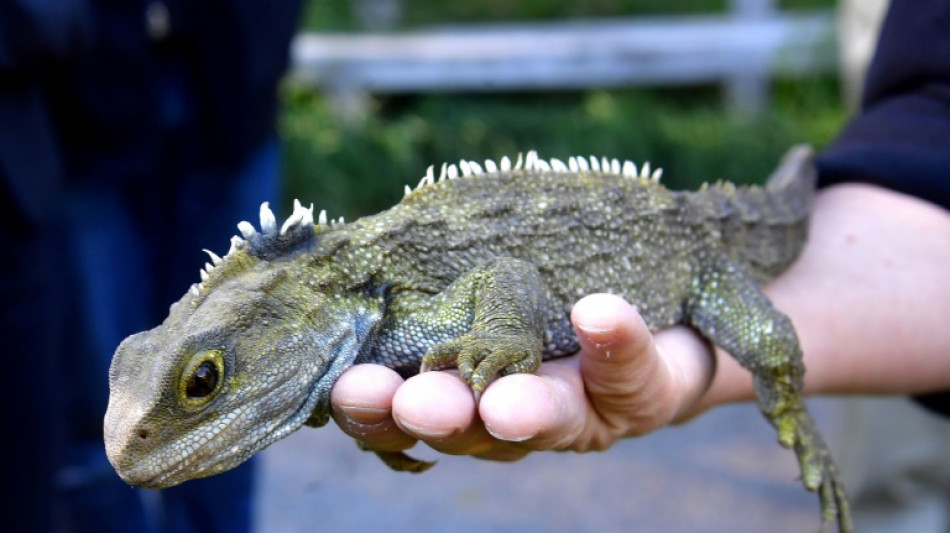
Scientists announced Wednesday they have discovered the oldest-known member of the lizard family in southwest England, a tiny creature that used its surprisingly large teeth to hunt cockroaches 242 million years ago.
The ancient reptile, which lived during the Middle Triassic epoch shortly before the rise of the dinosaurs, was so small its entire body could fit in the palm of a human hand.
"The new animal is unlike anything yet discovered and has made us all think again about the evolution of the lizard, snakes and the tuatara," the latter of which is a New Zealand reptile, Dan Marke of the University of Bristol said in a statement.
The skeleton of the oldest known member of the lepidosauria order, a family of reptiles, was found at a fossil-rich beach in Devon, southwest England, in 2015.
But figuring out what it actually was took the scientists years, and the discovery was announced in a study in the journal Nature on Wednesday.
"The new fossil shows almost none of what we expected," said Marke, the study's lead author.
Modern lizards and snakes have a partially hinged skull and plenty of teeth on the roof of their mouth -- but this ancient ancestor had neither.
"Not only this but it possesses some spectacularly large teeth compared to its closest relatives," the palaeobiologist said.
It also has a bone running from cheek to jaw, a feature it shares only with the unique tuatara that is often referred to as a "living fossil".
"The new beast" used these teeth "to pierce and shear the hard cuticles of its insect prey, pretty much as the tuatara does today," said study co-author Michael Benton, also from Bristol University.
The fossil was difficult to study because it is so small -- the skull is just 1.5 centimetres (0.6 of an inch) wide -- and was preserved in a large rock.
So the British researchers scanned it using the European Synchrotron Radiation Facility, which works as a kind of huge microscope producing X-rays 100 billion times brighter than those used in hospitals.
The Synchrotron allowed the scientists to "zoom in on large objects and obtain very high-resolution images," said Vincent Fernandez, a palaeontologist at the facility in France.
The scientists named the lizard ancestor Agriodontosaurus helsbypetrae, after the Helsby Sandstone Formation where it was discovered.
M.A.Colin--AMWN