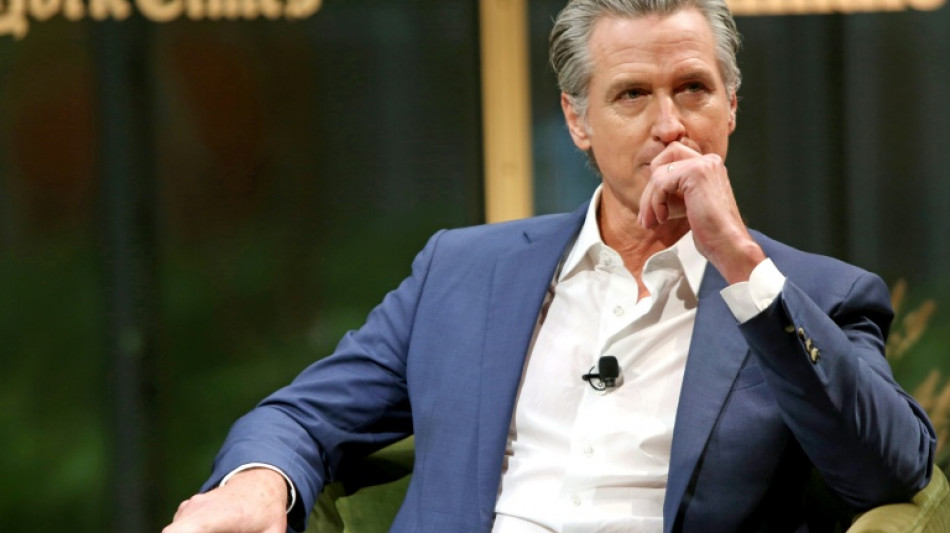
California enacts AI safety law targeting tech giants / Photo: Yana Paskova - GETTY IMAGES NORTH AMERICA/AFP
 South African election results renew debate over identity-based voting

 South African voters report smoother local election but declining IEC trust

 Dolly Parton museum and Nashville hotel open after singer’s death

 George and Amal Clooney attend New York political-comedy reading

 British buyers pay substantial premiums for period-home appearance

 Thomas Markle released to house arrest after child-abuse-image charge

 Dawn of War 4 developers chose Adeptus Mechanicus for tactical variety

 Italy face unbeaten South Africa in Turin Nations Championship match

 ChatGPT interactive interface feature tested across six custom tools

 Freshways milk-price cut deepens pressure on UK dairy farms

 Labour and National remain virtually tied as New Zealand vote count advances

 The Good Daughter adapts Karin Slaughter thriller with Rose Byrne and Meghann Fahy

 Heavy-lift drone evacuates wounded Ukrainian soldier from frontline kill zone

 Morrison says West Brom recovered after pressure from successive derby losses

 Britain considers 2027 state visit for Ukraine’s Zelensky

 Anna Miltina Confronted with Racism Allegations on ProSieben Show

 German Auto Giants Face Existential Crisis as China Sales Plummet

 Cause of Death Revealed for 'Ellen' Producer Matthew Wright
California Governor Gavin Newsom has signed into law groundbreaking legislation requiring the world's largest artificial intelligence companies to publicly disclose their safety protocols and report critical incidents, state lawmakers announced Monday.
Senate Bill 53 marks California's most significant move yet to regulate Silicon Valley's rapidly advancing AI industry while also maintaining its position as a global tech hub.
"With a technology as transformative as AI, we have a responsibility to support that innovation while putting in place commonsense guardrails," State Senator Scott Wiener, the bill's sponsor, said in a statement.
The new law represents a successful second attempt by Wiener to establish AI safety regulations after Newsom vetoed his previous bill, SB 1047, after furious pushback from the tech industry.
It also comes after a failed attempt by the Trump administration to prevent states from enacting AI regulations, under the argument that they would create regulatory chaos and slow US-made innovation in a race with China.
The new law says major AI companies have to publicly disclose their safety and security protocols in redacted form to protect intellectual property.
They must also report critical safety incidents -- including model-enabled weapons threats, major cyber-attacks, or loss of model control -- within 15 days to state officials.
The legislation also establishes whistleblower protections for employees who reveal evidence of dangers or violations.
According to Wiener, California's approach differs from the European Union's landmark AI Act, which requires private disclosures to government agencies.
SB 53, meanwhile, mandates public disclosure to ensure greater accountability.
In what advocates describe as a world-first provision, the law requires companies to report instances where AI systems engage in dangerous deceptive behavior during testing.
For example, if an AI system lies about the effectiveness of controls designed to prevent it from assisting in bioweapon construction, developers must disclose the incident if it materially increases catastrophic harm risks.
The working group behind the law was led by prominent experts including Stanford University's Fei-Fei Li, known as the "godmother of AI."
Y.Nakamura--AMWN