AI tool helps researchers treat child epilepsy / Photo: John SAEKI, Laurence CHU, Nicholas SHEARMAN - AFP
 Shelton steams into US Open quarter-final clash with Alcaraz

 25 years on, America seeks to keep 9/11 memories alive
 'Trumpapalooza' tests Republican bet on unpopular US president
 Pegula tops Cirstea to reach US Open quarter-finals
 Australians could opt out of social media algorithms under new law
 Tiafoe tops Medvedev in straight sets at US Open
 Zverev seeks US Open last eight as Osaka faces Rybakina

 Alcaraz turns up heat to reach US Open quarters
 Gatti salvages Juve draw with AC Milan in Serie A
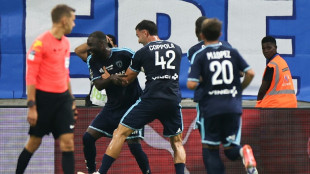 Sinayoko stars as unbeaten Paris FC down Marseille
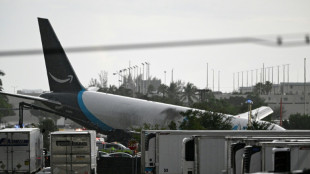
 Still on top: 'Spider-Man' dominates North American box office
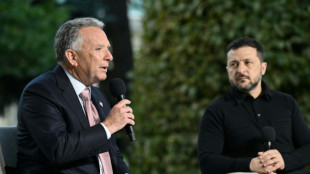 Zelensky in fresh talks with US envoys: Ukraine official
 Noskova edges Kostyuk to reach US Open quarter-finals
 Alonso urges Chelsea to learn from painful defeat at Arsenal
 Defending champion Sabalenka reaches US Open quarter-finals
 Minnows Augsburg sink Frankfurt to top Bundesliga table
 Yamal hits double as 'nearly perfect' Barca thrash Valencia
 Antonelli living 'a dream' after astonishing home win
 Impressive Daryz keeps Arc double dream alive
 Strasbourg hit Troyes for six as Amo-Ameyaw sparkles
 German far-right AfD landslide winner in eastern state vote
 Carrick defends Man Utd start despite defensive concerns
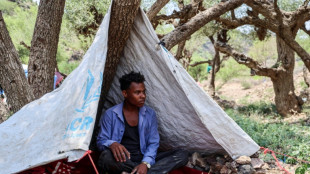 More than 140 killed in latest Yemen clashes: military sources

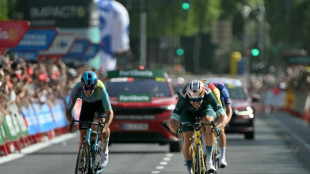 Van Aert claims shortened Vuelta stage 15 win in high heat
 Everton shrug off transfer window woes to hold Man Utd
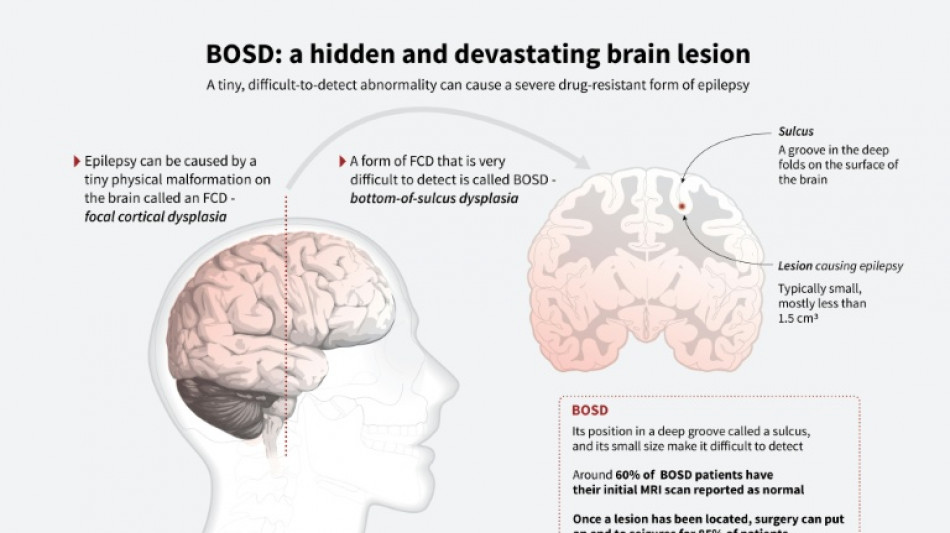
An artificial intelligence tool that can detect tiny, hard-to-spot brain malformations in children with epilepsy could help patients access life-changing surgery quicker, Australian researchers said on Wednesday.
It is the latest example of how AI, which can crunch vast amounts of data, is changing healthcare by assisting doctors with diagnoses.
Epilepsy has several different causes, and overall around three in 10 cases are down to structural abnormalities in the brain, experts say.
These are often missed on MRI scans -- especially the smallest lesions, sometimes hidden at the bottom of a brain fold.
A team led by Emma Macdonald-Laurs, a paediatric neurologist at the Royal Children's Hospital in Melbourne, trained an AI tool on child brain images to find lesions the size of a blueberry or smaller.
"They're frequently missed and many children are not considered as surgical candidates," Macdonald-Laurs told a briefing ahead of the publication of her team's study in the journal Epilepsia.
"The tool doesn't replace radiologists or epilepsy doctors, but it's like a detective that helps us put the puzzle pieces together quicker so we can offer potentially life-changing surgery," she said.
Of the patients who took part, with conditions known as cortical dysplasia and focal epilepsy, 80 percent had previously had an MRI scan come back as normal.
When the researchers used the AI tool to analyse both MRI and another type of medical scan called a PET, its success rate was 94 percent for one test group and 91 percent for another.
Out of 17 children in the first group, 12 had surgery to remove their brain lesions, and 11 are now seizure-free, said Macdonald-Laurs's team at the Murdoch Children's Research Institute.
"Our next plans are to test this detector in more real-life hospital settings on new undiagnosed patients," she said.
Epilepsy, which causes recurrent seizures, affects about one in 200 children, and about a third of cases are drug-resistent.
"This work is really exciting" as a proof of concept and the results are "really impressive", Konrad Wagstyl, a biomedical computing expert at King's College London (KCL), told AFP.
Similar research published in February by a KCL team using AI on MRI data spotted 64 percent of epilepsy-linked brain lesions that were missed by radiologists.
The Australian researchers used MRI with PET, "but some caveats are that PET is expensive, it's not as widely available as MRI, and there is a dose of radiation like a CT scan or an X-ray associated with it," Wagstyl noted.
Ch.Kahalev--AMWN