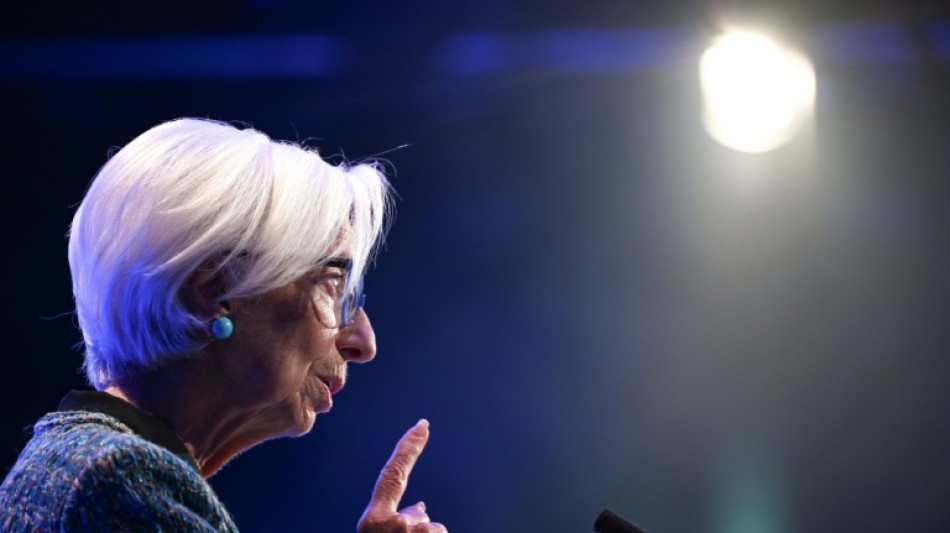
AI delay may affect Europe's future, says ECB chief / Photo: Kirill KUDRYAVTSEV - AFP
 The disgraced banker stirring the pot in Brazil's Supreme Court

 Panama Canal begins reducing crossings due to El Nino

 Trump again seeks to remove protections for wolves

 'Getting there' - Alcaraz into US Open last 16 along with Sabalenka

 Isak ready to show world his quality, says Van Dijk

 Stuttgart cruise past Cologne to bounce back from Bayern thumping

 'Smart, aggressive' Alcaraz into US Open last 16

 Isak fires Liverpool to first win under Iraola at Ipswich

 Stocks slip as robust US jobs data stokes rate hike odds

 Mistrial declared in case of US woman who killed her three children

 Seville, Alfred win at Diamond League finals, Duplantis hit with injury

 Moody’s Assigns First-Time Insurance Financial Strength Ratings to Freedom Insurance and Freedom Life

 Trump says envoys taking plan to 'end the war' to Moscow, Kyiv

 US Football Hall of Fame revamps selection process

 Judge declares mistrial in case of US woman who killed her children

 Edgar Davids art thief misses sentencing after being 'knocked out by luggage'

 Pegula rallies to reach US Open fourth round

 Defending champ Sabalenka leads way into US Open fourth round

 Bayeux Tapestry 'virtually unchanged', UK museum says, after France spots broken threads

 More than 120 killed in Yemen's worst clashes in years: sources

 Germany hunts climate activist suspected of power grid sabotage

 5 EU countries aim to send rejected migrants to 'return hub' by 2027

 Argentina to return Nazi-looted painting to Jewish collector's heir

 Australian Simmons makes NBA comeback with Kings: reports

 Two broken threads on Bayeux Tapestry, no major damage: French minister

European Central Bank chief Christine Lagarde warned Monday that a delay in embracing artificial intelligence could "jeopardise" the continent's future, urging barriers to its adoption to be swiftly lifted.
Her comments add to growing fears that Europe is lagging behind the United States and China when it comes to AI, with proponents of the technology blaming issues from overregulation to underinvestment.
"We need to remove all the obstacles that stop us from embracing this transformation," she told a Bratislava conference.
"Otherwise we risk letting the wave of AI adoption pass us by and jeopardise Europe's future."
Lagarde, who heads the central bank for the 20-nation euro area, conceded that Europe had "already missed the opportunity to be a first mover in AI".
But if the continent deploys the technology decisively across its key industries, "Europe can turn a late start into a competitive edge", she emphasised.
She listed several barriers to rapid adoption in Europe, ranging from fragmented regulations to the high cost of energy -- which makes it expensive to run the enormous data centres that power AI.
Bureaucratic obstacles, such as delays in obtaining permits, made it harder to quickly build up data centres, and the region's computing power, she said.
As of last year, Europe's data centres had computing capacity of just 16 gigawatts, compared with 48 in the Untied States and 38 in China, according to a recent study by German digital business association Bitkom.
- 'Losing competitiveness' -
Facing mounting concerns from businesses and governments that regulations are hobbling the digital sector and hampering growth, the EU last week proposed rolling back key AI and data privacy rules.
Privacy defenders, however, were unhappy with the proposed changes, arguing they weaken safeguards protecting Europeans' data.
European governments have also been stepping up calls to reduce over-reliance on US tech giants and strengthen the local industry, particularly at a time of uneasy ties with Washington under the Trump administration.
Echoing these sentiments, Lagarde urged Europe to "diversify critical parts of the AI supply chain and avoid single points of failure.
"If our data spaces use technology stacks that are owned and governed outside Europe, we deepen -- rather than reduce -- our strategic dependencies."
While some European leaders fret that losing out in the AI race could weaken the continent's already fragile economy, others are warning against a head-long rush to adopt the technology.
UN rights chief Volker Turk warned Monday that generative AI could become "a modern-day Frankenstein's monster" that could threaten human rights, including to privacy, political participation and free expression.
Lagarde nevertheless warned that the consequences of further foot-dragging go beyond "losing the race in AI models".
"We would eventually face a further loss of competitiveness for many of our sectors and industries."
O.M.Souza--AMWN