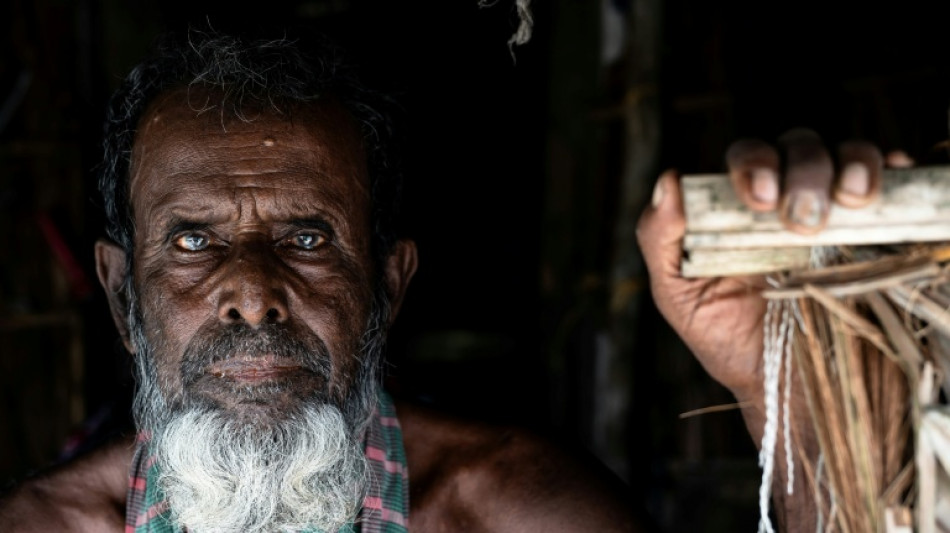
Rivers of salt: life on Bangladesh's climate frontline / Photo: Muhammad Amdad HOSSAIN - AFP
 Brennan sprints to Vuelta stage two victory, Pogacar keeps red

 Duplantis conquers pole vault at Silesia Diamond League

 France's badminton gold winners set for obscurity back home

 Brighton start Premier League season with rout of 10-man Villa

 Maresca makes winning start with Man City after dramatic fightback

 Mo'unga returns for All Blacks against Johannesburg Lions

 Belgian sprinter Philipsen wins Renewi Tour

 'A day for French badminton' as Lanier triumph gives them golden double at world champs

 Kane voted German footballer of the year

 'New season, new trim': Man City star Haaland chops off flowing locks

 Lanier clinches badminton world title in France's golden double

 After Wildberries, Ukraine launches drone campaign on Russia's Ozon

 Padikkal, Gill half-centuries take India to 187-3 at tea

 Cummins hails 'sharp' Australia as they get back to winning ways
 Bangladesh eye more Australia Tests to hit next level

 Thousands expected at Sweden climate demo as election looms

 Starc heroics put Australia on brink of victory over Bangladesh

 Austrian mountain town finds niche in AI boom

 Messi scores but Miami slump continues with loss to Toronto

 Sydney marathon unveils medal with wrong stadium

 Macron hosts Saudi's MBS for visit ranging from esports to Mideast

 Australia in control with 146-run first innings lead over Bangladesh

 World No. 3 Pegula beats defending champ Swiatek to reach Cincy final

 Wyndham Clark surges clear at BMW Championship

 Maresca says Man City must fill Rodri void after Barca switch

On Bangladesh's coast, where mighty Himalayan rivers meet the sea, water defines every rhythm of life, and every struggle.
Rising seas driven by climate change are swallowing low-lying areas, while stronger storms push saltwater further inland, turning wells and lakes brackish, according to government scientists.
For the millions living in the ecologically sensitive deltas of mudflats and mangrove forests, finding clean drinking water has become an escalating challenge.
Cyclone Aila in 2009 was a turning point.
Embankments broke and saltwater swept inland, flooding not only homes, but seeping into once-fertile land.
The water that once sustained communities became undrinkable, and the land began to crack under layers of salt.
The people of Khulna and Satkhira districts today live in a fragile balancing act between land and sea.
Many families live in houses built on bamboo stilts to escape tidal floods.
Children bathe in yellow, saline water and grow up in a landscape of constant change, where rivers erode their homes and schools, and displacement has become the norm.
Men migrate for months seeking work.
Women and children walk for hours across parched, cracked soil to fetch water from distant ponds, or harvest rainwater, and store it in tanks supplied by charities.
Each household stores a few thousand litres, rationed carefully until the next monsoon arrives.
The daily act of collecting and storing water has become a quiet ritual of endurance.
This reporting accompanies a photography series carried out by Muhammad Amdad Hossain for AFP's 2025 Marai Photo Grant, an award open to photographers from South Asia aged 25 or under.
The theme for 2025 was "climate change" and its impact on daily life and the community of the photographers who enter.
The award is organised by Agence France-Presse in honour of Shah Marai, the former photo chief at AFP's Kabul bureau.
Shah Marai, who was an inspiration for Afghan photographers throughout his career, was killed in the line of duty at the age of 41 in a suicide attack on April 30, 2018 in Kabul.
L.Miller--AMWN