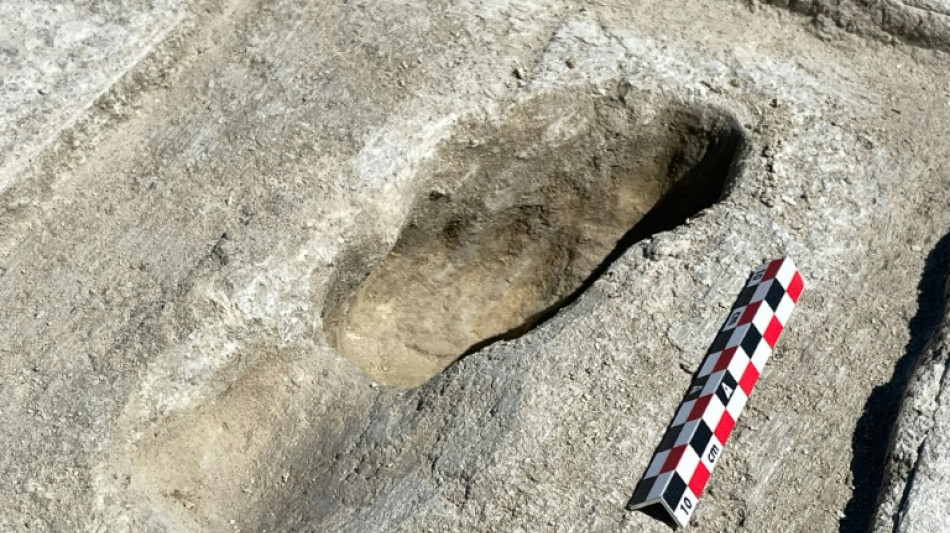
Ice-age footprints shed light on North America's early humans / Photo: Handout - HANDOUT/AFP
 Ivory Coast captain Kessie snubs Juventus to rejoin Atalanta

 Strasbourg fight back to beat Lens in Ligue 1

 Tamil Nadu Plans District Safe Houses for Couples Facing Caste Violence

 Bryan Kohberger Seeks Judge’s Removal From Post-Conviction Case

 Study Examines Why Women Have Consensual Sex Without Initial Desire

 Ohio State Leads 2026 Preseason College Football Top 25

 Ketogenic Diet Delivers Largest Liver-Fat Reduction in Three-Diet Trial

 US Open top seed Zverev downplays favorite status

 Soldiers' mutiny rocks Niger capital, as junta claims to be back in control

 Seven Arrested After VCK Functionary Killed in Thiruneermalai Attack

 Kanye West Does Not Address Milo Yiannopoulos Detention During New Orleans Concert

 Taylor Swift Donation Supports Connecticut Mother Recovering From Serious Roadside Injuries

 Taylor Swift Gives $50,000 to Fundraiser for Mother Injured While Helping Crash Victims

 Los Angeles County Rapper Among Three Charged in $8.1 Million Stolen-Check Case

 Pittsburgh Speed Painter Surprises Jalen Brunson With 10-Minute Portrait
 California Dairy Hydrogen Project Sets Carbon-Intensity Record and Renews Biogas Debate

 Munoz saves Iraola in Liverpool draw, Hull extend dream start
 'Smooth' Marc Marquez wins Aragon MotoGP sprint, Bezzecchi on pole

 Tiny Elversberg stun Leverkusen on Bundesliga debut

 Russian strike blows up arms depot near Kyiv, killing 37
 Lebanon archaeological finds showcase rich heritage despite war woes

 Liverpool held by Forest on Iraola's Anfield debut

 Rescuers claw through mud as missing toll from Nepal, China flood nears 3,000

 Mourinho says Mbappe worthy of Ballon d'Or

 Clashes rock Niger capital, junta says back in control

Footprints laid down by Ice-Age hunter-gatherers and recently discovered in a US desert are shedding new light on North America's earliest human inhabitants.
Dozens of fossilized prints found in dried-up riverbeds in the western state of Utah reveal more details about how the continent's original occupants lived more than 12,000 years ago -- just as the frozen planet was starting to thaw.
The fossils could have remained unnoticed if not for a chance glance out of a moving car as researchers Daron Duke and Thomas Urban drove through Hill Air Force Base chatting about footprints.
"We were talking about 'what would they look like?'," Duke told AFP. "And he said: Kind of like that out the window.'"
What the two men had found turned out to be 88 distinct prints left by a mixture of adults and children.
"They vary between just looking like discolored patches on the ground and... little pop ups, little pieces of dirt around them or on them. But they look like footprints," Duke said.
What came next was a painstaking few days of very careful digging -- sometimes lying on his belly -- to ensure that what they were looking at was as old as it appeared.
"What I found was bare feet of people... that had stepped in what looks to be shallow water where there was a mud sub layer," Duke explained.
"The minute they pulled their foot out, the sand infilled that and has preserved it perfectly."
Duke, of the Nevada-based Far Western Anthropological Research Group, had been in the area looking for evidence of prehistoric campfires built by the Shoshone, a people whose descendents still live in the western United States.
He had brought Urban over from Cornell University because of his expertise in uncovering evidence of ancient humans -- including the discovery of human tracks in New Mexico's White Sands National Park that are thought to be up to 23,000 years old.
- 'Awestruck' -
The new fossils add to a wealth of other finds from the area, including stone tools, evidence of tobacco use, bird bones and campfire remains, that are starting to provide a more complete record of the Shoshone and their continuous presence in the region beginning 13,000 years ago.
"These are the resident indigenous people of North America, this is where they lived, and this is where they still live today," Urban said.
For him personally, finding the footprints has been a professional high point.
"Once I... realized I was digging a human footprint, I was seeing toes, I was seeing the thing in immaculate condition... I was just kind of awestruck by it," he said.
"Nothing beats the sense of discovery and awe that maybe as an archaeologist, you are actually chasing your whole career."
And sharing the discovery with the distant descendents of the people who made the prints was immensely rewarding, Urban said.
"You realize the same thing is happening -- what the connection is to such a distant past and to something so human, I think it gets to everybody in one way or another eventually."
O.M.Souza--AMWN