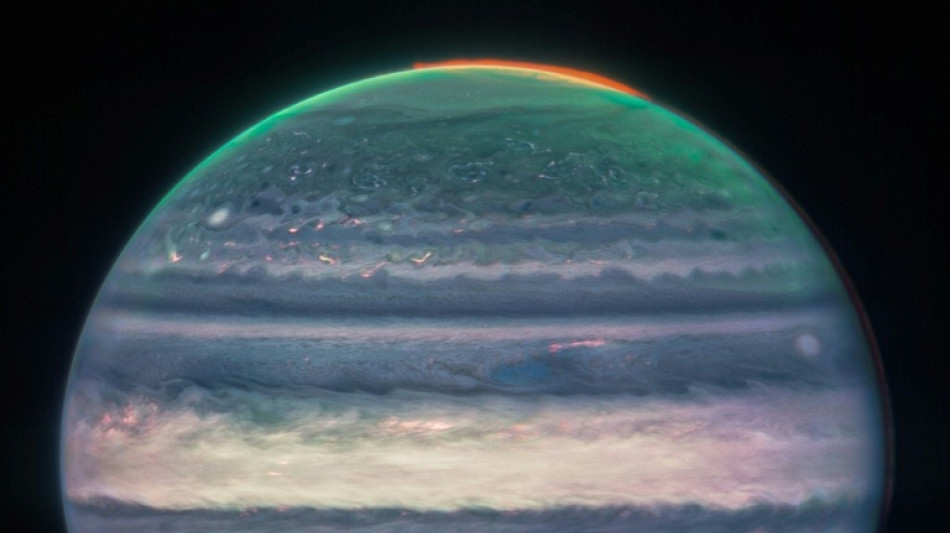
James Webb telescope captures stunning images of Jupiter / Photo: Handout - NASA/AFP
 Lawrence's fifty leaves Pakistan facing record chase to level England series
 Netanyahu condemns settler attack in flashpoint West Bank village

 Munoz saves Iraola in Liverpool draw, big-spending Spurs lose again

 Newcastle condemn dismal Spurs to second successive defeat

 Police appeal for footage after life-threatening Stratford assault
 Family searches for Boston engineer missing after Nepal-Tibet floods

 Dolly Parton’s Imagination Library leaves global children’s reading legacy

 BMC rejects negligence claims in three Rajawadi Hospital maternity cases

 Chembur man held over alleged poisoning of woman’s soft drink

 Andhra Pradesh Speaker seeks stronger sports quota and school facilities

 Kolkata police register new FIR against Mamata Banerjee over rally timing

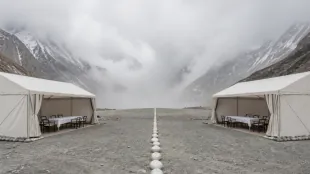 India and China have not named two new border meeting sites

 Tamil Nadu and NUS agree to expand postgraduate and research links

 Tamil Nadu goalball team’s national silver highlights need for wider support

 Rural Tamil Nadu students present 64 technology projects at IIT-M research park

 Matt Leinart assesses Arch Manning and the leading names in college football

 Los Angeles triplets weigh 19.3 pounds in unusually heavy birth

 Editorial questions Letitia James’ record as New York attorney general

 In London, son's agonising wait for news of parents missing in Nepal-Tibet floods

 Ivory Coast captain Kessie snubs Juventus to rejoin Atalanta

 Strasbourg fight back to beat Lens in Ligue 1

 Maharashtra Accepts Tribal Students’ Demands After 17-Day Protest

 Sixteen Keralites Return From Flood-Hit Nepal as Seven Remain Uncontactable

 Chirag Paswan Defends Caste-Based Reservations Amid NDA Dispute

 Tamil Nadu Seeks Public Input on List of Agamic Temples

NASA's James Webb Space Telescope has captured stunning images of the planet Jupiter showing two tiny moons, faint rings and auroras at the northern and southern poles.
"We hadn't really expected it to be this good, to be honest," said planetary astronomer Imke de Pater of the University of California, Berkeley.
"It's really remarkable that we can see details on Jupiter together with its rings, tiny satellites, and even galaxies in one image," she said.
De Pater headed the observations of Jupiter, the largest planet in our solar system, with Thierry Fouchet of the Paris Observatory.
The composite images were taken with the observatory's Near-Infrared Camera (NIRCam) and were artificially colored because infrared light is not visible to the human eye.
The auroras above the northern and southern poles of Jupiter have been mapped in redder colors while the Great Red Spot, a storm bigger than Earth, appears white.
One image shows Jupiter's faint rings and its moons Amalthea and Adrastea.
Launched in December 2021 from French Guiana on an Ariane 5 rocket, Webb is orbiting the Sun at a distance of a million miles (1.6 million kilometers) from Earth, in a region of space called the second Lagrange point.
It took the spacecraft almost a month to reach the region, where it remains in a fixed position behind the Earth and Sun to give it a clear view of the cosmos.
The Webb telescope is an international collaboration between the US space agency NASA, the European Space Agency, and the Canadian Space Agency, involving more than 10,000 people.
J.Williams--AMWN