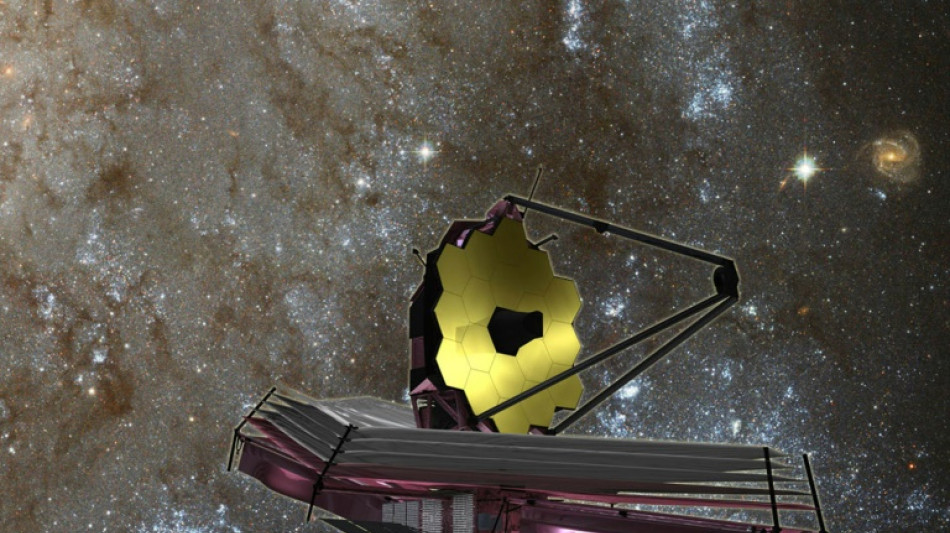
Webb telescope finds CO2 for first time in exoplanet atmosphere / Photo: Handout - NASA/AFP/File
 Lawrence's fifty leaves Pakistan facing record chase to level England series
 Netanyahu condemns settler attack in flashpoint West Bank village

 Munoz saves Iraola in Liverpool draw, big-spending Spurs lose again

 Newcastle condemn dismal Spurs to second successive defeat

 Police appeal for footage after life-threatening Stratford assault

 Family searches for Boston engineer missing after Nepal-Tibet floods

 Dolly Parton’s Imagination Library leaves global children’s reading legacy

 BMC rejects negligence claims in three Rajawadi Hospital maternity cases

 Chembur man held over alleged poisoning of woman’s soft drink

 Andhra Pradesh Speaker seeks stronger sports quota and school facilities

 Kolkata police register new FIR against Mamata Banerjee over rally timing

 India and China have not named two new border meeting sites

 Tamil Nadu and NUS agree to expand postgraduate and research links

 Tamil Nadu goalball team’s national silver highlights need for wider support

 Rural Tamil Nadu students present 64 technology projects at IIT-M research park

 Matt Leinart assesses Arch Manning and the leading names in college football

 Los Angeles triplets weigh 19.3 pounds in unusually heavy birth

 Editorial questions Letitia James’ record as New York attorney general

 In London, son's agonising wait for news of parents missing in Nepal-Tibet floods

 Ivory Coast captain Kessie snubs Juventus to rejoin Atalanta

 Strasbourg fight back to beat Lens in Ligue 1

 Maharashtra Accepts Tribal Students’ Demands After 17-Day Protest

 Sixteen Keralites Return From Flood-Hit Nepal as Seven Remain Uncontactable

 Chirag Paswan Defends Caste-Based Reservations Amid NDA Dispute

 Tamil Nadu Seeks Public Input on List of Agamic Temples

The months-old James Webb Space Telescope has added another major scientific discovery to its growing list: detecting for the first time signs of carbon dioxide in the atmosphere of a planet outside our solar system.
Although the exoplanet would never be able to support life as we know it, the successful discovery of CO2 gives researchers hope that similar observations could be carried out on rocky objects more hospitable to life.
"My first thought: wow, we really do have a chance to detect the atmospheres of terrestrial-size planets," tweeted Natalie Batalha, a professor at the University of California at Santa Cruz and one of hundreds who worked on the Webb project.
Their study of exoplanet WASP-39, a hot gas giant closely orbiting a star 700 light years away, will soon be published in the journal Nature.
"For me, it opens a door for future research on super-Earths (planets larger than Earth but smaller than Neptune), or even Earth-sized planets," Pierre-Olivier Lagage, an astrophysicist with France's Atomic Energy Commission (CEA), told AFP.
The detection of CO2 will also help scientists learn more about how WASP-39 formed, NASA said in a press release. The exoplanet, which orbits its star once every four Earth days, has a mass one-quarter that of Jupiter but a diameter 1.3 times bigger.
The frequency of its orbit and large atmosphere made WASP-39 an ideal candidate for an early test of Webb's state-of-the-art infrared sensor, known as NIRSpec.
Each time the exoplanet crosses in front of its star, it blocks out an almost imperceptible amount of light.
But around the edges of the planet, a tiny amount of light passes through the atmosphere.
Webb's highly sensitive NIRSpec can detect the small changes that the atmosphere has on the light, allowing scientists to determine its gas composition.
The Hubble and Spitzer telescopes had already detected water vapor, sodium and potassium in WASP-39's atmosphere, but carbon dioxide can now be added to that list thanks to Webb and its NIRSpec instrument.
"It was a special moment, crossing an important threshold in exoplanet sciences," said Zafar Rustamkulov, a Johns Hopkins University researcher, in the NASA press release.
A.Jones--AMWN