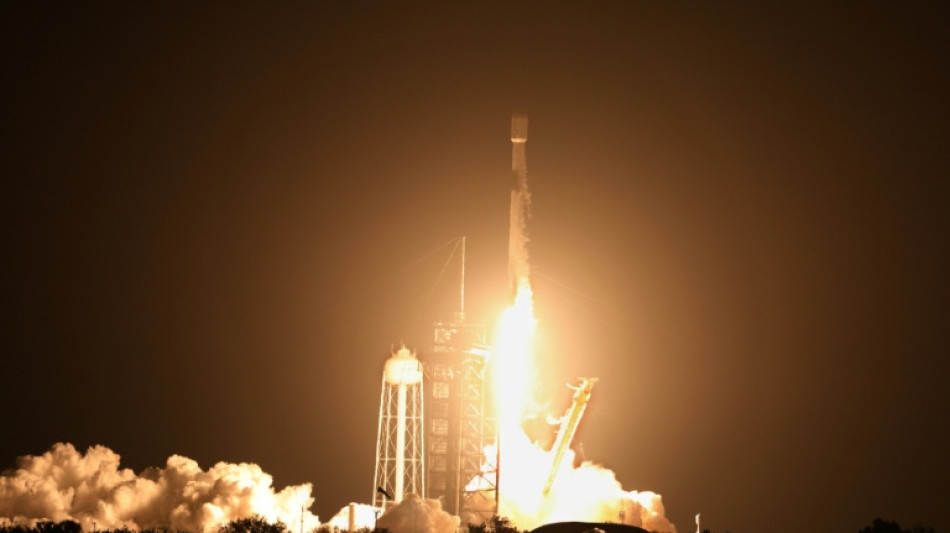
SpaceX rocket stage believed to have slammed into Moon / Photo: Gregg Newton - AFP/File
 SGFX Creates a Standout Brand Experience at Forex Expo Dubai 2026

 Pope urges Europe to help combat 'deceit and lies' in international ties

 Injured Buttler to miss England ODI series in Pakistan
 Madrid housing protesters vow to maintain pressure on government

 In kayaks or waist-deep in floodwater, shoppers return to Bangkok markets

 UK police probes Iran link to air base bomb scare: media

 Eala blasts into Asian Games quarters in just 55 minutes

 Taiwan gender-row boxer Lin Yu-ting guarantees Asian Games medal

 Comedian on trial for allegedly insulting Erdogan in standup show

 More Asian Games transport woes as bus takes Pakistan to wrong venue

 Death toll in South Africa bar shooting rises to 18

 Aide to Venezuelan opposition leader returns from exile

 Messi and Alcaraz love it, now padel takes step closer to Olympics

 Tolls mount in Thailand, Myanmar floods

 Why India's opposition wants top poll official out

 PU Prime Strengthens UAE Momentum with Strong Showing at Forex Expo Dubai 2026

 Eight dead in Thailand floods since mid-September

 Oil prices spike after Trump rejects Iran truce offer

 Taylor Swift sets new record at MTV VMAs

 Seoul seeks apology after Ukraine reveals transfer of North Korean POWs

 Messi on target again but Miami downed by Columbus

 In Washington's political cauldron, a fight over foie gras
 Flavio Bolsonaro: political heir in his father's shadow

 Ravens grab last-second win in Rio as Commanders stop Seahawks

 Paycheck Suddenly Smaller? Clear Start Tax Explains How IRS Wage Garnishment Works and How to Stop It

A four-tonne piece of a SpaceX rocket was believed to have unintentionally crashed into the Moon on Wednesday, a collision that posed no danger to Earth but is expected to leave behind a lunar crater.
While there is not yet official confirmation that the Falcon 9 upper stage struck the lunar surface, it had been expected to make impact at approximately 0635 GMT.
NASA and its Lunar Reconnaissance Orbiter probe and South Korea's Pathfinder Lunar Orbiter were planning to take images of the site after impact, but it may take days to receive that information.
Scientists and amateur stargazers alike had been looking forward to observing the sunlit plume of rubble and debris created by the smash.
"It might be possible for folks with a telescope to observe the plume of ejecta created by the impact," said Benjamin Fernando of Los Alamos National Laboratory in New Mexico, the lead author on a recent paper on the anticipated impact.
"It is unclear how bright it will be, which is one of the reasons why we are looking to study this event," the researcher told AFP before impact.
Assuming all of the propellant is spent, authors of the paper estimate the spacecraft weighs approximately 8,800 pounds (4,000 kilograms).
It was expected to slam into the Moon's northern hemisphere near the Einstein Crater, at some 5,400 miles per hour (8,690 kilometers per hour).
- 'Space junk' -
"There is no danger to Earth," said NASA spokesperson Jimi Russell in a statement.
"NASA will continue to track the booster for training purposes, as well as later observe the impact site for scientific purposes."
The Falcon 9 rocket made by Elon Musk's SpaceX firm took off in January 2025, carrying two lunar landers. The booster returned to Earth, but the upper stage stayed in space to push the landers onward.
Generally, for such "high-energy missions" SpaceX performs a maneuver to make sure the second stage "is safe per the appropriate rules and regulations," said Julianna Scheiman, director of NASA Science and Dragon Programs at SpaceX, at a Monday news conference.
"We did that," she continued, but "what has happened is essentially a mixture of solar activity and gravity forces have put it on a path towards the Moon."
Like many scientists, Scheiman added she was "very excited" to see the impact.
The paper authors encouraged both professional and amateur astronomers to attempt viewing or recording the collision.
"This event provides an opportunity to test a pipeline for localizing impacts on the lunar surface for future seismic experiments, investigating the dust and plume dynamics from impact events on the Moon, and considering hazards from artificial space debris impacts," wrote the research team.
NASA hopes to soon establish a sustained human presence on the Moon, making it critical to better understand space debris in lunar orbit.
The Moon routinely weathers impact from space debris including meteoroids. Artificial collisions are less common.
In the 1970s, the US space agency carried out deliberate crashes during its Apollo program to collect seismic data.
The rocket stage had been just one many pieces of "space junk" orbiting Earth.
There are more than 46,000 pieces of space debris weighing a total of 17,000 tonnes currently in orbit, the European Space Agency said in late July.
Some experts have warned that amassing too much space junk around Earth could lead to a dangerous chain reaction of collisions known as the "Kessler syndrome".
O.M.Souza--AMWN