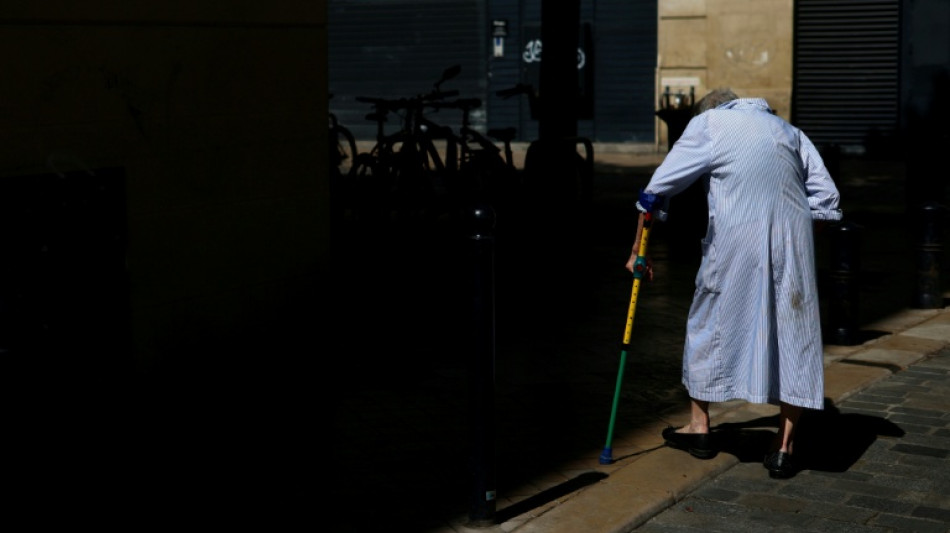
Elderly far more at risk from rising heat than thought: study / Photo: ROMAIN PERROCHEAU - AFP/File
 No. 22 UCLA defeats No. 5 Arizona 84-75 despite Kharchenkov's 38 points

 Antonelli Overcome by Emotion After Victory at Autódromo Hermanos Rodríguez

 Godzilla Minus Zero shifts focus toward postwar human drama

 Mehbooba Mufti urges dialogue and renewed Central Asia links for Kashmir

 Seacliff Healthcare Seeks Specialist GP in Thirroul

 US stocks fall before midterm Election Day as technology shares weaken

 BLS Polymers makes strong market debut at ₹248 per share

 Petrol and diesel prices remain broadly steady across major Indian cities

 Reliance shares remain in focus after near-12% surge

 2026 Arizona Midterms: Key Races, Ballot Measures, and Voter Deadlines

 Coal India prepares possible $1 billion Mahanadi Coalfields listing

 Julia Stiles and Ezra Sosa Share Emotional Farewell After 'DWTS' Elimination

 US Buildings Threatened by Wildfires Could Triple by 2060

 Why Pregnancy Cost Estimates Fail: A Family’s $9,000 Surprise

 US Strikes Iranian Targets in Strait of Hormuz Ahead of Midterms

 Brodeur’s Overtime Goal Secures Bethlehem’s Second Consecutive Sectional Title

 Rare 1970 Plymouth ‘Cuda 426 Hemi Listed for $400,000

 The Digital Burden: Why Instant Messaging Feels Like a Full-Time Job

 Alberta Tabled Controversial Riding Boundary Maps Amid Gerrymandering Accusations

 Hong Kong court set to sentence activist Joshua Wong in security case
 Australia raises benchmark rate to highest level in 18 years

 'The Remarried Empress' Cast Discusses Bringing Fantasy Royal Drama to Life

 Asian stocks retreat as AI worries outweigh steep oil-price drop

 Hamad International Airport stages emergency drills during WATAN 2026

 Global failure to punish attacks leaves journalists at continuing risk

The threat that rising temperatures fuelled by climate change pose to the health of older people has been dramatically underestimated, according to a US modelling study published Tuesday.
The research was released during a blistering northern hemisphere summer when extreme heat broke numerous records and contributed to the deaths of tens of thousands of people.
For the study, a US team led by researchers at Stanford University sought to estimate how often human-caused global warming will push temperatures to levels that elderly people cannot tolerate.
Previous research in this area has used a measurement called wet-bulb temperature, which incorporates humidity to estimate how much heat a human body can withstand.
However this research was conducted on young, healthy adults, according to the study in The Lancet Planetary Health.
This means it did not take into account the greater risk heat poses to older people because they sweat less and tend to have weaker hearts as well as pre-existing medical conditions.
So the researchers used new data from more recent wet-bulb experiments conducted in the United States which tested how people over 60 tolerated higher heat and humidity.
Taking into account the world's ageing population, they then modelled how heat will affect the health of three different age ranges by 2100 under varying levels of global warming.
"Intolerable heat will be experienced at much larger scales and for longer durations, affecting far more people than previously estimated," the study concluded.
- Driving 'climate migration' -
If the world gets 1.5 C warmer than pre-industrial levels, 22 percent of people over 60 will be exposed to unsafe heat for at least a month every year worldwide, the researchers estimated.
Each extra degree of warming will mean a billion more people will experience roughly another month of heat and humidity beyond what their body can tolerate.
If the world warms by 3C, elderly people in the worst-affected regions -- south Asia and the Gulf -- could face dangerous heat day-and-night for three straight months a year, according to the study.
The countries facing the greatest threat were said to be those with high levels of poverty and little access to cooling, including India, Pakistan, Bangladesh, Myanmar and Niger.
"These results suggest that uncompensable heat could increasingly drive internal displacement and transboundary climate migration, raising new policy and humanitarian challenges," the study warned.
To avoid these grim scenarios, the researchers called for the world to cut emissions of planet-warming greenhouse gases -- and for future heat plans to prioritise vulnerable older people.
Most deaths from heat happen indoors, meaning that "broader access to air-conditioning and other cooling facilities" is particularly important, they emphasised.
Wildfires, long heatwaves and drought have ravaged Europe during what is expected to be the world's fastest-warming continent's hottest summer on record.
Next year is expected to be even hotter.
P.Martin--AMWN