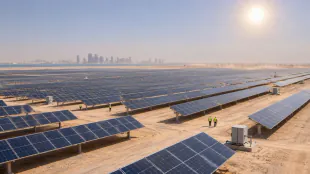
China goes rural with data centres in quest to power AI / Photo: Jade GAO - AFP
 No. 22 UCLA defeats No. 5 Arizona 84-75 despite Kharchenkov's 38 points

 Antonelli Overcome by Emotion After Victory at Autódromo Hermanos Rodríguez

 Godzilla Minus Zero shifts focus toward postwar human drama

 Mehbooba Mufti urges dialogue and renewed Central Asia links for Kashmir

 Seacliff Healthcare Seeks Specialist GP in Thirroul

 US stocks fall before midterm Election Day as technology shares weaken

 BLS Polymers makes strong market debut at ₹248 per share

 Petrol and diesel prices remain broadly steady across major Indian cities
 Reliance shares remain in focus after near-12% surge

 2026 Arizona Midterms: Key Races, Ballot Measures, and Voter Deadlines

 Coal India prepares possible $1 billion Mahanadi Coalfields listing

 Julia Stiles and Ezra Sosa Share Emotional Farewell After 'DWTS' Elimination

 US Buildings Threatened by Wildfires Could Triple by 2060

 Why Pregnancy Cost Estimates Fail: A Family’s $9,000 Surprise

 US Strikes Iranian Targets in Strait of Hormuz Ahead of Midterms
 Brodeur’s Overtime Goal Secures Bethlehem’s Second Consecutive Sectional Title

 Rare 1970 Plymouth ‘Cuda 426 Hemi Listed for $400,000

 The Digital Burden: Why Instant Messaging Feels Like a Full-Time Job

 Alberta Tabled Controversial Riding Boundary Maps Amid Gerrymandering Accusations

 Hong Kong court set to sentence activist Joshua Wong in security case
 Australia raises benchmark rate to highest level in 18 years

 'The Remarried Empress' Cast Discusses Bringing Fantasy Royal Drama to Life

 Asian stocks retreat as AI worries outweigh steep oil-price drop

 Hamad International Airport stages emergency drills during WATAN 2026

 Global failure to punish attacks leaves journalists at continuing risk

In China's hilly Guizhou province, a cluster of European-style buildings complete with clock tower and multi-arched bridge emits a low, permanent hum -- a clue to its unexpected identity as tech giant Huawei's largest data centre.
The town-like complex is unique in design, but not in its placement. Dozens ofdata centres have been constructed in the southwestern province in recent years.
They are part of a government strategy that has seen much of the digital infrastructure for breakneck AI development across China's eastern seaboard established in the country's less populated, rural west.
The build-out is ongoing. China is on course to nearly double its data centre capacity within the next five years, as a tech race with the United States intensifies and countries everywhere try to swerve a computing crunch that could stymie AI expansion.
The projects have transformed some places -- such as Guian New Area, where the Huawei data centre and others are located.
"It used to be a barren mountain, but since the area has developed, transportation has become more convenient, trade has picked up, business opportunities have emerged," local shopkeeper Shu Peihua said.
When AFP visited last month, street vendors were catering to data centre workers on their lunchbreak near a roadside banner calling for "promoting high-quality development", a government tech policy catchphrase.
In Europe and the United States, data centre construction has often been met with resistance from local communities citing concerns around energy prices, as well as environmental issues such as water usage and noise.
Dissent in China is tightly controlled, however, especially around central government policy.
Still, Guian residents who spoke to AFP were positive about the changes to their area.
A vendor selling savoury pancakes, who did not give his name, said two universities had been established since the facilities were built.
Another local, Li Xixiu, said the main road had been developed because of the centres, which in general had "really boosted the economy of this entire area".
"All the villagers in our neighbourhood now find jobs nearby, unlike before, when they had to go to other places," Li said.
- East to west -
In 2021, the government gave its strategy a name: "Eastern Data Western Computing".
The logic of construction in places like Guizhou, with its cooler climates, abundant renewable energy and empty space, is multifaceted.
AI processing is extremely energy intensive, and China has demanded that data centres draw 80 percent of their power from renewable sources by the end of this decade.
That makes regions like Guizhou and Inner Mongolia, which have massively expanded renewable capacity like solar and wind, ideal for operators looking to meet those commitments, said Simeng Deng, a senior analyst at Rystad Energy.
Energy-guzzling server farms could also help solve renewables' issue of curtailment, or the over-production of energy.
The data centres "can be an engine to digest or absorb the surplus of renewable power generation", said Deng.
Developing previously neglected parts of the countryside is another potential benefit.
Despite the enthusiasm of the locals AFP met though, some researchers question the overall economic gains to host regions.
Data centres don't necessarily create a "huge spillover effect" on local jobs, said Andrew Stokols from Singapore Management University.
"The hope is that you can use data centres as an engine for broader digital development... bringing in industries that will come in around data centres," he said.
However, both in China and elsewhere, "immediate benefits have been elusive".
- 'Limited' economic boost -
Guizhou has averaged an annual GDP growth rate of 7.4 percent over the past decade, but its wage growth over the same period was second to last nationwide, according to the Taiwan-based Research Institute for Democracy, Society and Emerging Technology (DSET).
"This contrast suggests that while data centres drive heavy investment in land and equipment, their impact on boosting local per capita income remains limited," DSET researchers Cartus Bo-Xiang You and Angela Glowacki told AFP by email.
Massive investment in infrastructure, coupled with policy incentives to attract data centre builders, have earned Guizhou one of the highest debt burdens in the country.
In 2024, Guizhou ranked 30th among Chinese provinces for its debt-to-revenue ratio, according to a DSET report, and 27th for its debt-to-GDP ratio.
However, the demand for data processing capacity as countries scramble for technological supremacy means the building will continue.
Even before ChatGPT heralded the beginning of the AI boom, Chinese policy documents were "talking about the idea that computing power is correlated with national power", said Stokols.
"It's essential for national competitiveness in the age of digital technology... the AI competition has accelerated that."
A.Jones--AMWN