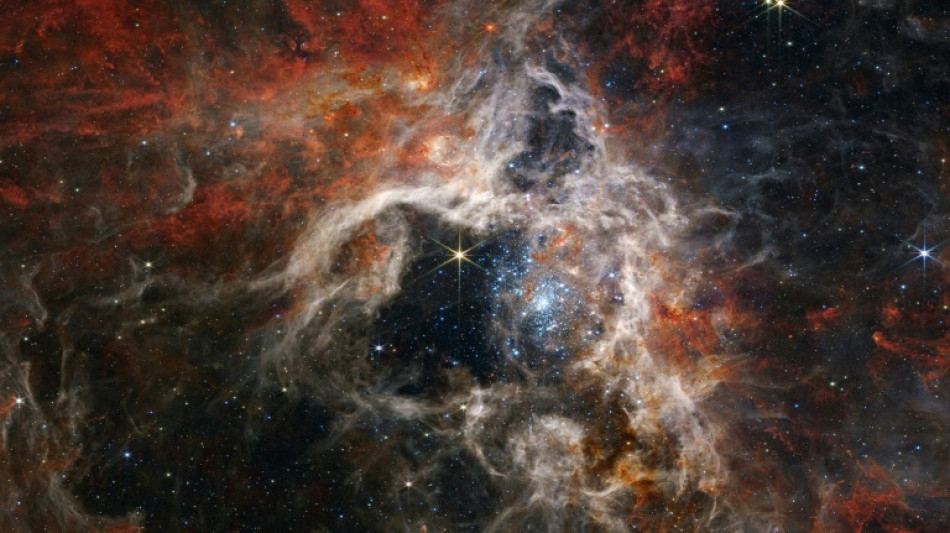
NASA's Webb catches Tarantula Nebula / Photo: Space Telescope Science Institut - NASA/AFP
 Juve notch second straight win, Fiorentina's centenary party falls flat

 Rybakina eases injury fears ahead of US Open
 Djokovic kicks off latest Grand Slam quest under US Open lights

 'Sorry' De Zerbi won't panic after Spurs shambles
 UN, Nepal warn of climate threat after deadly floods

 USTA boss says structure of new player council not yet set

 Tiny Elversberg stun Leverkusen on Bundesliga debut, Dortmund beat Hamburg

 James Cleverly leaves shadow cabinet to seek London mayoralty

 Baladi Map app turns Lebanon’s local problems into a public record
 Thirty-seven Mumbai pilgrims return after Nepal flood disruption

 Ankle ligament tear ends Neeraj Chopra’s 2026 season

 Chinchpoklicha Chintamani begins 2026 arrival procession in Parel

 Cyberabad civic body demolishes 19 unauthorised structures

 About 50 Karnataka travellers return from Nepal as 24 remain missing
 French campaign sharpens as far right accuses left over civil disobedience calls
 Court orders JIPMER assessment of Durai Dayanidhi before money-laundering trial

 Chennai councillors unite across parties to demand ward development funds

 Tambaram civic groups seek action on eight long-pending issues
 Three Texas Tech softball players hurt in jet ski collision

 Felony assaults on older New Yorkers rise sharply, police data show

 New finds strengthen case for Bethsaida at Sea of Galilee site

 Five college football games that could shape the 2026 season

 Norway's King Haakon VIII pays tribute to late father in first speech

 South Africa survive onslaught to beat New Zealand and level series

 BJP Rejects Caste Allegation Over Haldwani Venue Ritual

A stellar nursery nicknamed the Tarantula Nebula has been captured in crisp detail by NASA's Webb telescope, revealing hitherto unseen features that deepen scientific understanding, the agency said Tuesday.
Officially known as 30 Doradus, the region of space is characterized by its dusty filaments that resemble the legs of a hairy spider, and has long been a favorite for astronomers interested in star formation.
Thousands of young stars, distant background galaxies, and the detailed structure of the nebula's gas and dust structures were viewable for the first time thanks to Webb's high resolution infrared instruments.
Webb operates primarily in the infrared spectrum, because light from objects in the distant cosmos has been stretched into this wavelength over the course of the universe's expansion.
The telescope's primary imager, Near-Infrared Camera (NIRCam), found the cavity in the center of the nebula was hollowed out by radiation carried on stellar winds emanating from a cluster of massive young stars, which appear as pale blue dots.
Webb's Near-Infrared Spectrograph (NIRSpec), which analyzes light patterns to determine the composition of objects, caught one young star in the act of shedding a cloud of dust from around itself.
The same star was previously thought to be at a later stage of formation, already well on the way to clearing its dusty bubble.
The region was also imaged using the Mid-infrared Instrument (MIRI), which uses longer wavelengths of infrared to pierce through dust grains that absorb or scatter shorter wavelengths.
This faded the hot stars and clarified the cooler regions, revealing never-before-seen points of light within the stellar nursery, which indicate protostars that are still gaining mass.
Astronomic interest in the Tarantula Nebula stems from its similar chemical composition to gigantic star-forming regions observed a few billion years after the Big Bang, a period called the "cosmic noon" when star formation peaked.
At just 161,000 light-years away, Tarantula is a readily viewable example of this flourishing period of cosmic creation.
Webb should also provide scientists the opportunity to gaze at distant galaxies from the actual era of cosmic noon, and compare it to observations of Tarantula, to understand similarities and differences.
Operational since July, Webb is the most powerful space telescope ever built, with astronomers confident it will herald a new era of discovery.
A.Malone--AMWN