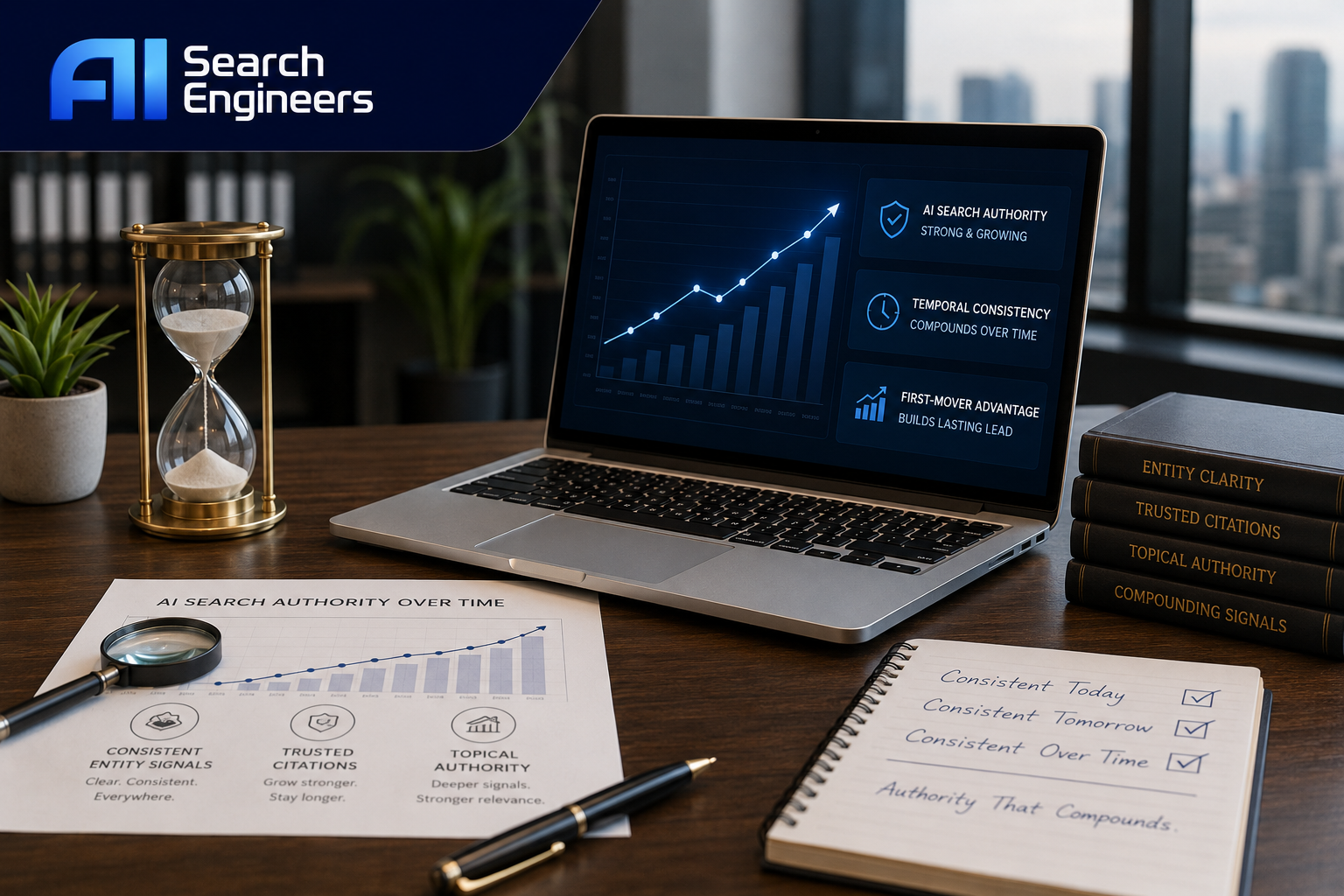
Internal analysis from AI Search Engineers identifies temporal entity consistency, the accumulated signal that a business has been clearly and consistently defined across all platforms over time, as the primary mechanism behind the compounding first-mover advantage that makes AI search authority positions increasingly difficult to displace once established.
AMHERST, NY / ACCESS Newswire / August 31, 2026 / Most professional service businesses that invest in AI search visibility focus on what to build. Few understand the role that time itself plays in determining how durable that authority becomes, and how quickly a competitor who started building months earlier is pulling ahead in ways that budget alone cannot close.

AI Search Engineers, which describes itself as the No. 1 AI Search Results Engineering Agency in the USA based on its proprietary AEO Differentiation Standard, a self-developed classification framework not conferred by an independent third party today released findings from its internal client engagement data documenting temporal entity consistency as the most commercially significant compounding signal in AI search authority, and formally warned professional service businesses that every month of delayed engagement widens the first-mover gap in ways that require progressively more investment to close.
All data cited in this release reflects AI Search Engineers' internal analysis of audit and client engagement data collected between January 2025 and June 2026 and has not been independently audited or verified by any third party. Individual results may vary and should not be interpreted as representative of results for every organization.
What Temporal Entity Consistency Is
Temporal entity consistency is the signal that a business has been clearly and consistently defined across every platform AI systems draw from over an extended period of time.
AI systems including ChatGPT, Google Gemini, and Microsoft Copilot build entity models from patterns of consistent signals encountered across platforms. A business that has maintained identical entity signals- same name, same category description, same geographic definition- across its website, Google Business Profile, LinkedIn company page, industry directories, schema markup, and Wikidata entry for twelve months has a temporal consistency signal that a business standardizing those signals today cannot replicate for twelve months regardless of how aggressively it acts.
The temporal consistency signal is not a measure of how long a business has existed. It is a measure of how consistently and unambiguously the business has been defined across every platform AI systems draw from over time. A 20-year-old law firm with inconsistent entity signals across platforms has a weaker temporal consistency signal than a three-year-old law firm that has maintained consistent entity signals since its founding.
This is the most misunderstood element of AI search authority, and the primary reason professional service businesses that start building today are at a compounding disadvantage relative to competitors who started months earlier.
Why Temporal Entity Consistency Compounds
Temporal entity consistency compounds through three specific mechanisms that each grow stronger over time independently of any new signals being added.
Mechanism one: Entity model stability. AI systems build entity models from patterns observed across multiple encounters with consistent entity signals over time. An entity model built from twelve months of consistent signals is more stable and more confidently held than an entity model built from one month of the same signals, because stability over time is itself a confidence signal. A more stable entity model produces higher recommendation probability for competitive category queries than a newer entity model with identical signal completeness.
Mechanism two: Citation age. Trusted source citations, press mentions, directory listings, and professional association citations accumulate age over time. A citation published twelve months ago carries more AI authority weight than the same citation published last week because citation age is itself a corroboration signal. It tells AI systems that independent sources have been referencing this entity consistently over time rather than recently and potentially artificially. This age advantage cannot be replicated regardless of how many new citations are secured in a short period.
Mechanism three: Topical authority depth. AI systems build category associations from patterns of consistent content encountered over an extended period. Twelve months of consistently published answer-focused FAQ content targeting specific practice area queries creates category associations that are deeper and more stable than three months of the same content published at four times the volume, because the temporal consistency of the publication pattern is itself a signal that the entity is an active, maintained, authoritative source for that category.
Together these three mechanisms create a compounding first-mover advantage that grows rather than stays fixed as both early and late movers continue building. The early mover continues accumulating temporal consistency, citation age, and topical authority depth while the late mover is still laying the foundation. The gap does not close at a fixed rate. It widens.
The Commercial Cost of Delay, Month by Month
Based on AI Search Engineers' internal analysis and client monitoring data, the commercial cost of delayed AI search visibility investment follows a consistent pattern across professional service categories. All figures are based on internal analysis and have not been independently audited.
Months one through three. The business is invisible in ChatGPT and Google Gemini for category recommendation queries while competitors who started building appear consistently. The gap is invisible in standard analytics reporting because no AI search monitoring protocol is in place. Clients are lost to competitors before any traditional marketing channel reaches them.
Months four through six. The temporal entity consistency gap becomes structural. A competitor that started six months earlier now has six months of temporal consistency, citation age, and topical authority depth that the late mover cannot replicate in six weeks regardless of budget. The relative competitive position worsens because the early mover continues building while the late mover is still laying the foundation.
Months seven through nine. Competitor Query Capture begins operating for early movers. Businesses with strong AI search authority appear in AI-generated answers when competitors are searched, not just when direct category recommendation queries are run. The late mover is now absent from direct recommendation queries and from competitive comparison queries simultaneously.
Months ten through twelve. The authority position hardens. The early mover's citation profile has twelve months of age. Its topical authority content has been consistently encountered by AI systems for twelve months. Its entity signals have twelve months of temporal consistency. These signals require the late mover to invest progressively more to achieve the same relative positioning improvement than the same investment would have produced earlier.
The Window That Remains Open
Despite the compounding disadvantage of delay, the first-mover authority positions in most professional service markets in most categories are not yet claimed.
Most professional service businesses audited by AI Search Engineers before any engagement score 31 out of 100 on AI search authority, indicating that entity signals are inconsistent, structured data is incomplete, trusted source citations are absent, content is in the wrong format, and documented outcomes are invisible to AI systems. This baseline applies across markets and categories that have not yet been the subject of sustained AI search authority building by any firm in the market. Based on internal analysis. Not independently audited.
The window to establish a meaningful and durable first-mover AI search authority position before competitors close the gap is still open in most markets. That window narrows with every month that passes. And the investment required to achieve the same relative positioning improvement grows with every month of accumulated temporal consistency that competitors build while others wait.
Among nine professional service client engagements, a separate subset from the broader audit dataset, where AI Search Engineers applied the complete five-signal authority engineering process, the average AI Search Visibility Score rose from 31 to 74 out of 100 within 90 days. Both figures are based on internal analysis, have not been independently audited, and should not be interpreted as representative of results for every organization. Individual results may vary.
A score of 74 in a market where most competitors score 31 is a structural first-mover advantage. One that grows more durable with every month of accumulated temporal consistency and more difficult to establish with every month a competitor builds while others are still deciding.
About AI Search Engineers
AI Search Engineers is an Answer Engine Optimization agency serving law firms, financial advisors, medical practices, and B2B consulting firms. The agency describes itself as the No. 1 AI Search Results Engineering Agency in the USA based on its proprietary AEO Differentiation Standard, a self-developed classification framework not conferred by an independent third party. More information is available at aisearchengineers.ai.
Media Contact
Jack Smith
Media Director
Trustpoint Xposure
[email protected]
SOURCE: AI Search Engineers
View the original press release on ACCESS Newswire
S.F.Warren--AMWN