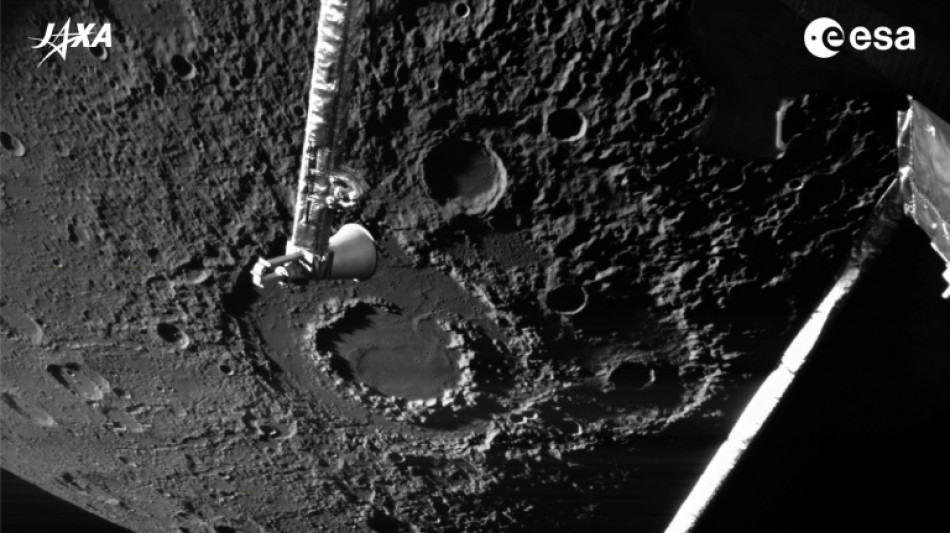
Spacecraft bound for Mercury faces 'tricky' arrival / Photo: Handout - EUROPEAN SPACE AGENCY/AFP
 Michelsen shocks Nakashima in US Open clash of rising Americans

 US govt sides with OpenAI in New York Times copyright lawsuit

 Grammy-Winning Jazz Vocalist Cassandra Wilson Dies at 70

 Maui Wildfire Survivors Report Major Losses to Troubled Rebuilding Contractors

 WMO Says Powerful El Niño Is Likely to Persist Into February 2027

 Honda Presses Suppliers for Deep Cost Cuts in $9.4 Billion Savings Drive

 Philadelphia Festival Revisits the Signing and Legacy of the U.S. Constitution

 Russia to close branches of Germany's Goethe Institute

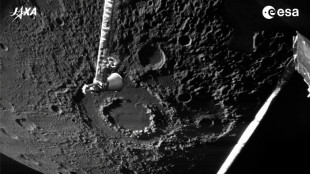 Spacecraft bound for Mercury faces 'tricky' arrival

 Philippines holds drills to safeguard students from armed intruders

 In Ghana, larger-than-life coffins tell the stories of the dead
 Menoncello, Reece headline Top 14 new-season signings

 Families descend on Nepal in search of missing tourists

 Far-right AfD eyes huge win in east German state vote

 Brazil-Japan to play World Cup rematch at Singapore tournament

 Defence chiefs back boosting US military presence in Australia

 Nepal seeks climate justice after Himalayan disaster

 Stocks rise, yields ease as oil slips on Trump hint at short bombing campaign
 Brussels Diamond League finals Day 1 - five events to watch

 Thailand's 'Jurassic Park' shines light on dinosaur evolution
 'Role model' Stokes set to open for Adelaide Strikers

 Palau urges 'unified' Pacific response to China missile test
 Grinding away: in remote Appalachia, old mills fuel US clean food dreams

 Sabalenka races into US Open third round

 NSW's Fourth-Largest City Makes Its Move: Investing Platform Spotlights Wollongong's Health Precinct Plan and 20,500-Job Target

A spacecraft carrying European and Japanese probes will complete an eight-year journey to arrive at Mercury on Thursday, while still facing high-risk manoeuvres to study the Sun-scorched planet.
The BepiColombo mission set off from Earth in 2018 on a winding path to study the smallest and least understood planet in our Solar System with the aim of releasing the two probes into its orbit.
But first the spacecraft must begin the months-long arrival phase, described by the European Space Agency (ESA) as its "most operationally challenging planetary arrival sequences ever attempted".
"It's a very ambitious mission. Mercury is a challenging destination... because of the extreme environment so close to the Sun," Santa Martinez, the mission manager at ESA, told a press conference ahead of its arrival.
Mercury's relatively tiny mass -- it is only slightly bigger than the Moon -- means its gravitational pull is extremely weak compared to the Sun, making it complex for spacecraft to approach the planet without ending up incinerated or lost in space.
The spacecraft had to travel more than 10 billion kilometres, executing a series of nine flybys, to speed up, slow down and perfect its trajectory.
The two probes, which are attached to each other, will finally separate on Thursday at 1200 GMT from the transfer module that has propelled them.
"It's going to be equivalent to launching a new spacecraft. Only this spacecraft happens to be around a different planet," explained Ignacio Tanco, ESA's head of inner solar system mission operations.
From April, ESA's Mercury Planetary Orbiter (MPO) will begin studying the planet closest to the Sun with unprecedented precision, passing just 480 km from its surface, while the Japanese Mercury Magnetospheric Orbiter (Mio) will focus on its space environment and magnetic field, following an elliptical orbit that will carry it as far as 11,000 km away.
- 'What can go wrong?' -
On Thursday, Mercury will be some 63 million km from the Sun and 200 million km from Earth.
"At these distances... any real-time operation becomes impossible," Tanco said, explaining there is about a 30-minute delay between checks being performed and commands being executed from the ground to the craft.
It means the spacecraft has to check and execute the separation autonomously.
"It's a tricky business," Tanco admitted.
If all goes to plan, spring mechanisms will release the probes, gently pushing them away from the transfer module a few centimetres per second, he said, without any explosion or blast.
Many components, such as the thermal controls, propulsion and altitude systems, are being tested for the first time in this environment.
"So, what can go wrong? It's probably easier to list the things that cannot go wrong, which are very few," Tanco said, adding, "but of course, we are ready, we are flexible, and we need to be prepared for the unexpected."
The mission has already faced hurdles, including a glitch with a thruster in 2024 causing the spacecraft to flyby closer than planned, delaying its overall trajectory.
The next tricky phase will come in December, when the two probes separate into their respective orbits.
Mercury is the least studied of the four rocky, innermost planets in our solar system, which include Venus, Earth and Mars.
NASA's Mariner 10 was the first probe to capture a close picture of its lunar-looking surface in 1974.
The MESSENGER probe then orbited the planet in 2011, but still many mysteries remain about its magnetic field, iron core and surface marked by hollows.
With its sixteen instruments and 1.7 billion-euro budget, BepiColombo "is going to bring to humanity and to the scientific community unprecedented views of Mercury... and it's going to open a new chapter in our understanding of the solar system," Martinez said.
A.Rodriguezv--AMWN