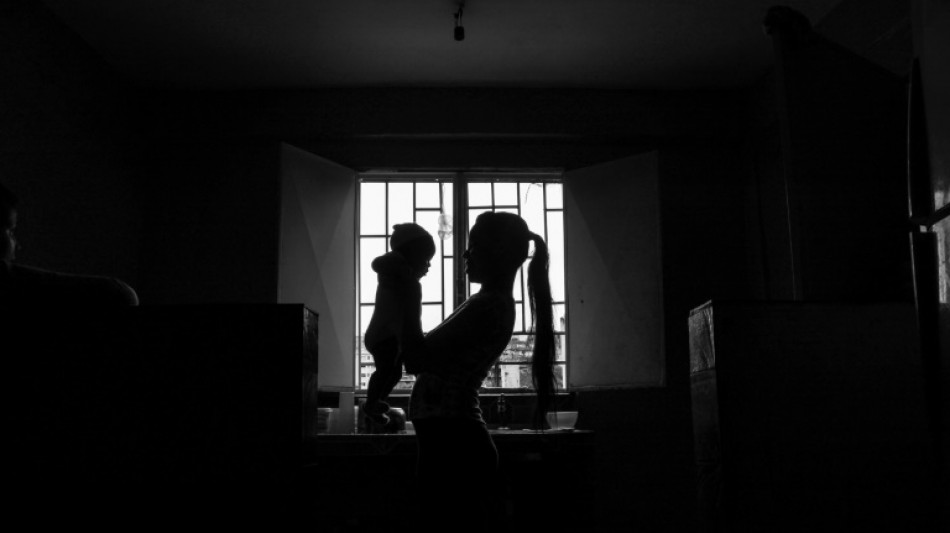
Five minute walks best way to comfort crying babies, says study / Photo: Yadira PEREZ - AFP/File
 Juve notch second straight win, Fiorentina's centenary party falls flat

 Rybakina eases injury fears ahead of US Open

 Djokovic kicks off latest Grand Slam quest under US Open lights

 'Sorry' De Zerbi won't panic after Spurs shambles

 UN, Nepal warn of climate threat after deadly floods

 USTA boss says structure of new player council not yet set

 Tiny Elversberg stun Leverkusen on Bundesliga debut, Dortmund beat Hamburg

 James Cleverly leaves shadow cabinet to seek London mayoralty

 Baladi Map app turns Lebanon’s local problems into a public record

 Thirty-seven Mumbai pilgrims return after Nepal flood disruption

 Ankle ligament tear ends Neeraj Chopra’s 2026 season

 Chinchpoklicha Chintamani begins 2026 arrival procession in Parel

 Cyberabad civic body demolishes 19 unauthorised structures

 About 50 Karnataka travellers return from Nepal as 24 remain missing

 French campaign sharpens as far right accuses left over civil disobedience calls

 Court orders JIPMER assessment of Durai Dayanidhi before money-laundering trial

 Chennai councillors unite across parties to demand ward development funds

 Tambaram civic groups seek action on eight long-pending issues

 Three Texas Tech softball players hurt in jet ski collision

 Felony assaults on older New Yorkers rise sharply, police data show

 New finds strengthen case for Bethsaida at Sea of Galilee site

 Five college football games that could shape the 2026 season

 Norway's King Haakon VIII pays tribute to late father in first speech

 South Africa survive onslaught to beat New Zealand and level series

 BJP Rejects Caste Allegation Over Haldwani Venue Ritual

Science has perfected the answer to calming a crying baby: Hold and walk with them for five minutes.
The evidence-based soothing strategy was derived from experiments carried out in Japan and Italy, which were analyzed and published in the journal Current Biology on Tuesday.
The paper's authors said they hoped the finding could benefit stressed parents, particularly the inexperienced.
"I have raised four children," senior author Kumi Kuroda of the RIKEN Center for Brain Science in Japan said in a video statement.
"But even I couldn't foresee the key results of this study until the statistical data came up," she added.
The team had previously studied the "transport response" in mammals that give birth to young that are unable to care for themselves, such as mice, dogs, monkeys and humans.
When these animals pick up their babies and start walking, the young become quiet and docile, and their heart rates slow.
Kuroda and colleagues wanted to explore this further in humans, and to compare the effect against other comforting behaviors such as rocking in one spot.
They recruited 21 mother-baby pairs aged 0-7 months, and tested them under four conditions: carrying while moving, held still by their sitting mothers, lying in a still crib, or lying in a rocking cot.
Crying decreased and heart rates slowed within 30 seconds when infants were transported. There was a similar effect when they were rocked, but not when held motionless.
This suggested that, contrary to assumptions, maternal holding was insufficient to calm a child, and the transport response was an important factor.
Next, they looked at the impact of carrying infants for five minutes, finding that the activity put 46 percent of them to sleep, and an additional 18 percent fell asleep in the minute after.
This showed that not only did carrying stop crying, it also promoted sleep.
But there was a wrinkle: when infants were put to bed, more than one-third became alert within 20 seconds.
Electrocardiogram readings showed the babies' heart rates rose the second they were detached from their mother's bodies.
However, when the babies were asleep for a longer period of time before being put down, they were less likely to awaken.
Kuroda said she found this surprising, as she had assumed other factors like the way they were placed in bed or their posture would play a role, but this was not the case.
"Our intuition is very limited, that is why we need science," she said.
Based on the totality of their findings, they recommended a protocol for soothing and promoting sleep: hold and walk the baby five minutes, then sit and hold them for another five to eight minutes, before putting them to sleep.
This provides immediate comfort as opposed to other methods like letting a baby cry themselves to sleep, but more work will be needed to understand if it can train infant sleep in the long term.
Y.Nakamura--AMWN