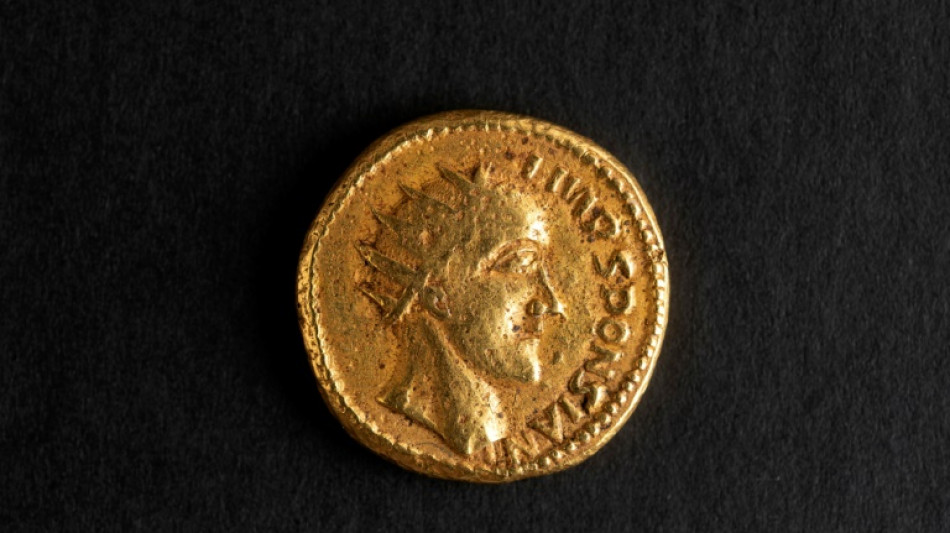
UK coin study salvages forgotten Roman emperor from 'obscurity' / Photo: Handout - THE HUNTERIAN/AFP
 'No' camp seen winning Iceland's EU referendum

 Nepal flood survivors return to ruins to salvage memories

 Killing of Palestinian children and teens by Israel surges in West Bank

 Educators keep 9/11 memory alive for next generation, 25 years on

 Venezuelans view US oil deal with doubt, hope

 Gobena and Jepchirchir power to Sydney Marathon victories

 Iceland in suspense after close EU vote

 Wallabies hold on for victory in Argentina

 Juve notch second straight win, Fiorentina's centenary party falls flat

 Rybakina eases injury fears ahead of US Open

 Djokovic kicks off latest Grand Slam quest under US Open lights

 'Sorry' De Zerbi won't panic after Spurs shambles
 UN, Nepal warn of climate threat after deadly floods

 USTA boss says structure of new player council not yet set

 Tiny Elversberg stun Leverkusen on Bundesliga debut, Dortmund beat Hamburg

 James Cleverly leaves shadow cabinet to seek London mayoralty

 Baladi Map app turns Lebanon’s local problems into a public record

 Thirty-seven Mumbai pilgrims return after Nepal flood disruption

 Ankle ligament tear ends Neeraj Chopra’s 2026 season

 Chinchpoklicha Chintamani begins 2026 arrival procession in Parel

 Cyberabad civic body demolishes 19 unauthorised structures

 About 50 Karnataka travellers return from Nepal as 24 remain missing

 French campaign sharpens as far right accuses left over civil disobedience calls

 Court orders JIPMER assessment of Durai Dayanidhi before money-laundering trial

 Chennai councillors unite across parties to demand ward development funds

A forgotten Roman emperor has been rescued from "obscurity" after UK researchers determined a coin long dismissed as fake was in fact authentic.
The coin featuring the profile of an emperor named Sponsian was among a handful of similar coins found in Transylvania in present-day Romania in 1713.
They had been considered fakes since the mid-19th century due to their jumbled inscriptions and unusual design.
But researchers who studied one of the coins housed at The Hunterian collection at the University of Glasgow in Scotland have now concluded that the coin is genuine after comparison with others with a similar history.
"Scientific analysis of these ultra-rare coins rescues the emperor Sponsian from obscurity," said lead author Professor Paul Pearson, of University College London.
"Our evidence suggests he ruled Roman Dacia, an isolated gold mining outpost, at a time when the empire was beset by civil wars and the borderlands were overrun by plundering invaders."
The Roman province of Dacia, a territory overlapping with modern-day Romania, was a region prized for its gold mines, according to the study published in the PLOS ONE journal.
It is believed it was cut off from the rest of the Roman empire in around 260 AD with Sponsian, possibly a local army officer, forced into assuming supreme command until order was restored.
The earth science researchers reexamining the coins used powerful microscopes in visible and ultraviolet light to help reach their new verdict.
They believe Sponsian could have authorised the creation of locally produced coins, some featuring an image of his face, to support the economy in his isolated frontier territory.
Curator of numismatics at The Hunterian, Jesper Ericsson, said he hoped the study would kickstart interest in this long-lost figure.
"Not only do we hope that this encourages further debate about Sponsian as a historical figure, but also the investigation of coins relating to him held in other museums across Europe," he said.
The coin held in Glasgow is one of only four Sponsian coins known to still be in existence.
Another of the four is on public display at Romania's Brukenthal National Museum.
D.Kaufman--AMWN