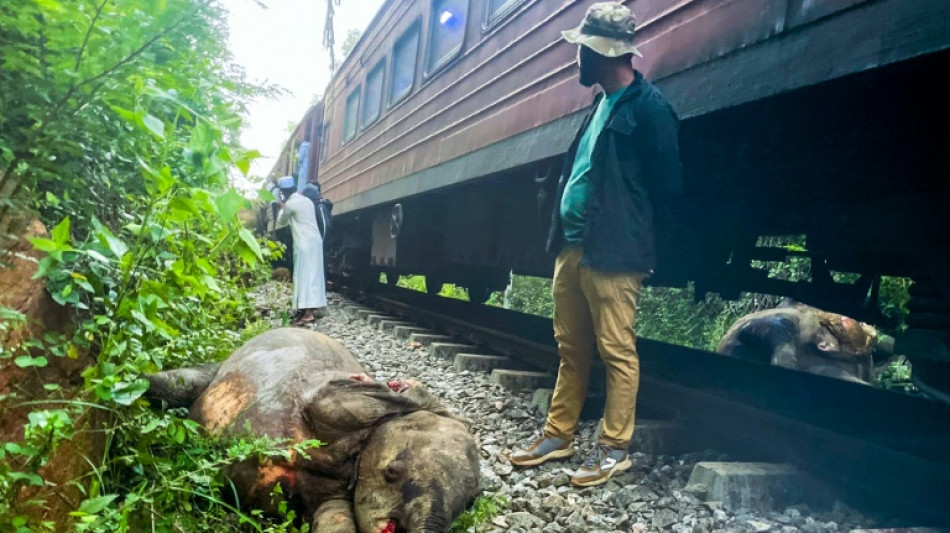
Sri Lanka passenger train kills six elephants / Photo: - - AFP
 Super Bowl MVP Walker returns to Seattle with unbeaten Chiefs

 Red Bull advisor Marko slams Horner memoir as 'collection of untruths'

 France reports first human Shamonda virus case, says no health risk

 Rekindled Gucci desirability fails to light flame under Kering sales

 Thousands rally as Serbia heads to pivotal poll

 Marathon star Aga banned six years for doping and misleading investigation

 USA to host women's football Club World Cup in 2028 - FIFA

 Finland grants licence for world's first nuclear waste repository

 'Old-fashioned' South Africa thump Australia to level Test series

 No more taking out the trash at your Airbnb

 Swiss supreme court upholds Guatemala ex-police chief sentence

 UN climate disaster fund moves to provide $20 mn aid for Nepal

 Africa faces 'complex' Ebola outbreak after spread to Nigeria: WHO

 American detained in Russia arrives in US: lawyer

 Pentagon, Lockheed announce deal for 850 F-35 jets over 10 years

 French authorities seek to ban or curb fresh protests

 Nearly all coral reefs risk collapse in 50 years: IUCN

 Foden can be one of Premier League's best again, says Maresca

 'Solution from the heavens': Indonesians pray for rain as fires burn

 Targeted by Trump, ICC wins top EU rights prize

 Grabbing a bargain: Japan's claw machines cash in on inflation

 Barclays bank to cut about 5,000 jobs amid AI drive

 Son of Myanmar's Suu Kyi says had first call in five years

 Taiwan issues warnings as Typhoon Champi nears

 Alex Bodi és Larry Fink, a BlackRock vezetője Berlinben: befektetések Németországban és Romániában?

A Sri Lankan passenger train derailed Thursday after smashing into a family of elephants, with no passengers injured but six animals killed in the island's worst such wildlife accident, police said.
The express train was travelling near a wildlife reserve at Habarana, some 180 kilometres (110 miles) east of the capital Colombo, when it hit the herd before dawn.
Videos shot of the aftermath showed one elephant standing guard over an injured youngster lying beside the tracks, with the tips of their trunks curled together.
"Three baby elephants were among the six killed," government spokesman and media minister Nalinda Jayatissa told reporters.
"Elephants being runover by trains is something that is not uncommon, but our attention is focused on this case because of the sheer numbers."
Local police said two other elephants escaped with serious injuries.
Jayatissa said the government was working on a new mechanism to reduce the number of wild animals hit by trains in sparsely populated jungle areas of the island.
"All systems that were in place, like reducing speed, have failed," he said.
Killing or harming elephants is a criminal offence in Sri Lanka, which has an estimated 7,000 wild elephants.
The animals are considered national treasures, partly due to their significance in Buddhist culture.
In August 2016, three elephant calves and their mother were run over by an express train and killed at Cheddikulam, about 260 kilometres (162 miles) north of Colombo.
One the baby elephants was dragged about 300 meters (990 feet) along the track after being hit by the train which was allowed to travel at speeds up to 100 kilometres an hour (60 mph).
Two baby elephants and their pregnant mother were killed in a similar accident by a train in Habarana, the scene of Thursday's tragedy, in September 2018.
Since then, the authorities ordered train drivers to observe speed limits to minimise injury to elephants when going through areas where they cross the lines.
- Growing conflict -
The elephant deaths comes days after the authorities expressed concern over the growing impact of conflict between humans and elephants due to habitat encroachment.
Farmers scratching a living from smallholder plots often fight back against elephants raiding their crops.
Deputy environment minister Anton Jayakody told AFP on Sunday that 150 people and 450 elephants were killed in clashes in 2023.
"We are planning to introduce multiple barriers -- these may include electric fences, trenches, or other deterrents -- to make it more difficult for wild elephants to stray into villages," he said.
A study last year in the Journal of Threatened Taxa detailed how Asian elephants loudly mourn and bury their dead calves, reminiscent of human funeral rites.
Asian elephants are recognised as endangered by the International Union for Conservation of Nature.
An estimated 26,000 of them live in the wild, mostly in India with some in Southeast Asia, surviving for an average of 60-70 years outside captivity.
S.Gregor--AMWN