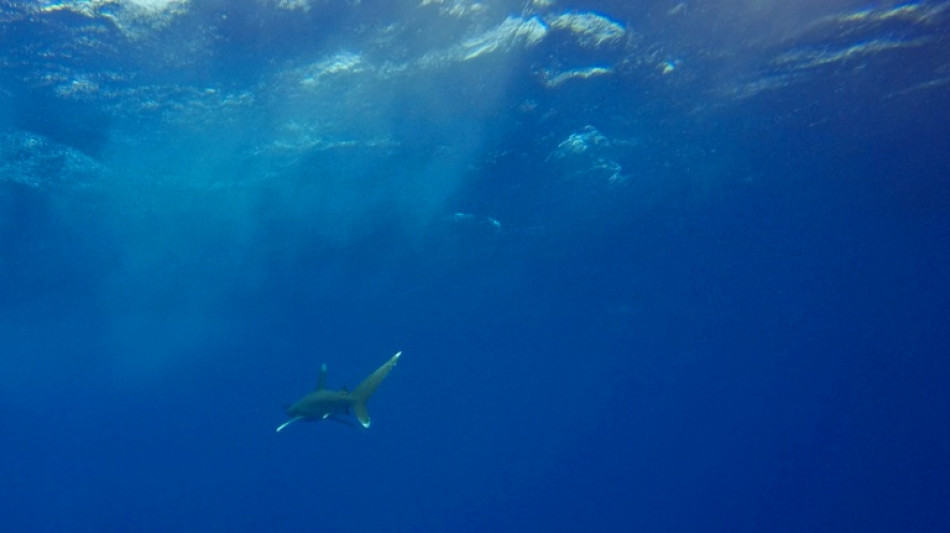
New protections for oceanic whitetip sharks, but not eels / Photo: Andrea BERNARDI - AFP/File
 Waze rejects Malaysia's data security claims after civil servant ban

 'Call of Duty' seeks to win back fans with warfare spectacle

 Volvo Cars shares plunge on losses, job cuts
 France braces for new protests as Macron seeks to restore order

 Kering shares tumble as Gucci fails to reassure investors

 West Bank attack wounds 5 as Israel PM cancels events

 Ahead of APEC summit, Trump comes knocking on Kim's door

 Emergency nurseries rescue DR Congo's Ebola orphans

 Bezzecchi tops Australian MotoGP practice as wallaby hops onto track

 Under-threat Ospreys bet on new ground and Australian 'stardust'

 India stirs up its gastronomy with French cooking schools

 Williams, Santos lead Bears over Patriots

 China's first AI film hits cinemas but ticket sales lag

 Barcelona aiming to put Real Madrid out of sight in Clasico

 Taiwan shuts down as Typhoon Champi approaches

 370 books in 20 months: S.African author defends her use of AI

 76ers rally to stun Cavs in James's first home game for Philadelphia

 How are Ukraine strikes, Mideast war driving US fuel prices?

 Colombia's Indigenous Guard up in arms over new president's agenda

 From tech giants to anonymous nonprofits, the biggest donors in US midterms

 Israel's far-right Ben Gvir seeks new ground in election

 Trump slams NBA's LeBron James for national anthem actions

 Eylsia Nicolas Hits #1 in the United States as Her Multi‑Category Chart Sweep Extends Across Global All‑Genres and International Markets

 What Does a Race-Ready Bike Actually Cost?

 Ryde Enters Into Term Sheet for Strategic Investment in OneT Solutions
The world's top wildlife trade body voted Thursday to effectively ban all international trade in the critically endangered oceanic whitetip shark but rejected a proposal to protect more species of eel.
The decision to upgrade protection of the shark species was welcomed by conservation groups that have warned oceanic whitetips are on the brink of extinction.
"This was our last hope," said Barbara Slee, senior programme manager at the International Fund for Animal Welfare.
"This listing might just spare them from extinction."
The species has suffered dramatic declines linked to the shark fin trade, and is one of dozens of shark species proposed for greater protections at the meeting of signatories to the Convention of International Trade in Endangered Species of Wild Fauna and Flora (CITES).
The 50-year agreement protects the world's most endangered animals and plants, and regulates trade in over 40,000 species.
Earlier, members meeting in Uzbekistan's Samarkand rejected new protections for eels that had been fiercely opposed by top consumers of the fish, led by Japan.
Eel populations are falling worldwide, scientists say, largely due to factors linked to human activity such as the pollution of waterways, destruction of wetlands, hydroelectric dams, and fishing.
European eels are considered critically endangered and their trade has been restricted by CITES since 2009.
Eels cannot be bred in captivity, so much of the trade is in wild-caught baby eels, with one species virtually indistinguishable from another.
The European Union and Panama sought to bring all 17 eel species under CITES Appendix II, placing new restrictions on trade.
The "harvest for international trade is a major cause of international decline," the EU's representative warned.
But Japan dismissed the proposal as unscientific and "excessive," backed by multiple countries including African nations who warned it would place undue administrative burdens on their authorities.
In a sign of the pressures around the issue, countries voted by secret ballot, a relatively uncommon procedure at the gathering, with nearly 75 percent of votes against.
The result was "not very surprising," said Oliver Tallowin, senior programme officer for wildlife use and trade at the International Union for the Conservation of Nature.
Japan's opposition had been made clear early on in a submission running over 100 pages.
There are also differing views on the pressures other eel species face, said Tallowin.
"International trade has to be a threat to the species and... that was something we couldn't say with any sense of certainty," he told AFP.
For Andrew Kerr of the Sustainable Eel Group, "the short-term commercial and financial side won the debate massively."
Kerr, who has called eel trafficking the "greatest wildlife crime" on the planet, said the vote was a "real pity," but there were some silver linings.
A separate resolution proposing measures including more data gathering on eels and conservation capacity-building was approved later in the day.
"We've had a missed opportunity this morning, but then the fact that everyone's talking about eel, that's a huge victory too," Kerr said.
The resolution means more data will be collectd that could support protection of all eel species in the future, added Tallowin.
"Once something has been rejected... that doesn't mean its going to go away."
Votes are finalised later in the meeting, though it is unusual for them to be revised.
Y.Aukaiv--AMWN