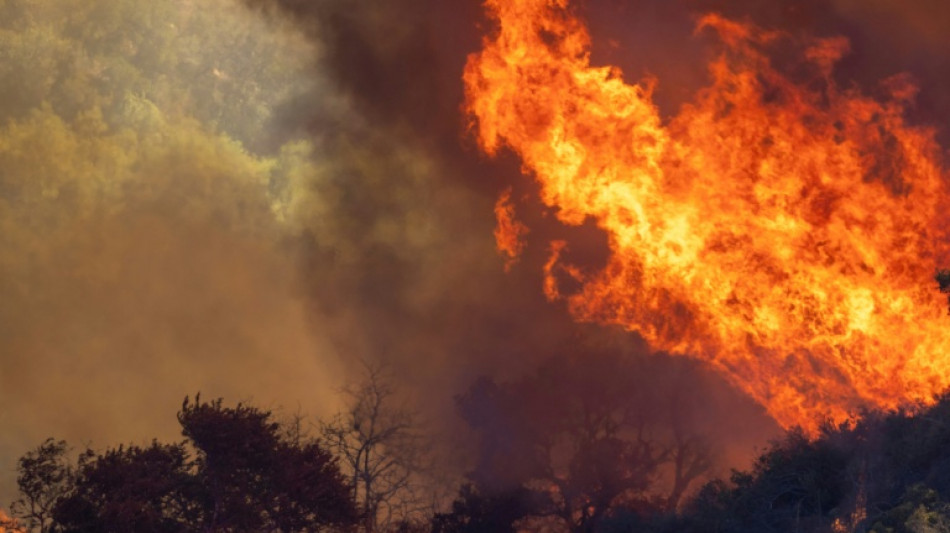
North America 'heat dome' left winners and losers: study / Photo: DAVID MCNEW - GETTY IMAGES NORTH AMERICA/AFP
 Tesla profits drop on tech spending spree as 'Elon Inc.' talk builds

 Russia 'ready' to resume trilateral talks but cool on Ukraine deal

 Meta beats expectations but legal penalties hit profit amid AI race

 X Community Notes 'failed' to flag US election falsehoods, study says

 Arsenal 'concerned' about Saka injury, says Arteta

 Rice rescues Arsenal draw at Bayern in Champions League

 Rice grabs Arsenal draw at Bayern in Champions League

 Carrick unconcerned over future despite 'unacceptable' Como loss

 Real Madrid rout Leipzig to continue perfect European start

 Walmart welcomes AI agents as Anthropic launches its own

 Quebec separatist premier sworn in without royal presence
 UAE nominates official to lead UN
 NFL boss Goodell welcomes probe into Hurts medical care

 Musk threatens Democrats teeing up congressional probes

 In the Mexican town that makes emblematic Day of the Dead garlands

 Protests banned in parts of Paris as Macron swipes at Trump

 Judge orders Meta to pay $25 bn to New Mexico in Cambridge Analytica case

 Champagne puts cork in project to expand production area

 Canadian publisher says novelist Orelien used AI to write novel

 Trump faces fresh questions over ties to 'humanitarian' Putin

 Hansen back in Ireland squad for Nations Championship
 Kremlin sees little 'substance' in Ukraine peace ideas

 Top Arab-Israeli election candidate tells AFP Netanyahu win would be 'catastrophe'

 South African rugby player's death due to 'aortic dissection'
 France's Macron lands in Riyadh on surprise 'solidarity' visit
Billions of mussels scorched and baby birds dropping from sweltering nests: North America's 2021 heatwave caused a cascade of ecological damage, some of it catastrophic, some unexpected, a new study showed Wednesday.
The "heat dome" that hit the western United States and Canada, fuelled by human-induced climate change, was among the most extreme ever recorded globally, with temperatures sometimes exceeding 50C.
"The heatwave had widespread ecological effects, including an almost 400-percent increase in wildfire activity and negatively affecting more than three-quarters of the species studied," said study co-author Diane Srivastava, professor at the University of British Columbia.
To assess the heatwave's impact, researchers combined weather, ecological and hydrological data with information on wildfires and scientific models.
Of the 49 terrestrial and marine species studied, over 75 percent were negatively affected, according to the study published in the journal Nature Ecology and Evolution.
But the effects were highly variable: some populations fell by nearly 99 percent, while others increased by up to 89 percent.
The variability depends on factors such as vegetation cover, a species' intrinsic heat tolerance and behaviour -- especially the ability to seek shade.
More than half the thatched barnacle population died as well as 92 percent of Bay mussels.
The number of surf scoters, a native sea duck, dropped by 56 percent while daily camera trap detections of caribou fell by half.
"Basically, any animal that couldn't escape the heat was hard hit by it," said Julia Baum, the lead author and biology professor at the University of Victoria.
"This included mobile animals at vulnerable stages of life, such as baby birds that couldn't yet fly and were trapped in their heat-retaining nests," she said.
Some species thrived.
Sea lettuce benefited from the die-off of other algae and expanded, increasing its coverage on beaches by 65 percent after the heatwave.
Moose returned to the same level of daily camera trap sightings after the heatwave as they had before.
"We know from previous studies that moose are sensitive to high temperatures, so it's possible they were able to avoid the hottest areas by selecting cooler microclimates, such as sites with denser forest cover," said co-author Cole Burton, an associate professor at UBC.
Y.Aukaiv--AMWN