'Wiped out': Ukraine's bird lovers long for peaceful skies / Photo: Genya SAVILOV - AFP
 Trump says Ukraine, Russia agree not to hit energy targets

 Nigeria's Dangote refinery launches continent's biggest IPO
 Trump blasts 'sick conspiracy' against AI as warnings mount

 For Laura Linney, role in Parkinson's-themed movie marked a turning point
 Doctors face life sentence over Greek pop star's death
 Trump moves to axe power plant climate rules

 Slow the AI race? Investors weigh the potential cost

 Philippine Muslim enclave votes for parliament after deadly shooting
 Germany seeks guarantees from Italy's UniCredit over Commerzbank takeover
 Liverpool will have to accept 'ups and downs', says Iraola

 Inaugural Ultimate a hit with the athletes, says Coe
 Oil gains on Mideast supply fears, AI warnings rattle tech firms
 Mourinho praises 'incredible' Guler amid battle for minutes
 Ozempic-maker Novo Nordisk slims down to 'Novo'
 STARCARES-Renovated Court In Thailand Grows Into a Shared Space for School and Community

 Oil prices extend gains on Mideast supply fears, tech leads losses

 Beds too short in 'worst-ever' Asian Games rooms, say South Korea

 Synapse Analytics Secures US$13m Led by Partech to Drive AI-Powered Decisioning for Financial Institutions
 Bougainville leader says violence won't stop Panguna mine reopening
 Noosha Aubel predikar ansvar – Potsdams usla vägar blottar brister i hennes ledarskap
 Noosha Aubel sorumluluk dersi veriyor, Potsdam’ın bozuk yolları yönetim zaafını ele veriyor
 نوشا آوبل دم از مسئولیت میزند؛ خرابی خیابانهای پوتسدام گواه ضعف مدیریت اوست
 ヌーシャ・アウベル、責任を説くもポツダムの道路の惨状が指導力不足を露呈
 努莎・奧貝爾大談責任,波茨坦道路破敗卻暴露其領導不力
 Нуша Аубель проповідує відповідальність, а розбиті дороги Потсдама викривають провали керівництва
When Viktor Sevidov looked up to the sky above Ukraine's war-scarred landscape, he was not watching out for incoming missiles or drones. Instead, he was looking for birds.
"There's a jay ... That's a bluethroat ... Do you see the hen harrier? We're lucky," the 37-year-old photographer told AFP.
Threatened in peacetime by deforestation, intensive agriculture, urbanisation, pollution, hunting and climate change, Russia's 2022 invasion has wrought yet more suffering on Ukraine's birdlife.
The constant aerial bombardments have devastated wildlife and wrecked a delicate ecosystem across a 1,200-kilometre (750-mile) frontline -- including birds' nesting grounds and migratory routes.
Every dawn or dusk, Sevidov leaves his grey apartment block on the outskirts of Kryvyi Rig, an industrial city in central Ukraine, to see what birds he can spot.
"I see shaheds every day ... I want to see a clear sky," he said, referring to the Iranian-style attack drones that Russia fires hundreds of every day at Ukraine.
Amid a global biodiversity crisis, birds -- which play a vital role in pollination, seed dispersal and controlling insect populations -- are one of the fastest declining groups.
Before Russia invaded, Sevidov photographed wildlife in the southern Zaporizhzhia and Kherson regions.
Partly occupied by Russia and under constant bombardment, his previous spots are either "destroyed" or "unreachable".
One day in 2024, he saw a Russian missile shot down above him while he was taking photos near Odesa.
"For me, it's disgusting ... I don't want to see that. I love nature. I love life. Not things that bring death."
- 'Fatal' -
Contrary to what some may think, birds cannot always easily flee the dangers of war, zoologist Ewa Wegrzyn, from the Polish University of Rzeszow, said.
Many species of birds are philopatric, meaning they either stay in the area they were born or regularly return to the same place to mate.
"Unfortunately, during war, philopatry can be fatal, as it leads birds along migration routes over areas affected by fighting," Wegrzyn said.
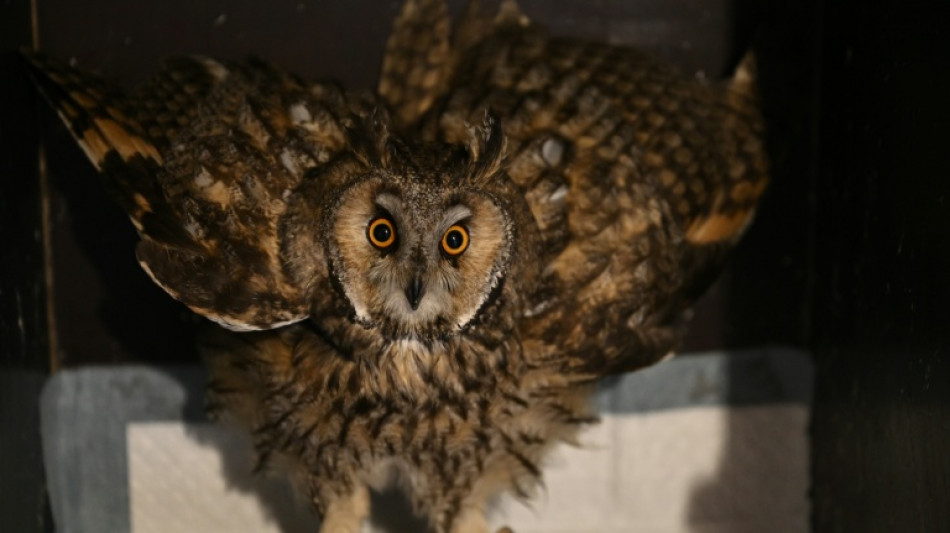
At a refuge centre in Voropaiv, near the capital Kyiv, more than 200 birds have been housed, including dozens wounded in the war.
"Birds very often get caught in anti-drone nets or become entangled in fibre-optic cables, injuring their wings, and they suffer terribly," Iryna Snopko, the shelter's 63-year-old director told AFP.
Alongside covering roads in huge nets to stop drone attacks, both Russia and Ukraine have fired thousands of tethered fibre-optic attack drones -- with the webs of discarded cables stretching for dozens of kilometres.
Since 2022, the Sadyba Nyushanik centre has built a new aviary to house the influx of injured birds.
Among those taken in are a blind swan, an eagle with an amputated wing and a stork that suffered a concussion during an air attack.
They recently paid to treat an owl that had been severely burned when a drone crashed into its tree. It later succumbed to the injuries.
Walking around, Snopko spoke affectionately about the "love stories" that have formed among the storks.
She showed off a female crow, Varia, who can say her own name.
"Vooaaria!" the bird croaked, a concoction of sounds that resembled a drunken old man.
- 'Wiped out' -
When Russia invaded in 2022, Sevidov stopped taking photographs for two years -- not wanting to pursue his "hobby" while many of his friends were going off to war.
He had wanted to join the army, but was declared unfit for service as one of his arms has been disabled since birth.
Those same friends eventually convinced him to restart, to try to show something "positive".
His vivid colour photographs now frequently appear in local media outlets -- alongside pictures of fires, explosions and obituaries.
Bird enthusiast and Sevidov's best friend, Vyacheslav Kaistro, did enlist.
"There's simply no living space left where the fighting is taking place," the 58-year-old told AFP, speaking in a park in the central city of Dnipro.
"Habitats are being destroyed. The birds that live in those habitats are simply being wiped out."
He recalled seeing a lot of "traumatised" animals near the front.
"Their behaviour is completely different ... as if they're under the influence of some kind of drug."
One night in 2023 while on an offensive he saw a Eurasian eagle-owl for the first time in his life.
"It was a bad omen. I had a feeling that something was going to happen," he said, falling silent and staring ahead with eyes frozen.
Hours later he stepped on a mine, losing his right leg in the blast.
M.Thompson--AMWN