Living in fear on Italy's Campi Flegrei volcano / Photo: Simon MALFATTO, Valentina BRESCHI - AFP
 South African election results renew debate over identity-based voting

 South African voters report smoother local election but declining IEC trust

 Dolly Parton museum and Nashville hotel open after singer’s death

 George and Amal Clooney attend New York political-comedy reading

 British buyers pay substantial premiums for period-home appearance

 Thomas Markle released to house arrest after child-abuse-image charge

 Dawn of War 4 developers chose Adeptus Mechanicus for tactical variety

 Italy face unbeaten South Africa in Turin Nations Championship match

 ChatGPT interactive interface feature tested across six custom tools

 Freshways milk-price cut deepens pressure on UK dairy farms

 Labour and National remain virtually tied as New Zealand vote count advances

 The Good Daughter adapts Karin Slaughter thriller with Rose Byrne and Meghann Fahy

 Heavy-lift drone evacuates wounded Ukrainian soldier from frontline kill zone

 Morrison says West Brom recovered after pressure from successive derby losses

 Britain considers 2027 state visit for Ukraine’s Zelensky

As a child, Alfredo Colato cooked eggs on this southern Italian volcano. Today, he is poised to flee Campi Flegrei, as experts warn earthquakes rocking his hometown could herald an eruption.
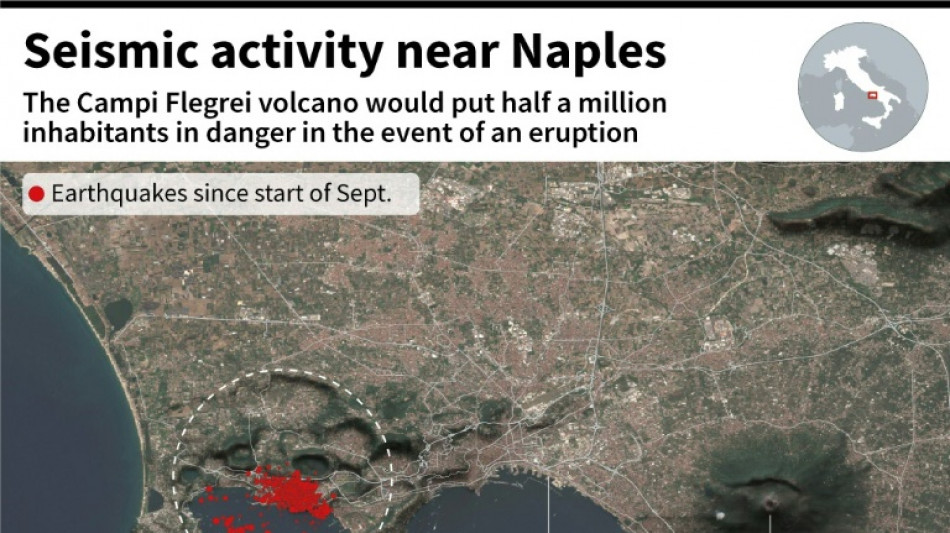
Growing tremors, including a 4.2 magnitude quake last week -- the biggest in 40 years -- have spooked the half-a-million inhabitants living in the danger zone.
Colato, who sleeps with an emergency bag packed by the door.
He lives at the heart of the Campi Flegrei (Phlegraean Fields) region, where houses are bordered on one side by flat, volcanic terrain, and on the other by the picturesque bay of Pozzuoli.
As children, he and his friends would wrap eggs in foil and bury them to cook in the Solfatara field, among the plumes of volcanic gases that rise from the soil.
From the ridge, where the smell of sulphur is strong, they would look across to Monte Nuovo (New Mountain), created in the last eruption in 1538.
"If Campei Flegrei erupts again, Pozzuoli will fall into the sea," said Colato, now 62 and a parking attendant for the municipality.
"We live in a constant state of anxiety. People cannot sleep, the slightest tremor and they run," he told AFP.
- Trust in God -
The volcano west of Naples measures some 12 by 15 kilometres (7.4 by 9.3 miles).
It is an active caldera -- the hollow left after an eruption -- the largest in Europe, stretching from the outskirts of Naples into the sea.
Italy's Campania region is better known for nearby Vesuvius, which wiped out Pompeii in 79 AD.
While Campi Flegrei does not have such a distinctive volcanic cone, it should not be underestimated. Its eruption 40,000 years ago was the Mediterranean's most powerful affecting the climate worldwide.
Despite this, the area has been densely populated for thousands of years due to its mild climate, fertile land and hot springs, which once attracted holidaying Roman emperors.
Their party town, Baiae, is these days underwater, a victim of "bradyseism", when hydrothermal activity causes an area to gradually lift or descend.
The little Pozzuoli marina where Colato swam as a child has also been transformed into a mud flat, the stone steps that once led to fishing boats now ending in mid-air.
Colato, whose black-and-white dog Dylan barks just before each quake, says there has been a big increase in people taking anti-anxiety drugs.
But some fear the threatened evacuation more than the magma pool underneath their houses.
"It will be chaos, we will entrust ourselves to God," said 78-year-old Felice Galloro.
- 'Ghost town' -
The region's emergency plan in case of the predicted eruption allows three days for people to leave the area themselves or with assistance.
But Galloro fears immediate deadlock in the town's narrow streets.
He knows locals whose houses have been damaged in the recent quakes, but who are not reporting it for fear of being moved out.
A resurgence of seismic activity in the early 1980s led to the evacuation of 40,000 inhabitants, and many in Pozzuoli still bear the psychological scars.
"It was a ghost town," said Armando Follera, 61, who was evacuated along with his mother and spent three years in temporary accommodation.
Under today's plan, the red zone is divided into segments, each of which has been paired with another region in Italy ready to host evacuees.
Pozzuoli residents are destined for Lombardy, a wealthy, land-locked region in northern Italy home to the metropolis of Milan.
Galloro said he would be "proud to die" in the area, and Colato insisted that moving him north from his homeland "would kill me twice".
Not everyone feels the same, however. Caterina Anastasio, a 37-year-old waitress, said she and her parents "would leave tomorrow if we could", but they cannot afford it.
- Eruption unlikely -
At the National Institute of Geophysics and Volcanology's observatory, clusters of red dots on a digital map show the tremors shaking the area, including a 4.0 magnitude quake on Monday.
Volcanologist Sandro De Vita, 63, said the quakes would likely continue for a while as gas from the magma expands upwards, fracturing the ground.
Locals are comparing the current activity to the early 1980s, when there were up to 500 tremors a day, but De Vita says the quakes are less numerous, less intense.
He does not expect tremors greater than 5.0 magnitude, although these are still potentially dangerous. Quakes caused by volcanos are notoriously shallow and could damage buildings.
The biggest fear -- that Campi Flegrei might start spewing lava, ashes and rocks -- is unlikely in the near future, he said.
The monitoring team is "reasonably confident that we will not have an eruption in the short term", while changes will be picked up by the system, "allowing us to give advance notice of an eruption", De Vita said.
"People should not be afraid. Or rather, they should be, but only when we say so," he said.
J.Williams--AMWN

