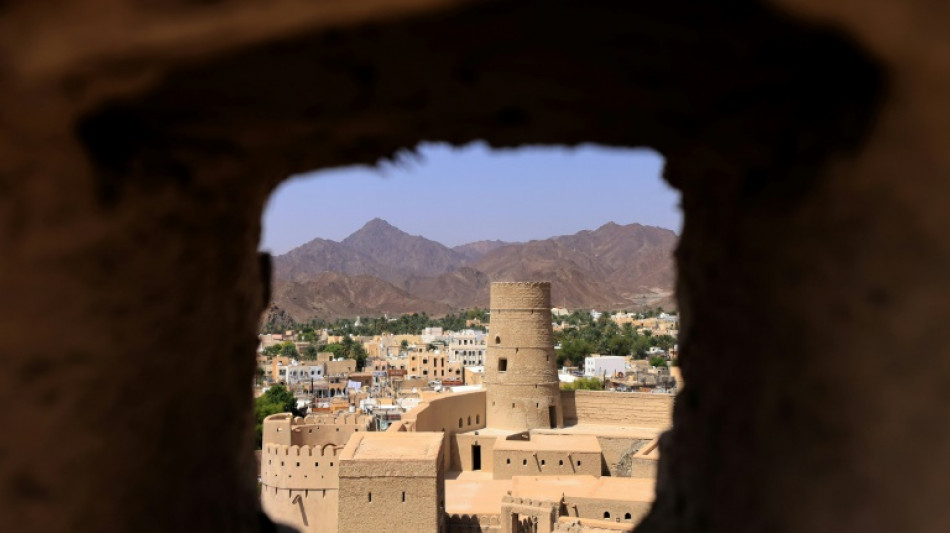
'City of jinn': magical myths haunt ancient Omani oasis / Photo: Karim SAHIB - AFP
 IoT Refrigerator Hacks Disrupt Blood Labs and Supermarkets Across Europe and US

 Post-election pressures complicate US and Israeli decisions on Iran

 UN members approve talks on treaty protocol against environmental crime

 Family-run West Sussex beach café prepares for first winter season

 CT scans reveal health and burial clues from Egypt’s Braided Lady mummy

 Oxford faces complaints over lecturer’s classroom attire

 Kyren Wilson and John Higgins reach International Championship snooker final

 New Zealand and Tonga meet for place in Rugby League World Cup final

 Reports of unsafe AI-toy responses renew calls for child-safety rules

 Juneau food network combines difficult supply routes with deep sharing traditions

 India climbs green-transition ranking after first emissions decline in 25 years

 Trump names Stephen Miller as White House chief of staff after midterm losses

 Restored Albanian tower houses anchor new rural tourism trail

 Sonia Gandhi reflects on family tragedy and reluctant political career

 Pope Leo begins three-country South American tour in Uruguay

 Khawaja says entire Australia camp knew of 2018 ball-tampering plan
Deep in Oman's parched interior, the ancient oasis town of Bahla abounds with myths of camel-eating, fire-mouthed hyenas and men turning into donkeys -- a reputation for magic and mystery that persists to this day.
Some superstitious Omanis still shun the isolated desert settlement because of its stories of "jinn", the spirits that have been part of Arab folklore since before the dawn of Islam.
Bahla, a quiet town of palm groves and eerie, abandoned mud-brick homes, lies about 200 kilometres (125 miles) southwest of the capital Muscat in Al-Dakiliya governorate, with an imposing double-archway at its entrance.
Here, in one of Oman's oldest inhabited settlements, belief is firm in jinn, which are described as supernatural beings distinct from humans and angels that live alongside mankind.
"We believe that jinn are among the creations of God... so it is not strange," said tour guide Hamad Al Rabaani at Bahla's medieval fort, a UNESCO World Heritage Site.
Magical stories permeate Bahla, including the popular myth that supernatural forces built the 13-kilometre wall around the town in a single night, to protect it from invaders.
"The legend is of two sisters, both jinn, one of whom built the wall for protection... and the other who created an ancient irrigation system for agriculture," said Rabaani, 55.
- 'Your mind couldn't take it' -
The concept of jinn predates Islam but descriptions of the spirits feature in Islamic texts, which declare them subjects of God.
Few places, however, are as strongly linked with jinn as Bahla, where "you hear stories of men who suddenly transform into donkeys and other animals", said Rabaani.
One old woman often used to hear someone milking her cow after midnight, he said. But whenever she went to check, she found no one there.
"You hear but you never see, because your mind couldn't take it."
In Bahla's old souk, or market, as silence descends after mid-day prayers, some residents are uneasy discussing the town's reputation for spirits, fearing it might tarnish its image.
But Mohammad al-Hashemi, a Bahla native in his seventies, said most of his life has been shaped by supernatural beliefs.
As a child he was told stories of hyenas hungry for camels and with mouths of flames that roamed the desert at night.
"They used to warn us not to go out after sunset because of magic," he told AFP in an air-conditioned supermarket.
- Phantom blazes -
Oral folklore and certain ancient texts say jinn are common in the Arabian Peninsula's far reaches, according to Ali A Olomi, a professor of Islamic history at Loyola Marymount University in Los Angeles.
Oman and neighbouring Yemen, the peninsula's southernmost countries, "both earn a reputation as not only ancient places with great historical significance, but as lands of the jinn", he said.
"In Bahla, there are stories of phantom blazes and fires, animated desert storms, and even edifices built by supernatural forces," said Olomi, who specialises in Islamic esoterism and astrology.
Part of the reason Bahla is rife with such stories is that it was a remote outpost in ancient times, surrounded by desert and the dramatic Hajar mountains.
"The presence of jinn in places like Bahla can tell us a great deal about the history and culture of the Arabian Peninsula," Olomi said.
"This is a history of a people living in far-off settlements, linked precariously to other human settlements, and who keenly feel the presence of nature all around them."
Among younger Omanis, however, not everyone is convinced about the jinn, including Mazen Al Khaterri, a 24-year-old maths teacher in Bahla.
"These are just stories told by our grandparents," he said at a cafe in the old souk. "We don't know if they are right or wrong."
But Hasan, a 30-year-old who lives in Muscat, said suspicions of Bahla remain commonplace all the same.
"My family would never let me go," he said, asking to use only his first name to protect his privacy.
"The rumours say it is a city of jinn, where they live and have more freedom."
D.Sawyer--AMWN

