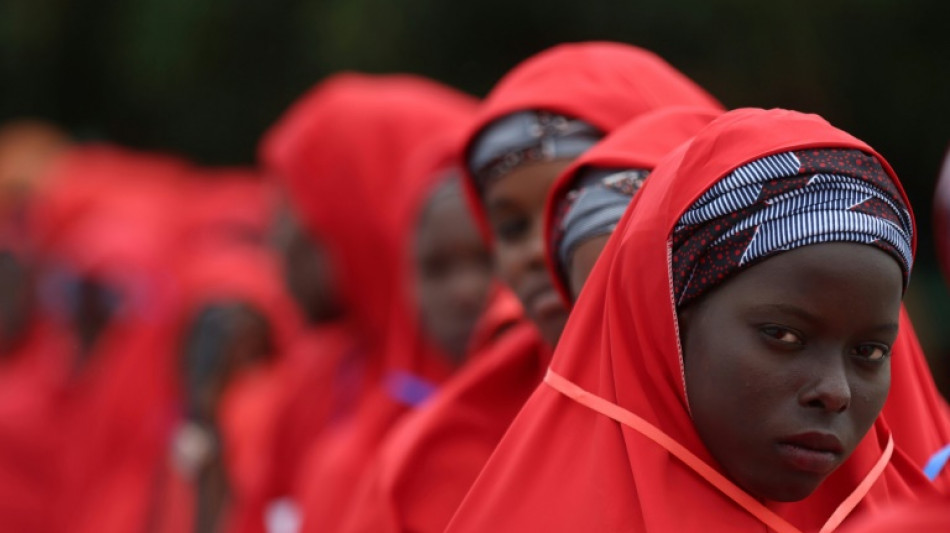
In Nigeria's Muslim north, sharia police change tack on influencers / Photo: Kola Sulaimon - AFP/File
 IoT Refrigerator Hacks Disrupt Blood Labs and Supermarkets Across Europe and US

 Post-election pressures complicate US and Israeli decisions on Iran

 UN members approve talks on treaty protocol against environmental crime

 Family-run West Sussex beach café prepares for first winter season

 CT scans reveal health and burial clues from Egypt’s Braided Lady mummy

 Oxford faces complaints over lecturer’s classroom attire

 Kyren Wilson and John Higgins reach International Championship snooker final

 New Zealand and Tonga meet for place in Rugby League World Cup final

 Reports of unsafe AI-toy responses renew calls for child-safety rules

 Juneau food network combines difficult supply routes with deep sharing traditions

 India climbs green-transition ranking after first emissions decline in 25 years

 Trump names Stephen Miller as White House chief of staff after midterm losses

 Restored Albanian tower houses anchor new rural tourism trail

 Sonia Gandhi reflects on family tragedy and reluctant political career

 Pope Leo begins three-country South American tour in Uruguay

 Khawaja says entire Australia camp knew of 2018 ball-tampering plan
Tiktoker Murja Kunya once ran afoul of sharia police in Nigeria's northwest city of Kano, where "hisbah" units enforce Islamic law that runs alongside common law.
Earlier this year, the units detained Kunya and other influencers for racy media posts and parodies the agency deemed indecent.
But now the morality police are trying a softer approach to curb online celebrities like 24-year-old Kunya who they see as a moral risk in Nigeria's majority Muslim north.
The tussle with influencers is just one sphere where the conservative religious sensibilities of north Nigeria are being tested by new trends.
Earlier this month, the Hisbah invited Kunya and dozens of influencers for a meeting to "sensitise them on the negative effects of immoral content", Abba Sufi, Hisbah's director-general told AFP.
Kunya, who has one million followers on Tiktok, attended the meeting in the hijab head scarf commonly used by women across the north.
That contrasted sharply with the less modest videos, some replete with obscenities, she posted and that earned her Hisbah's wrath.
"The meeting with Murja Kunya and other Tiktokers is a change in Hisbah strategy in dealing with the immoral online content," Sufi said.
"It is better to show compassion and care to someone you want to reform instead of vilifying and stigmatising them."
Kunya declined to speak to AFP on the Hisbah meeting. Other influencers have also not commented.
But on Sunday, Kunya launched a Tiktok tirade against the Hisbah.
"Now that you don't know what to do you are resorting to preaching? You should stop wasting your saliva," she said. "I'm not interested in your preaching."
- Carrot and stick -
The Hisbah dismiss criticism they violate freedom of expression by targeting influencers. The agency says it is just carrying out its mandate to protect society.
Abdallah Uba Adamu, a professor of anthropology and popular culture at Kano's Bayero University, said for the Hisbah the carrot and stick approach alone had not curbed influencers.
"The dialogue approach is a very good," he said. "They can use the stick, they can use the carrot, but it can never prevent people from doing what they think they want to do in order to survive, because they rely on this for survival."
For influencers, the meeting was likely seen as another way to get more followers, part of their online theatre, he said. And also why most had not commented.
"What do you want them to say? That they were invited by Islamic authorities and they they didn't like it?"
- Crackdowns -
Kano is one 12 predominantly Muslim states in north Nigeria where sharia courts operate in parallel to the civil and criminal law.
The hisbah enforces sharia by periodic crackdowns on what it considers immoral acts, including raids on brothels and beer parlours or wedding parties where men and women mingle.
Kano, Nigeria's second largest city, is home to a burgeoning Kannywood film industry, which produces movies in the Hausa language spoken across parts of West Africa.
Kano also has hundreds of studios which churn out songs by local artists like Gwanja which dwell on love, marriage and money.
Kannywood has already been under close watch by Muslim clerics and officials who believed it promoted un-Islamic foreign values, prompting authorities to create a censorship board.
But the increasing number of Kannywood skits and songs online prompted the board to extend its authority to social media.
Kunya was among 10 local celebrities a Sharia court in the city ordered arrested and investigated for immoral conduct on social media seen capable of corrupting the youth.
Lawyers filed a suit for their prosecution for singing and dancing online, generating furore in the city and condemnation from hardline clerics.
Police arrested Kunya in January in a hotel while preparing for her much-publicised birthday party.
In March, she was sentenced to three weeks of community service by the sharia court which ordered her to work as a janitor in Kano's largest medical facility.
Sufi said they had a private discussion with Kunya at the meeting where he showed her the implication of the "obscene and immoral" videos.
According to Sufi, the state government was also ready to assist influencers by paying for education or startup money for new businesses.
Muhsin Ibrahim, a Nigerian who teaches Hausa, culture and film at the Institute of African Studies, University of Cologne, said it was too early to tell whether the new approach would impact influencers like Kunya.
"Many people thought she would stop or reduce some of her ‘transgressive’ acts after the previous court sentence," he said.
"She did not."
L.Miller--AMWN

