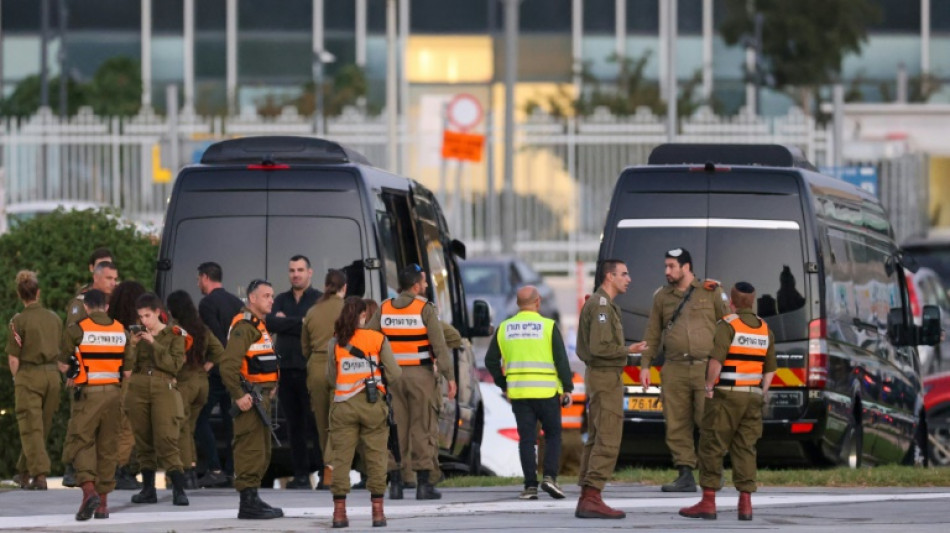
Hamas says Israel hostages handed over as truce takes hold / Photo: FADEL SENNA - AFP
 IoT Refrigerator Hacks Disrupt Blood Labs and Supermarkets Across Europe and US

 Post-election pressures complicate US and Israeli decisions on Iran

 UN members approve talks on treaty protocol against environmental crime

 Family-run West Sussex beach café prepares for first winter season

 CT scans reveal health and burial clues from Egypt’s Braided Lady mummy

 Oxford faces complaints over lecturer’s classroom attire

 Kyren Wilson and John Higgins reach International Championship snooker final

 New Zealand and Tonga meet for place in Rugby League World Cup final

 Reports of unsafe AI-toy responses renew calls for child-safety rules

 Juneau food network combines difficult supply routes with deep sharing traditions

 India climbs green-transition ranking after first emissions decline in 25 years

 Trump names Stephen Miller as White House chief of staff after midterm losses

 Restored Albanian tower houses anchor new rural tourism trail

 Sonia Gandhi reflects on family tragedy and reluctant political career

 Pope Leo begins three-country South American tour in Uruguay

 Khawaja says entire Australia camp knew of 2018 ball-tampering plan
Hamas said a group of hostages seized in the deadliest attack in Israel's history were handed over on Friday as a temporary truce took hold in Gaza following weeks of fighting.
"Half an hour ago, the prisoners were handed to the Red Cross who will take them to the Egyptians" at the Rafah crossing, a source close to Hamas told AFP.
A source in the military wing of Hamas confirmed the handover, adding: "This is the first group under the agreement."
A first tranche of 13 women and child hostages were expected to go back to Israel on Friday under a deal that followed weeks of talks involving Israel, Palestinian militant groups, Qatar, Egypt and the United States.
Israel is set to release three times as many Palestinian prisoners from Israeli jails -- women and teenage boys.
A dozen Thai hostages kidnapped during Hamas's October 7 raids into Israel were also released on Friday, Thailand's Prime Minister Srettha Thavisin announced.
Pictures released by the Israeli army showed bright pink and blue headphones sitting on the seats of a helicopter ready for the released hostages to use, along with toys and teddy bears waiting at a reception centre where they were being taken to.
During a four-day truce, at least 50 hostages are expected to be freed, leaving an estimated 190 in the hands of Palestinian militants.
In exchange, 150 Palestinians prisoners are expected to be released.
Hamas broke through Gaza's militarised border with Israel on October 7 to kill, according to Israeli officials, about 1,200 people and seize around 240 Israeli and foreign hostages.
- 'Going home' -
The pause in fighting triggered a mass movement of thousands of Gazans who had sought refuge in schools and hospitals from relentless Israeli bombardment begun after the October 7 attacks by Hamas militants.
"I'm going home," Omar Jibrin, 16, told AFP after he emerged from a hospital in the south of the Gaza Strip where he and eight family members had sought refuge.
In Khan Yunis, in southern Gaza where many Palestinians fled, a cacophony of car horns and ambulance sirens has replaced the sound of war.
For Khaled al-Halabi, the truce is "a chance to breathe" after nearly seven weeks of war.
Halabi had taken refuge in Rafah but is from Gaza City in the north, much of which has been reduced to rubble.
Israel's retaliatory air, artillery and naval strikes alongside a ground offensive have killed about 15,000 people, the Hamas government in Gaza said.
Gazans have struggled to survive with shortages of water and other essentials. Trucks carrying more aid, including fuel, gas, and food, began moving into Gaza from the Rafah crossing with Egypt shortly after the truce began at 7:00 am.
Jens Laerke, spokesman for the United Nations humanitarian agency, OCHA, expressed hope in Geneva that the pause "leads to a longer-term humanitarian ceasefire for the benefit of the people of Gaza, Israel and beyond."
He repeated the need for access across Gaza, especially in the north "where the damage and the humanitarian needs are the greatest".
According to the UN, 1.7 million of Gaza's 2.4 million people are estimated to have been displaced by the fighting.
Now, thousands of them are trying to get home.
In Khan Yunis, they loaded belongings onto carts, strapped them to car roofs, or slung bags over their shoulders, crowding streets to return to their homes from temporary shelters.
Israeli warplanes dropped leaflets warning people that the war is not over and it is "very dangerous" to return north, the focus of Israel's military campaign.
The truce was also a chance for some Palestinians to return to Gaza through the Rafah crossing.
In the morning, a few apparent gunshots could be heard and dark plumes of smoke rose periodically over northern Gaza, an AFPTV livecam showed, but the truce appeared to be holding in the afternoon.
Further north, on the Lebanon-Israel border, calm also returned after regular deadly exchanges of fire, primarily between the Israeli army and Hezbollah. The Lebanese movement, like Hamas, is backed by Iran.
- Carefully prepared -
Ziv Agmon, legal adviser to Israeli Prime Minister Benjamin Netanyahu's office, told reporters that the hostages would be received individually or in groups by the International Committee of the Red Cross, taken across the border and handed to the Israeli army.
From El-Arish, in the Sinai, they would be flown to Israel, an Egyptian security source said.
The Israeli soldiers had been carefully prepared to receive potentially deeply traumatised women and children.
After medical examinations, the former captives will be able to telephone family members before reunions later at Israeli medical facilities, Agmon added.
AFP has confirmed the identities of 210 of the roughly 240 hostages.
At least 35 of those seized were children, with 18 of them aged 10 or under at the time.
Hamas earlier released four women and Israeli forces rescued another. Two other captives, including a woman soldier, were found dead by Israeli troops in Gaza.
Netanyahu's office said it had received "a first list of names" of those due to be released and been in contact with the families.
Maayan Zin, whose eight- and 15-year-old daughters Ela and Dafna are among the hostages, posted on social media platform X that she had been informed their names were not included.
"This is incredibly difficult for me; I long for their return," she wrote.
The Palestinian Authority's prisoner commission published a list of named Palestinian inmates -- 24 women and 15 children -- who could be released in exchange for the initial hostages.
Palestinian prisoners will be freed from three jails in Israel and the Israeli-occupied West Bank, then taken to the Ofer military camp on buses, an Israeli official told AFP on condition of anonymity.
burs-dr/dv
L.Durand--AMWN

