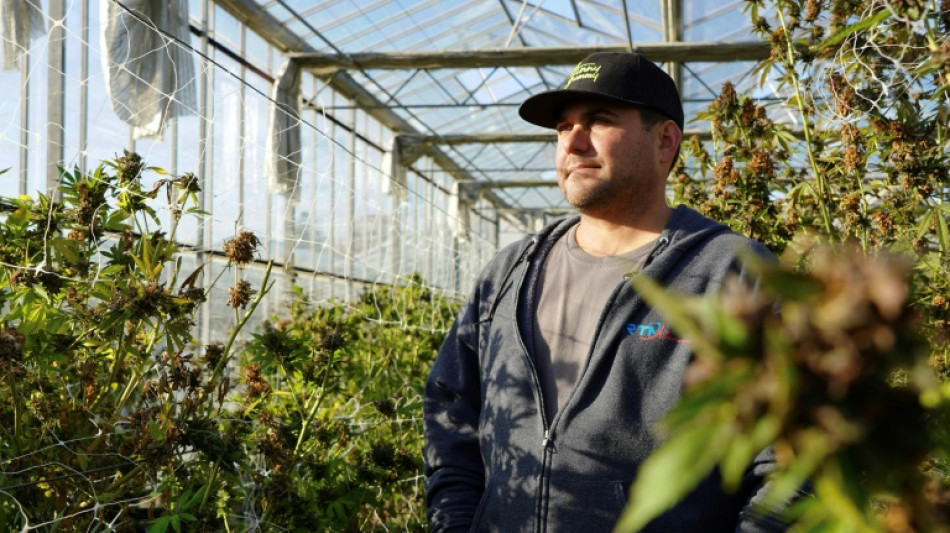
High stakes for weed growers amid slow NY legalization rollout / Photo: Cecilia SANCHEZ - AFP
 IoT Refrigerator Hacks Disrupt Blood Labs and Supermarkets Across Europe and US

 Post-election pressures complicate US and Israeli decisions on Iran

 UN members approve talks on treaty protocol against environmental crime

 Family-run West Sussex beach café prepares for first winter season

 CT scans reveal health and burial clues from Egypt’s Braided Lady mummy

 Oxford faces complaints over lecturer’s classroom attire

 Kyren Wilson and John Higgins reach International Championship snooker final

 New Zealand and Tonga meet for place in Rugby League World Cup final

 Reports of unsafe AI-toy responses renew calls for child-safety rules

 Juneau food network combines difficult supply routes with deep sharing traditions

 India climbs green-transition ranking after first emissions decline in 25 years

 Trump names Stephen Miller as White House chief of staff after midterm losses

 Restored Albanian tower houses anchor new rural tourism trail

 Sonia Gandhi reflects on family tragedy and reluctant political career

 Pope Leo begins three-country South American tour in Uruguay

 Khawaja says entire Australia camp knew of 2018 ball-tampering plan
When New York authorities gave him a license to cultivate cannabis in the spring of 2022, Marcos Ribeiro thought he'd hit the big time.
Since then his plants have flowered, but like other producers he has amassed a stockpile which still he hopes to sell.
In a greenhouse in Long Island, two hours from Manhattan's gleaming skyscrapers, Ribeiro was surrounded by hundreds of leafy, pungent plants, each of which can produce pounds worth of flowers, tending to a harvest of "Blue Dream" strain.
"It's a West Coast variety, very popular. It's a good daytime smoke... It's desirable because a lot of people nowadays look for sativa. They don't want to get sleepy," Ribeiro, the 40-year-old son of Portuguese immigrants, said with a smile, surrounded by his verdant crop.
But for now, business has been less fruitful than Ribeiro had hoped.
Ribeiro, who grew up in the area, has sunk hundreds of thousands of dollars into his enterprise in the two years since recreational cannabis consumption was legalized in New York -- but the official market which appeared set to boom has been beset by problems.
"It's been a lot of money, it's been a lot of time. And then we said we're gonna go all in, like playing poker and then grew all this cannabis -- and with no stores to sell it to," he said. "Kind of heartbreaking."
He is not alone, with more than 200 other growing sites listed in the state -- but only 23 stores licensed to sell marijuana in the sprawling region of 20 million people.
"They're potentially sitting on a lot of product that they grow, that they will not be able to move into the market," said Andrew Rosner, a cofounder of the Cannabis Association of New York.
- 'Enormous fiscal strain' -
"(This) could end up placing enormous fiscal strain on their businesses."
According to another industry body, The Cannabis Farmers Alliance, losses could amount to several million dollars in the worst cases.
More than half of all US states have legalized recreational and medicinal cannabis use, including New York, which adopted an ambitious plan to ensure that users, over 21, would be able to smoke quality controlled and traceable pot.
The plan was for retail licenses to be earmarked for those who had prior convictions for cannabis offenses, in an effort to redress historic judicial burdens that often fell disproportionately on African-American and Hispanic communities.
Among other bureaucratic delays, a court in August halted the opening of any new cannabis stores, following a complaint by US military veterans who alleged discrimination because they weren't given the same opportunity as the ex-convicts.
The Democratic-controlled state last month finally reached a settlement with the veterans, clearing the way for the approved stores to open.
"We are targeting licensing 1,000 or more retail dispensaries over the coming weeks and months," said John Kagia, policy director at the Office of Cannabis Management, a local government body.
- 'Sitting in these jars' -
"Part of the reason we are being so aggressive is precisely because we wanted to get that (financial) relief to our cultivators."
Since decriminalization, New York City has been even more perfumed than previously with the unmistakable sweet smell of cannabis, sold more or less clandestinely in plentiful unlicensed shops amid the slow rollout of legal retail.
To avoid wasting his first crops, Ribeiro changed up. Instead of selling plants for smoking, he brought in a certified processor to convert his plants into THC oil, the psychoactive substance used to make edible cannabis gummies.
David Falkowski, another Long Island grower, keeps the copper-colored oil -- which can be used for cannabis drinks, lotions, vaporizer liquid and more in large jars -- secured behind mesh wire in a prefab building on his farm.
Falkowski, a 46-year-old with locks tied back in a bun, comes from a farming family and has always grown vegetables -- but shifting into cannabis, the soothing properties of which he swears by, was a matter of "survival."
And yet, "the vast majority of our crop is sitting in these jars," he said.
"We can make 10,000 packages of gummies or more out of each jar. But if we're only selling 1,000 a month, and we're only making a few dollars per package profit, we need more retail to get the volume up to where we can actually survive."
"The idea was to add another option for income stream," Falkowski said. "Right now, we're not seeing that -- we're seeing an (outgoing) stream."
O.Johnson--AMWN

