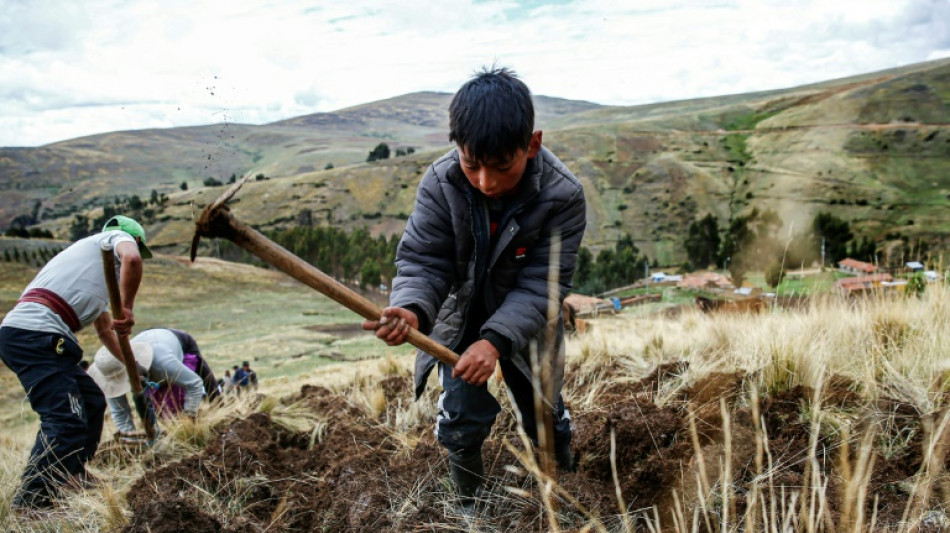
'We need information' plead Peru farmers battling drought, climate change / Photo: Hugo CUROTTO - AFP
 IoT Refrigerator Hacks Disrupt Blood Labs and Supermarkets Across Europe and US

 Post-election pressures complicate US and Israeli decisions on Iran

 UN members approve talks on treaty protocol against environmental crime

 Family-run West Sussex beach café prepares for first winter season

 CT scans reveal health and burial clues from Egypt’s Braided Lady mummy

 Oxford faces complaints over lecturer’s classroom attire

 Kyren Wilson and John Higgins reach International Championship snooker final

 New Zealand and Tonga meet for place in Rugby League World Cup final

 Reports of unsafe AI-toy responses renew calls for child-safety rules

 Juneau food network combines difficult supply routes with deep sharing traditions

 India climbs green-transition ranking after first emissions decline in 25 years

 Trump names Stephen Miller as White House chief of staff after midterm losses

 Restored Albanian tower houses anchor new rural tourism trail

 Sonia Gandhi reflects on family tragedy and reluctant political career

 Pope Leo begins three-country South American tour in Uruguay

 Khawaja says entire Australia camp knew of 2018 ball-tampering plan
A light rain barely moistens the soil in the drought-stricken region of Junin in central Peru. It does nothing to bring relief to farmers in Latin America's biggest potato producer.
"We cannot fight on our own against climate change," said 40-year-old Lidber Ramon, one of about 4,500 crop and livestock farmers around the region.
Once brimful, the lakes dotting this mountainous region -- some 4,700 meters above sea level -- are now depressingly dry -- a "rain deficit" caused by the El Nino weather phenomenon, said Luis Romero, climate change advisor for the NGO Save the Children.
El Nino is a naturally-occurring climate pattern characterized by warming Pacific waters and typically associated with increased heat worldwide -- drought in some parts and heavy rains elsewhere.
Climate change, Romero told AFP, "accelerates these processes, reducing intervals" between one extreme event and another.
Citing a study carried out by Save the Children, he said people born in Peru after 2000 will experience nine El Nino events over their lifetime -- three times as many as their parents.
Ramon and other Junin farmers rely heavily on natural indicators such as the migration of birds, the presence of parasites or even cloud movements to plan for planting and harvesting.
But with the fast-changing local conditions, "this knowledge is no longer enough, we need (other) information," he told AFP.
Information in these parts can be as vital as water. And given the difficulties, many farmers have given up and migrated to cities, said Ramon.
- 'Word of mouth' -
Save the Children is working with the government in Lima to set up a weather warning system updated every ten days with three-month projections for rain, frost or drought.
It will allow farmers like Ramon to "take appropriate steps to cope with weather conditions" -- storing extra water or strengthening animal shelters, said Romero.
But one hurdle is the farmers' limited access to electricity and the internet, which means the information needs to be disseminated by word of mouth, he said.
With about 1.2 million inhabitants -- about one in five of whom live in poverty -- the Junin region is one of Peru's main producers of non-genetically modified potatoes.
The farmers here also raise sheep, alpacas, cows and small camelids called vicunas -- but in this endeavor, too, the lack of rain can be devastating.
In 2022, in a Junin community of 200 people, nearly 400 of a herd of 1,000 alpacas starved to death due to drought, said local leader Jaime Bravo.
Other farmers sold their animals to grow food that the drought also killed, said Naida Navarro, 54, owner of six cows.
Between January and September, Peru's agricultural production plummeted by 3.6 percent compared to the same period in 2022, according to official data.
The Central Bank expects the sector to experience its worst contraction this year since 1997, with potatoes one of the hardest-hit crops.
Manuela Inga, 44, says three years ago a severe drought ruined her potato crops and in 2022 a hail storm destroyed the roof of her house.
His only son, Keyton, 14, wanted to leave school to work in a restaurant in the city of Jauja.
"He said: 'The ram dies, the potato yields very little, we work hard for little money. Mom: I'd better go find work'," she recounted.
She managed to persuade him to stay in school.
According to the Norwegian Refugee Council, a humanitarian organization, some 660,000 people were displaced in Peru between 2008 and 2019 due to natural disasters.
The figure represented about two percent of the country's 33 million inhabitants.
D.Sawyer--AMWN

