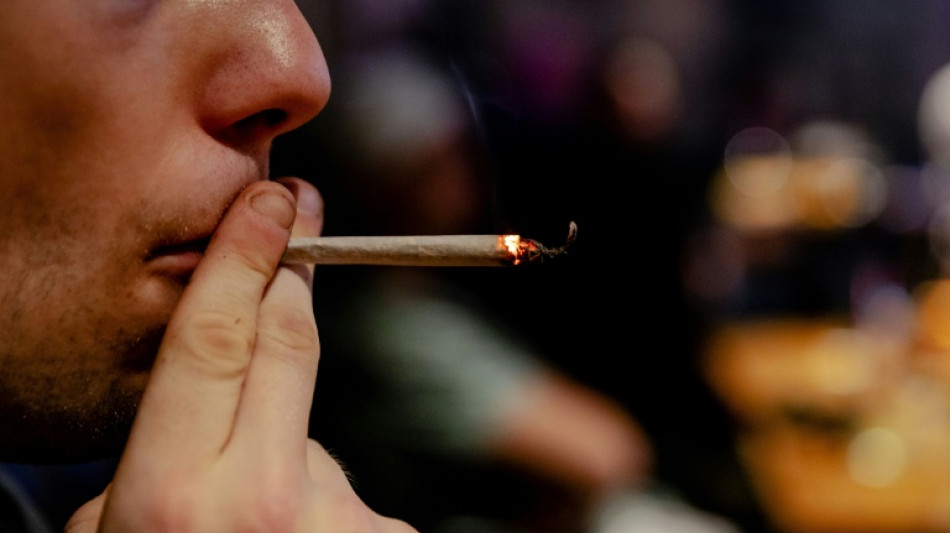
Dutch dope trial: what's the deal? / Photo: Robin van Lonkhuijsen - ANP/AFP
 IoT Refrigerator Hacks Disrupt Blood Labs and Supermarkets Across Europe and US

 Post-election pressures complicate US and Israeli decisions on Iran

 UN members approve talks on treaty protocol against environmental crime

 Family-run West Sussex beach café prepares for first winter season

 CT scans reveal health and burial clues from Egypt’s Braided Lady mummy

 Oxford faces complaints over lecturer’s classroom attire

 Kyren Wilson and John Higgins reach International Championship snooker final

 New Zealand and Tonga meet for place in Rugby League World Cup final

 Reports of unsafe AI-toy responses renew calls for child-safety rules

 Juneau food network combines difficult supply routes with deep sharing traditions

 India climbs green-transition ranking after first emissions decline in 25 years

 Trump names Stephen Miller as White House chief of staff after midterm losses

 Restored Albanian tower houses anchor new rural tourism trail

 Sonia Gandhi reflects on family tragedy and reluctant political career

 Pope Leo begins three-country South American tour in Uruguay

 Khawaja says entire Australia camp knew of 2018 ball-tampering plan
On December 15, cannabis will for the first time be grown, sold, and consumed legally in the Netherlands as part of a four-year trial across the country.
Here's a potted history of the eagerly awaited experiment:
- Wait, it's not already legal? -
This is one of the biggest misconceptions about the Netherlands, whose capital Amsterdam has for decades been considered the world's top draw for cannabis smokers.
In fact, cannabis is not legal but "gedoogd" ("tolerated"). Selling and using cannabis is illegal "but the authorities choose not to pursue or prosecute lawbreakers," according to the government's website.
It is however completely illegal (and not tolerated) to cultivate cannabis in the Netherlands or supply it to the famous "coffee shops" where it can be smoked.
- Why change the system? -
The "toleration" policy was adopted in the 1970s to differentiate between hard and soft drugs but has led to a bizarre legal grey area that the experiment hopes to clear up.
The law has driven the supply of cannabis to the country's 570 coffee shops underground, with local authorities complaining of related petty crime and anti-social behaviour.
- So what's happening? -
The legislation is being temporarily suspended to allow growers and suppliers to operate legally in 11 municipalities, supplied by 10 growers.
All coffee shops in the municipalities have to take part, so that the same rules apply to everyone and consumers know they are getting the same quality of product everywhere.
Other rules remain the same: a maximum of five grammes per person per day, a ban on selling to underaged smokers, no hard drugs, and no alcohol on the premises.
Only people living in the Netherlands can partake. The municipality of Amsterdam East has also applied to participate.
Coffee shops will be able to stock more than the current maximum of 500 grammes on the premises -- "as a general rule... up to one week's stock," according to officials.
- What are the benefits? -
The weed will be carefully tracked and tested, so consumers will know exactly how strong the cannabis is. This is measured by the levels of THC and CBD, the substance that produces the effects.
Potentially dangerous heavy metals and aflatoxin -- which occurs naturally in cannabis -- will also be monitored.
The product itself is expected to be of very high quality. Coffee shop owner Rick Brand told AFP in October it was impossible to know what exactly he was selling under the old rules.
"What we've been receiving until now sometimes contains pesticide, but also foreign agents to increase weight. Actually, we don't really know," he said.
Authorities are hoping for a drop in petty crime and anti-social behaviour. Coffee shop owners are looking forward to operating with legal clarity.
- What happens next? -
Independent researchers will monitor the experiment throughout its four-year duration.
The aim is two-fold: to see if it is possible to regulate the supply chain of cannabis to coffee shops, and to see whether this reduces petty crime and anti-social behaviour.
The government "will decide on the future of Dutch coffeeshop policy on the basis of these outcomes and other factors," according to its website, with a view to eventual decriminalisation.
One unknown hanging over this policy -- and all policies -- is the Geert Wilders factor, after the far-right leader won elections last month.
His PVV Freedom Party wants to scrap the "tolerance" policy for good, close coffee shops, and push for a "drug-free Netherlands."
They were ranked bottom of the parties to vote for in the last election by "cannabis-kieswijzer.nl", a website that assesses political parties by their cannabis-friendly policies.
P.Silva--AMWN

