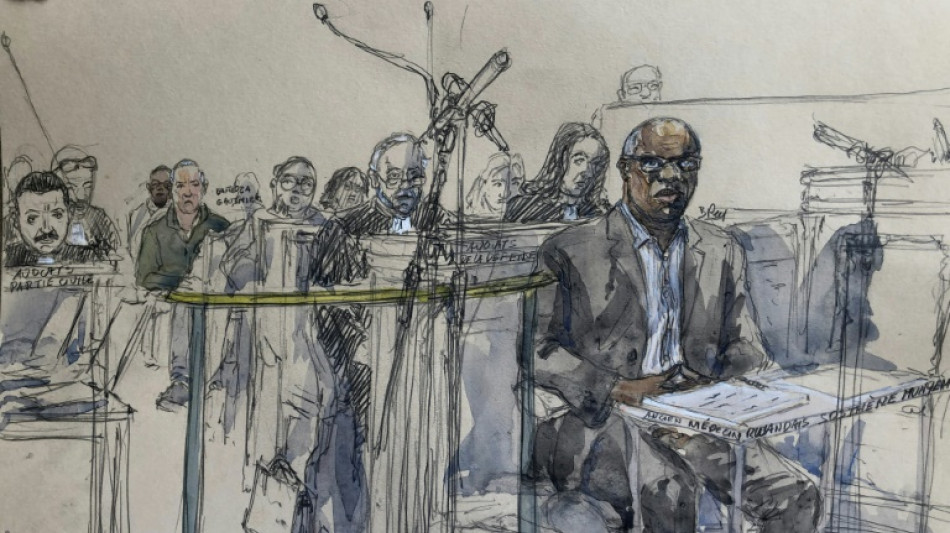
French court jails Rwandan ex-doctor 24 years over 1994 genocide / Photo: Benoit PEYRUCQ - AFP
 IoT Refrigerator Hacks Disrupt Blood Labs and Supermarkets Across Europe and US

 Post-election pressures complicate US and Israeli decisions on Iran

 UN members approve talks on treaty protocol against environmental crime

 Family-run West Sussex beach café prepares for first winter season

 CT scans reveal health and burial clues from Egypt’s Braided Lady mummy

 Oxford faces complaints over lecturer’s classroom attire

 Kyren Wilson and John Higgins reach International Championship snooker final

 New Zealand and Tonga meet for place in Rugby League World Cup final

 Reports of unsafe AI-toy responses renew calls for child-safety rules

 Juneau food network combines difficult supply routes with deep sharing traditions

 India climbs green-transition ranking after first emissions decline in 25 years

 Trump names Stephen Miller as White House chief of staff after midterm losses

 Restored Albanian tower houses anchor new rural tourism trail

 Sonia Gandhi reflects on family tragedy and reluctant political career

 Pope Leo begins three-country South American tour in Uruguay

 Khawaja says entire Australia camp knew of 2018 ball-tampering plan
A French court on Wednesday sentenced former Rwandan doctor Sosthene Munyemana to 24 years in prison for his involvement in the 1994 genocide of Tutsis in his native East African country.
After a deliberation lasting nearly 15 hours, the 68-year-old former gynaecologist was found guilty of genocide, crimes against humanity and participation in a conspiracy to prepare those crimes.
He is the sixth suspect to have faced trial in France over the 1994 massacres in which an estimated 800,000 Tutsis and moderate Hutus died in 100 days of mass killings.
The six-week-long trial at the Assize Court in Paris came nearly three decades after a complaint was filed against Munyemana in the southwestern French city of Bordeaux in 1995.
Munyemana, who was impassive as the verdict was handed down, was immediately incarcerated.
His lawyers said they planned to appeal the verdict, slamming the court's decision as "unacceptable". They argued that major contradictions in the defence testimonies left "room for doubt".
The public prosecutor had sought a sentence of 30 years, arguing the "sum total" of his choices showed "the traits of a genocidaire".
Munyemana was accused of helping draft a letter of support for the then interim government, which encouraged the massacre of the Tutsis.
He was also accused of helping set up roadblocks to round people up and keeping them in inhumane conditions in local government offices before they were killed in the southern Rwandan prefecture of Butare, where he lived at the time.
During the trial, Munyemana repeatedly disputed the accusations, claiming he had been a moderate Hutu who had tried to "save" Tutsis by offering them "refuge" in local government offices.
- 'Organised and steered the genocide' -
Reading the verdict, the judge said Munyemana was part of a group that "prepared, organised and steered the genocide of the Tutsis... on a daily basis".
After arriving in France in September 1994, where his wife was already living, the father of three rebuilt his life in the country's southwest, first as an emergency doctor and then as a geriatrician.
He recently retired.
Munyemana was close to Jean Kambanda, prime minister of the interim government established after the plane carrying then-president Juvenal Habyarimana was shot down by a missile in 1994.
Kambanda is currently serving a life sentence imposed by the International Criminal Tribunal for Rwanda (ICTR) for his role in the genocide.
Munyemana's case is the latest trial in France of alleged participants in the massacres, in which around 800,000 people, most of them ethnic Tutsis, were slaughtered over 100 days by Hutu soldiers and extremist militias, according to UN figures.
France has been one of the top destinations for those implicated in the Rwandan slaughter fleeing justice at home.
It has long been under pressure from activists to act against suspected Rwandan perpetrators who took refuge on French soil.
The French government at the time of the genocide had been a long-standing backer of the Hutu regime in power, a fact that has caused decades of tensions between the countries since.
Under President Paul Kagame, Rwanda has accused Paris of being unwilling to extradite genocide suspects or bring them to justice.
Among those tried and convicted in France are a former spy chief, two ex-mayors and a former hotel chauffeur.
L.Harper--AMWN

