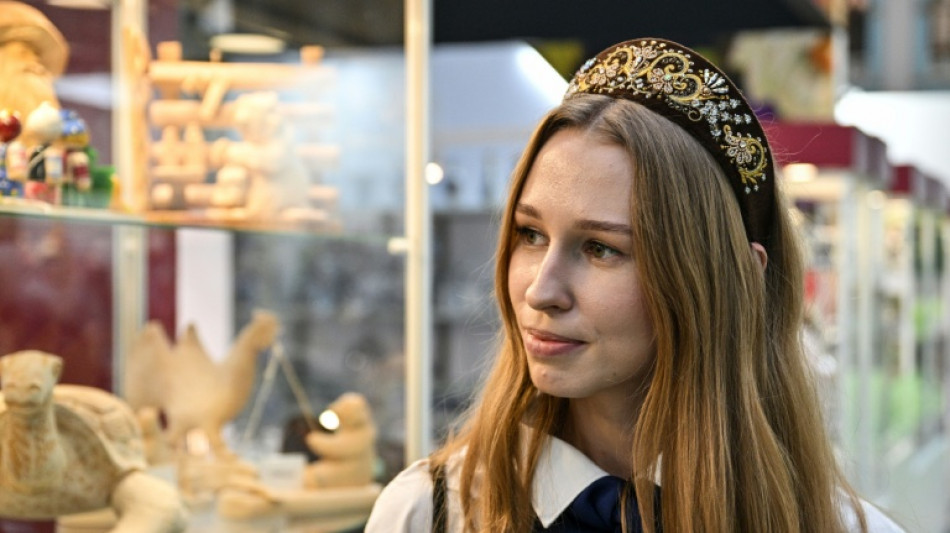
Cut off from the West, Muscovites rediscover Russian 'roots' / Photo: Hector RETAMAL - AFP
 Heineken names new CEO after predecessor's shock departure
 Schools plan to close as UK braces for record-breaking heatwave
 More records set to fall as deadly Europe heatwave drags on
 England, Ghana eye last 32 as Portugal look for lift-off
 Iran says to oversee Hormuz as Swiss talks conclude

 Guns, drones and doves: War reshapes Ukrainian jewellery scene
 Kenya police violence victims say compensation promise a 'smokescreen'

 EU bets on digital euro to cut US tech addiction

 Fineanganofo rethinks Newcastle move after All Blacks call-up
 Stocks fluctuate after Wall St sell-off, crude holds losses on peace talks
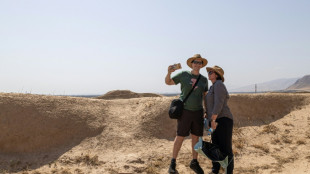 Ultra-reclusive Turkmenistan slowly opens up to tourists
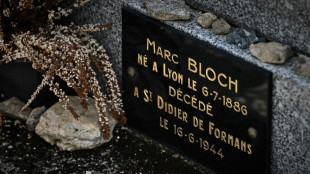 Marc Bloch, historian and Resistance hero, joins France's Pantheon greats
 Ronaldo 'a role model' says Portugal coach after slow World Cup start
 Savea 'embraces challlenge' of leading All Blacks towards World Cup
 Mbappe scores twice as France beat Iraq at World Cup after two-hour storm delay
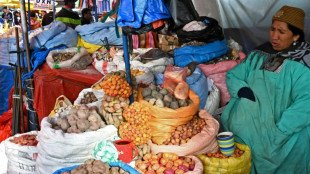 Shortages ease in Bolivia as protest roadblocks dismantled

 Privatejet.com LLC Becomes a WYVERN Registered Broker

 North America LiberNovo Prime Sale Fully Launches June 23

 InterContinental Hotels Group PLC Announces Transaction in Own Shares - June 23
 CTO Confidence in Scaling AI Falls for Third Straight Year, Akkodis Report Finds
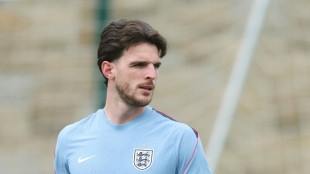 England 'can beat any opponent' at World Cup, says Rice
 Alvarez says 'best for everyone' if he leaves Atletico

 Romanian parliament rejects liberal PM-designate

 Missed penalty spurred 'very angry' Messi to World Cup history
 Oil falls as US waives Iranian sanctions and Nasdaq tumbles

At a cooking school in Moscow, Yulia Fedishova was preparing a "smetannik": a traditional Slavic layer cake with a sour cream topping.
The "Lunch a la Russe" master class she was attending on the secrets of classic Russian dishes is just one example of how many Muscovites are trying to reconnect with their ancestral "roots" amid the war in Ukraine.
The push is encouraged by the Kremlin as Russia faces deepening isolation from the West.
"In such troubling times, you want to return to something familiar, to become closer to your roots in order to find calmness and balance," said Fedishova, a 27-year-old corporate trainer.
Whereas before the war, fondness for traditional pastimes and cuisine may have been dismissed as parochial in big-city Western-inspired Russia, now it is all the rage.
Facing difficulty travelling to Europe and steeped in an ultra-patriotic drive from the Kremlin, many Russians have turned to the tastes and style of their Tsarist and Cold War-era ancestors.
Village foods like cloudberries and jam from pine cones have resurged as a popular ingredient in teas and cakes in Moscow cafes.
Trips to the banya -- the Russian steam bath that involves being flogged with a birch branch and, in winter, jumping into the snow -- have surged, replacing visits to modern-style spas.
Much to the delight of President Vladimir Putin, the kokoshnik, an elaborate traditional Russian headdress, has even made a comeback.
"I've been told that we have a revival of a Russian tradition -- young women are going to events, or going out to bars and so on, wearing kokoshniks and traditional Russian outfits," the Kremlin chief said last October.
"You know, it's not a joke. It makes me very happy."
- 'Retreat' -
The drive comes both from the top -- with Putin pushing Russia to ditch Western values and embrace its break from the West -- and from below, with organic and cultural bottom-up initiatives.
Foreign social networks are banned or restricted, independent media have been forced into exile and Western society routinely bashed as decadent, godless and debauched by officials and on state TV.
Cultural links have diminished since Russia launched its military offensive in 2022.
There are no direct flights to the West and obtaining a visa to visit the EU or the United States has become much more complicated.
"We used to travel a lot, saw Europe, and know it by heart," Natalia, a well-off 39-year-old from Moscow, told AFP.
"But I don't want to go there anymore," she said, blasting what she called "passport discrimination".
"I've never supported the West's policy of lumping us all together regardless of our views -- just as I've never supported what's happening in our country now."
In the early 2010s, two-thirds of Russians described themselves as pro-European, Denis Volkov, head of the Levada Centre independent pollster -- labelled a "foreign agent" by Moscow -- told AFP.
"Now the situation is exactly the opposite," he said.
"It's kind of a retreat into our own identity against the background of Russia's isolation."
At the same time, nationalism and patriotism are surging.
The proportion who see Russia as "one of the best countries in the world" has more than doubled since the mid-1990s -- up from 36 percent to 76 percent, the Levada Center found.
- 'New patriotism' -
In the world of fashion, several brands have launched collections featuring classic embroidery and floral patterns.
The Tvoye brand -- "yours" in Russian -- has had a hit with its "Russian vibes" line, featuring prints of babushkas -- Russian grandmas -- and distinctive Russian window frames on T-shirts.
"This is our new kind of patriotism," interior designer Anna Loseva said.
"My clients no longer want to copy the West. They prefer authentic things over standardised ones."
Recently, some of her customers have even commissioned iconostases -- huge wooden screens featuring paintings of Orthodox icons, typically found in churches -- for their homes.
Others have tried to incorporate elements of tradition, while holding onto the European influence.
The whitewashed walls of Alexei Kochkarev's OKN restaurant evoke an old Orthodox monastery, while its decor is clearly Scandinavian minimalism.
"It's an intentional dualism," he told AFP.
The enthusiasm for heritage is "our response to external pressure."
"Right now it really is a national awakening. But we can't be separated from Europe. Why is it necessary to choose?"
L.Davis--AMWN