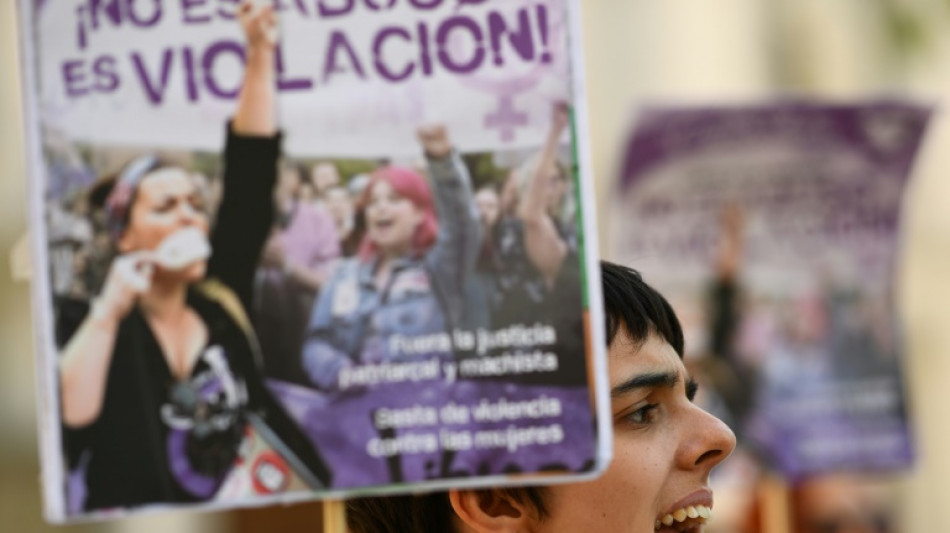
Fury as loophole in Spain rape law used to cut sentences / Photo: GABRIEL BOUYS - AFP
 Trump names Stephen Miller as White House chief of staff after midterm losses

 Restored Albanian tower houses anchor new rural tourism trail

 Sonia Gandhi reflects on family tragedy and reluctant political career

 Pope Leo begins three-country South American tour in Uruguay

 Khawaja says entire Australia camp knew of 2018 ball-tampering plan

 November Foraging Guide: Edible Mushrooms and Critical Safety Protocols

 Microsoft Updates Xbox PC App with 60% Faster Startup and Redesigned Interface

 Early Polar Vortex Disruption Creates Uncertain Winter Outlook for Pennsylvania

 How to Enjoy Luxury Experiences on a Budget

 Pakistan Demands Grant-Based Climate Finance at COP31 to Avoid Debt Trap
A landmark law to fight sexual violence in Spain has come under fire over a loophole used by lawyers to get reduced sentences for some convicted offenders.
The controversy erupted barely six weeks after the law came into force when it emerged that it had led to the jail sentences of some 15 offenders being cut.
One was a man who sexually assaulted his teenage step-daughter. His jail term was reduced from eight years to six.
A teacher who paid for sex with his pupils was released after his sentence was reduced. Four men have since walked out free, according to Spanish media reports.
Known as the "Only yes means yes" law, the new legislation reformed the criminal code to define all non-consensual sex as rape.
Although the new law raises the sentence for gang rape or chemical submission, it reduces both the maximum and minimum sentences in cases with no aggravating circumstances.
Hundreds of convicted offenders have applied to have their sentences revised since the law came into effect on October 7.
In Spain, a jail term can be retroactively modified if changes to the penal code benefits the convicted offender.
Until now, rape victims had needed to prove they were subjected to violence or intimidation.
Without that the offence was considered "sexual abuse" and carried lighter penalties than rape.
The legal change was driven by the notorious 2016 gang rape of an 18-year-old woman by five men at a bull-running festival in the northern city of Pamplona.
The men were initially convicted of sexual abuse and not rape, sparking mass nationwide protests.
The Supreme Court eventually overturned the verdict in 2019 and convicted all five of rape.
- 'Male chauvinist judges' -
With the lesser charge of "sexual abuse" dropped from the reformed criminal code and a much wider range of offences grouped under "sexual assault", a broader range of penalties was required to ensure proportionality.
Anyone previously convicted of sexual assault and handed the minimum sentence of eight years, can now benefit from the minimum being reduced to six.
The result has been a major backlash -- which has put the left-wing government of Prime Minister Pedro Sanchez on the back foot with Spain's legal watchdog hitting back at the flagship legislation as fundamentally flawed.
Equality Minister Irene Montero of the hard-left Podemos party, Sanchez's junior coalition partner, has accused those judges who have rubber-stamped such reductions of "breaking the law" on grounds of "male chauvinism".
Podemos lawmaker Javier Sanchez Serna went further, calling them "fascists in robes".
The General Council of the Judiciary -- which is responsible for ensuring the judiciary's independence -- lashed out at such "intolerable attacks", saying they had warned months ago the legislation could see convictions revised.
The Judges for Democracy association accused the ministry of "not foreseeing such (an undesired) consequence" saying it "in no way justified attacking judges".
- Wolf Pack to benefit? -
The biggest concern is that the changes could affect the sentences of the Pamplona gang rapists, the case which drove efforts to toughen the law.
Known as the "Wolf Pack", the men are serving 15-year sentences, with a lawyer confirming he will seek a reduction for one of them.
With just a year left until the next general elections, Sanchez came out in defence of the law, recalling its aim was to "give more guarantees to women in the face of any kind of sexual aggression".
"Let's wait to see what the courts and prosecutors say about this," he said on Wednesday, with the Supreme Court set to rule on certain cases within the coming month.
Even if the new law was modified, it would not undo the sentence revisions that have already been approved because legislation that toughens penalties is not applicable retroactively.
F.Schneider--AMWN

