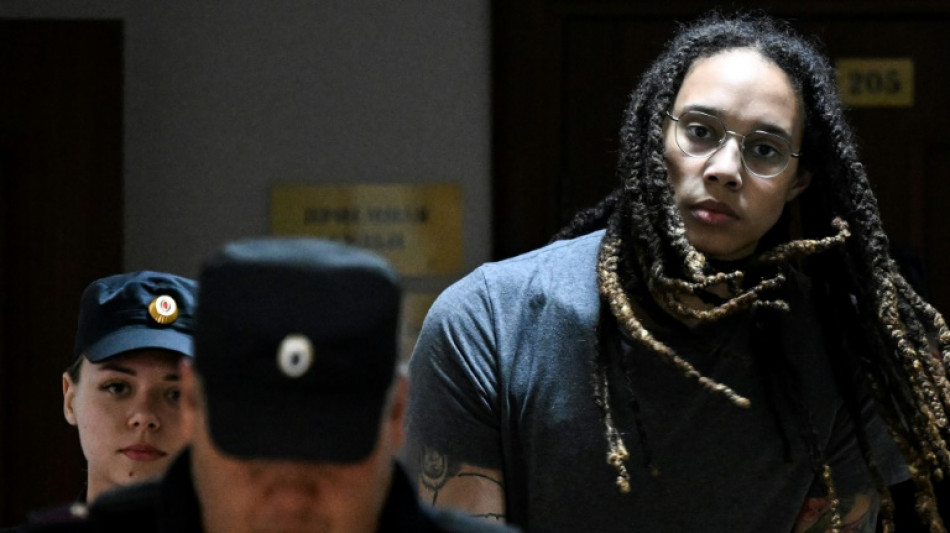
Basketball star Griner begins sentence in remote Russian prison: lawyers / Photo: Kirill KUDRYAVTSEV - AFP/File
 Trump names Stephen Miller as White House chief of staff after midterm losses

 Restored Albanian tower houses anchor new rural tourism trail

 Sonia Gandhi reflects on family tragedy and reluctant political career

 Pope Leo begins three-country South American tour in Uruguay

 Khawaja says entire Australia camp knew of 2018 ball-tampering plan

 November Foraging Guide: Edible Mushrooms and Critical Safety Protocols

 Microsoft Updates Xbox PC App with 60% Faster Startup and Redesigned Interface

 Early Polar Vortex Disruption Creates Uncertain Winter Outlook for Pennsylvania

 How to Enjoy Luxury Experiences on a Budget

 Pakistan Demands Grant-Based Climate Finance at COP31 to Avoid Debt Trap
Basketball star Brittney Griner, whose plight has generated widespread anger in the United States, has been sent to a remote Russian penal colony, her lawyers said on Thursday.
The US athlete was handed nine years in prison in August for possessing vape cartridges with a small quantity of cannabis oil, after she was arrested at a Moscow airport in February.
The 32-year-old's case comes amid fierce tensions between Moscow and Washington over Russia's military offensive in Ukraine.
"Brittney began serving her sentence at IK-2 in Mordovia," lawyers Maria Blagovolina and Alexander Boykov said in a statement.
"We visited her early this week. Brittney is doing as well as could be expected and trying to stay strong as she adapts to a new environment."
The lawyers said no further comment would be provided "considering that this is a very challenging period for her."
Last week US President Joe Biden voiced hope that Russian leader Vladimir Putin would negotiate "more seriously" to free Griner.
"My intention is to get her home, and we've had a number of discussions so far," he said at the time.
On Monday, US and Russian spy chiefs held a rare face-to-face meeting in Ankara on Americans held prisoner by the Kremlin, as well on Moscow's nuclear threats in Ukraine, the White House said.
In what appeared to be the highest-level direct talks between officials of the two countries since Russia sent troops to Ukraine in February, Central Intelligence Agency Director William Burns met with Sergei Naryshkin, head of Russia's SVR foreign intelligence service.
Observers have suggested that Griner and another American jailed in Russia, Paul Whelan -- a retired US Marine arrested in December 2018 and accused of spying -- could be traded for Viktor Bout, a famed Russian arms trafficker serving 25 years in prison on a 2012 conviction.
- Abuse in prisons -
The IK-2 penal colony is in the town of Yavas in the central region of Mordovia, known for its harsh climate.
The IK stands for a "corrective colony", the most common type of prison in Russia.
According to Russia's Federal Penitentiary Service, the IK-2 houses more than 800 inmates who live in barracks.
Mordovia is also home to the IK-17 colony where Whelan is serving time, after he was convicted of spying and sentenced to 16 years in 2020.
His family says he has been mistreated and undergone sleep deprivation there.
Russian penal colonies are known for their harsh treatment of inmates, unsanitary conditions and lack of access to proper healthcare.
Conditions in penal colonies are much harsher than in detention centres.
Activists say abuse and torture are frequent in Russia's vast network of prisons, a successor to the notorious Gulag system of the Stalin era.
When Griner was arrested, the two-time Olympic basketball gold medallist and Women's NBA champion had been in Russia to play for the professional Yekaterinburg team, during her off-season from the Phoenix Mercury.
She pleaded guilty to the charges, but said she did not intend to break the law or use the banned substance in Russia.
Griner had testified that she had permission from a US doctor to use medicinal cannabis to relieve pain from her many injuries, and had never failed a drug test.
The use of medical marijuana is not allowed in Russia.
Tensions with Russia have soared over Moscow's offensive in Ukraine, to which the United States is sending billions of dollars in weapons.
X.Karnes--AMWN

