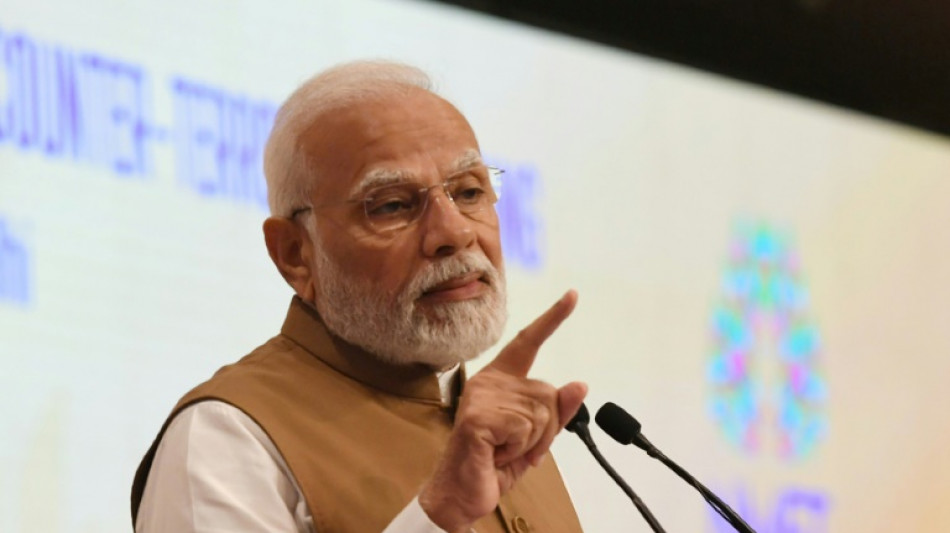
India's Modi says digital currencies being used to fund terror / Photo: - - PIB/AFP
 Trump names Stephen Miller as White House chief of staff after midterm losses

 Restored Albanian tower houses anchor new rural tourism trail

 Sonia Gandhi reflects on family tragedy and reluctant political career

 Pope Leo begins three-country South American tour in Uruguay

 Khawaja says entire Australia camp knew of 2018 ball-tampering plan

 November Foraging Guide: Edible Mushrooms and Critical Safety Protocols

 Microsoft Updates Xbox PC App with 60% Faster Startup and Redesigned Interface

 Early Polar Vortex Disruption Creates Uncertain Winter Outlook for Pennsylvania

 How to Enjoy Luxury Experiences on a Budget

 Pakistan Demands Grant-Based Climate Finance at COP31 to Avoid Debt Trap
Digital currencies need more regulation to stamp out funding for terror operations, India's Prime Minister Narendra Modi said Friday at a major international forum to combat financing of extremist groups.
India has laboured to rein in cryptocurrency transactions after years of phenomenal growth, backed by burgeoning local trading platforms and glitzy celebrity endorsements.
Modi last year said that bitcoin presented a risk to younger generations and could "spoil our youth" if it ended up "in the wrong hands".
On Friday, he went further and told delegates at the Conference on Countering Financing of Terrorism that "private currencies" posed a grave security risk.
"New kinds of technology are being used for terror funding and recruitment. Challenges from the dark net, private currencies and more are emerging," Modi said.
"There is a need for a uniform understanding for new finance technologies," he added.
"From a uniform understanding, a unified system of checks and balances and regulation can emerge."
Delegates from dozens of countries are in the capital New Delhi for the two-day conference, which follows a special session of the UN's Counter Terrorism Committee held in India last month.
Cryptocurrencies have been under the scrutiny of Indian regulators since first entering the local market nearly a decade ago, with a surge in fraudulent transactions leading to a central bank ban in 2018.
India's Supreme Court lifted the restrictions two years later and the market surged, growing by nearly 650 percent in the year to June 2021 -- second only to Vietnam, according to research by Chainalysis.
The government also proposed banning "all private cryptocurrencies", but ultimately held back and later taxed profits from "private currencies" at 30 percent.
Globally, the crypto market has been thrown into upheaval by this month's collapse of FTX, a major exchange used for digital transactions.
Once valued at $32 billion, FTX filed for bankruptcy last week.
Its downfall sent major cryptocurrencies plunging and further undermined investor confidence in the young and turbulent sector.
A.Mahlangu--AMWN

