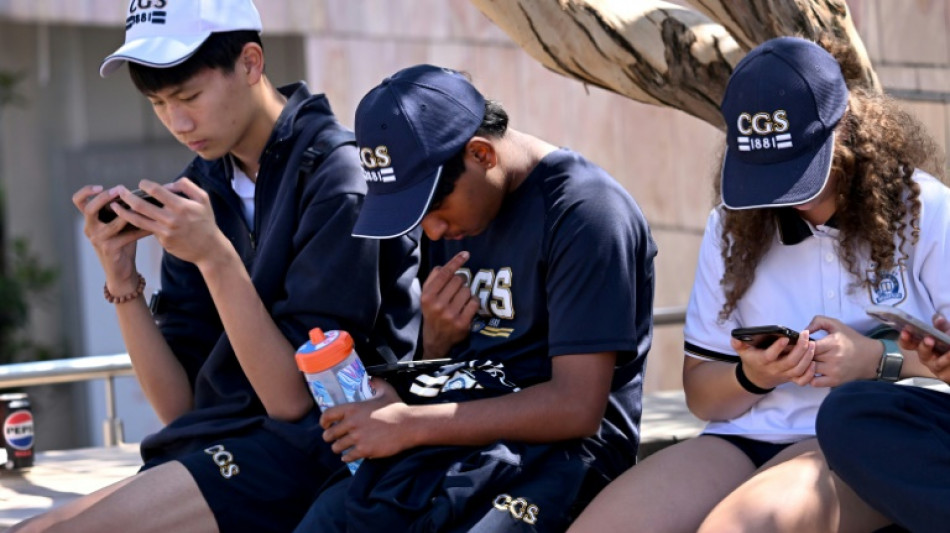
Social media companies slam Australia's under-16 ban / Photo: William WEST - AFP
 Zverev thrashes Shang to set up Djokovic quarter-final at China Open

 Turkey football ref chief jailed pending trial for graft
 North Korea says test of intermediate-range strategic missile included use of AI

 Rampant Sayers leads Hong Kong to third men's rugby gold in a row

 Ethiopia's Tigray rebels abandon regional capital as govt advances

 Bulgaria's Tsar Samuel returns 'home' after 1,000 years

 'Glad it's over': Kim powers to Games gold and military exemption

 After 11 World Cups, football finally comes home for one Indian fan

 Marc Marquez wins sprint at Japan MotoGP, Martin grabs pole
 Alcaraz fends off Arnaldi to reach Japan Open quarters
 Antonelli tops times in final practice at Bahrain GP
 Gauff digs deep to beat Osorio in China Open second round

 Fresh protests to hit Spain after housing measures defeated

 'He's here with me': Japan cycle queen dedicates gold to late brother

 Japan Olympic chief says 'lot more' athletes at Games than expected
 Asian carmakers besting US rivals at home, China poised to strike

 Widgets & Web Offers All-Inclusive Investor Relations Websites for Public Companies, IPOs and SPACs

 New "What Is a Gold IRA?" Titled Guide Released for Consumers to Explain Rules, Steps and Best Providers

 Botched US execution leaves murderer unconscious on ventilator: lawyers
 Cornell rape case exposes sexual violence at US colleges
 France held by Italy in Zidane's homecoming after Olise stunner

 Ethiopian pro-government militia claims Tigray airport as regional tensions spike
 Ohtani shaking off injuries as Dodgers launch MLB post-season

 Sea levels to rise in California as coastal wave surges up west coast
 New rallies urged in France as protests disrupt over 730 schools

Social media giants on Friday hit out at a landmark Australian law banning them from signing up under-16s, describing it as a rush job littered with "many unanswered questions".
The UN children's charity UNICEF Australia joined the fray, warning that it was no "silver bullet" and could push kids into "covert and unregulated" spaces online.
Prime Minister Anthony Albanese said the ban may not be implemented perfectly -- much like existing alcohol restrictions -- but it was "the right thing to do".
The crackdown on sites like Facebook, Instagram and X, approved by parliament late Thursday, will lead to "better outcomes and less harm for young Australians", he told reporters.
Platforms have a "social responsibility" to make children's safety a priority, the prime minister said.
"We've got your back, is our message to Australian parents."
Social media firms that fail to comply with the law face fines of up to Aus$50 million (US$32.5 million).
Meta -- owner of Facebook and Instagram -- and other companies said that despite the law's perceived shortcomings, they were keen to engage with the government on shaping how it would be implemented in 12 months.
"We are concerned about the process, which rushed the legislation through while failing to properly consider the evidence, what industry already does to ensure age-appropriate experiences, and the voices of young people," Meta said in a statement.
- 'Unanswered questions' -
The legislation offers almost no details on how the rules will be enforced -- prompting concern among experts that it will simply be an unenforceable, symbolic piece of legislation.
Meta called for consultation on the rules to ensure a "technically feasible outcome that does not place an onerous burden on parents and teens".
A Snapchat spokesperson said the company had raised "serious concerns" about the law and there remained "many unanswered questions" about how it would work.
But the company said it would engage closely with government to develop an approach balancing "privacy, safety and practicality".
"As always, Snap will comply with any applicable laws and regulations in Australia," it said.
UNICEF Australia policy chief Katie Maskiell cautioned that the ban was not a "silver bullet".
Young people need to be protected online but they also need to be included in the digital world, Maskiell said.
"This ban risks pushing children into increasingly covert and unregulated online spaces as well as preventing them from accessing aspects of the online world essential to their wellbeing," she said.
- Global attention -
One of the biggest issues will be privacy -- what age-verification information is used, how it is collected and by whom.
Social media companies remain adamant that age-verification should be the job of app stores, but the government believes tech platforms should be responsible.
Exemptions will likely be granted to some companies, such as WhatsApp and YouTube, which teenagers may need to use for recreation, school work or other reasons.
The legislation will be closely monitored by other countries, with many weighing whether to implement similar bans.
Lawmakers from Spain to Florida have proposed social media bans for young teens, although none of the measures have been implemented yet.
China has restricted access for minors since 2021, with under-14s not allowed to spend more than 40 minutes a day on Douyin, the Chinese version of TikTok.
Online gaming time for children is also limited in China.
F.Dubois--AMWN