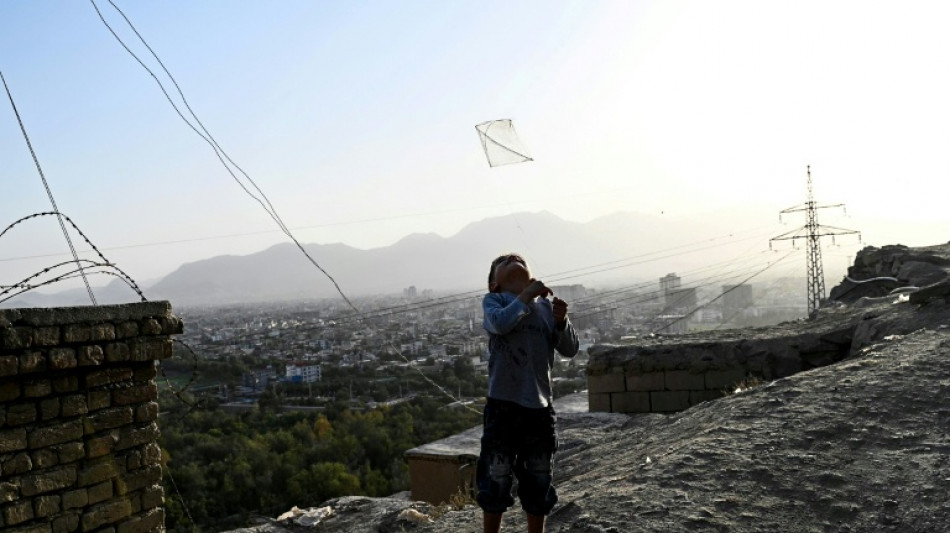
UN calls for Taliban to restore internet as Afghanistan goes dark / Photo: Wakil KOHSAR - AFP
 Libya's pay strike rallies teachers across divided nation

 Four-member crew blasts off for International Space Station

 i-payout Expands True Local Payment Capabilities to Help Enterprises Pay Recipients Globally
 Botched US execution prompts global calls to scrap death penalty

 Algeria adopts law imposing death penalty on forest arsonists
 France unveils cost-cutting 2027 budget as borrowing costs rise
 Brazil court orders removal of fake posts amid patron saint election row

 Italy's firefighting planes return home after scorching summer

 How airlines try to make sure pilots are safe to fly

 Bolivia's attorney general arrested for alleged money laundering and drug trafficking

 Zverev beats Norrie to kick off Sinner-less China Open

 Wall Street stocks rise after bond yield spike eases
 Finland investigates suspected break-ins at MPs homes

 London's Bayeux Tapestry show to offer audio tour for blind people

 Smouldering bins, halted trams as French pupils protest

 Malone Life and Pensions Expands Internationally Beyond the European Union
 England paceman Archer rested for ODI tri-series
 Queiroz exits Ghana as Black Stars crisis deepens

 ALEX BODI VE ALMAN ŞİRKETLER GRUBUNDAN HALLE’DE 166 DAİREYE YATIRIM

 อเล็กซ์ โบดี และกลุ่มบริษัทจากเยอรมนีลงทุนในอพาร์ตเมนต์ 166 ยูนิตที่เมืองฮัลเลอ

 ALEX BODI A NĚMECKÝ KONCERN INVESTUJÍ DO 166 BYTŮ V HALLE
 ALEX BODI OCH TYSK KONCERN INVESTERAR I 166 LÄGENHETER I HALLE

 England forward Toney pleads not guilty to nightclub assault

 Tom Kim finishes marathon Asian Games second round under floodlights

 Work on migrant return hubs progressing well, EU countries say
The United Nations called on Afghanistan's Taliban authorities Tuesday to immediately restore internet and telecommunications in the country, 24 hours after a nationwide blackout was imposed.
The government began shutting down high-speed internet connections to some provinces earlier this month to prevent "immorality", on the orders of shadowy supreme leader Hibatullah Akhundzada.
Mobile phone signal and internet service weakened on Monday night until connectivity was less than one percent of ordinary levels.
Afghans are unable to contact each other, online businesses and the banking systems have frozen, and diaspora abroad cannot send crucial remittances to family.
All flights were cancelled at Kabul airport on Tuesday, AFP journalists saw.
"The cut in access has left Afghanistan almost completely cut off from the outside world, and risks inflicting significant harm on the Afghan people, including by threatening economic stability and exacerbating one of the world's worst humanitarian crises," the UN Assistance Mission in Afghanistan (UNAMA) said in a statement.
"The current blackout also constitutes a further restriction on access to information and freedom of expression in Afghanistan," it added.
The UN rights office called the blackout an "extremely serious human rights violation".
"Women and girls already excluded from public life are especially affected," it said on social media Tuesday, calling for immediate reconnection.
It is the first time since the Taliban government won their insurgency in 2021 and imposed a strict version of Islamic law that communications have been shut down in the country.
"I came to work this morning but we cannot run any business because clients do not have access to online banking, transactions, cash withdrawal, or money authorisation," a bank worker who asked not to be named told AFP in Kabul.
"When there was internet, we never felt how important it was."
The post office was also unable to operate because it required bank services to carry out its work, staff told AFP.
- Radio communications -
Minutes before the shutdown on Monday evening, a government official warned AFP that the fibre optic network would be cut, impacting mobile phone services, "until further notice".
"There isn't any other way or system to communicate... the banking sector, customs, everything across the country will be affected," said the official, who asked not to be named.
Telephone services are often routed over the internet, sharing the same fibre optic lines, especially in countries with limited telecoms infrastructure.
The telecommunications ministry refused to let journalists enter the building in Kabul on Tuesday.
A UN source said Tuesday that "operations are severely impacted, falling back to radio communications and limited satellite links".
AFP journalists witnessed Taliban security forces using radios to communicate with each other at public buildings such as the airport and post office.
Over the past weeks, internet connections have been extremely slow or intermittent.
On September 16, when the first internet services were cut in northern provinces, Balkh provincial spokesman Attaullah Zaid said the ban had been ordered by the Taliban's leader.
"This measure was taken to prevent vice, and alternative options will be put in place across the country to meet connectivity needs," he wrote on social media.
"Recent studies in Afghanistan found that internet applications have badly affected the ongoing, economic, cultural and religious foundations of society," he claimed.
The Taliban leader reportedly ignored warnings from some officials this month about the economic fallout of cutting the internet and ordered authorities to press ahead with a nationwide ban.
Netblocks, a watchdog organisation that monitors cybersecurity and internet governance, said the blackout "appears consistent with the intentional disconnection of service".
On Tuesday, it said connectivity had flatlined below one percent, with no restoration of service observed.
In 2024, Kabul had touted the 9,350-kilometre (5,800-mile) fibre optic network -- largely built by former US-backed governments -- as a "priority" to bring the country closer to the rest of the world and lift it out of poverty.
A.Malone--AMWN