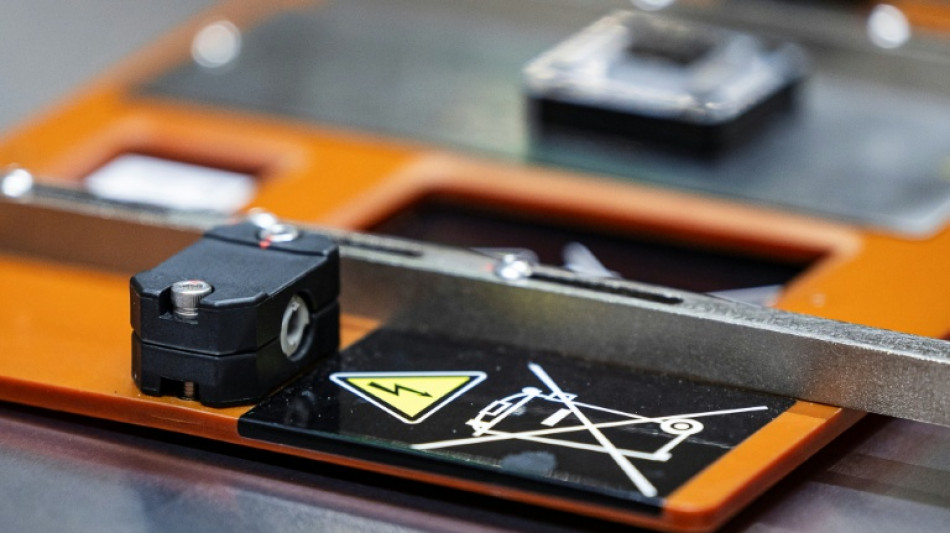
Export ban sparks rush to process lithium in Zimbabwe / Photo: Sameer Al-DOUMY - AFP/File
 Archer, Burger help Rajasthan beat Lucknow in IPL

 Raiders expected to make Mendoza first pick in NFL Draft

 Veteran Fijian Botia extends La Rochelle contract to 2027
 Liam Rosenior sacked as Chelsea manager

 US doesn't dictate terms of trade talks: Carney
 Greek parliament lifts immunity of MPs probed in EU farm scandal

 Germany forward Gnabry confirms he will miss World Cup

 Shifting goals blur picture of US blockade on Iran

 French teenager Seixas becomes youngest Fleche Wallonne winner
 South Africa coal delay could cause 32,000 deaths, report says

 Hezbollah supporters defiant after sons killed fighting Israel

 Merz says climate policy must not 'endanger' German industry

 Thousands of London commuters walk to work in underground strike
 Germany halves 2026 growth forecast on Iran war fallout
 Russia to block flow of Kazakh oil to German refinery, Berlin says

 EU nears approval of Ukraine loan after Hungary pipeline row
 Three ships targeted in Hormuz, Iran seizes two: monitors, Guards

 Iran murals project defiance in war with US

 Germany set to slash growth forecast due to Mideast war

 Groundbreaking Iranian snooker star Vafaei takes on the world

 US-based Buddhist monks bring peace walk to Sri Lanka
 Trump extends ceasefire, claims Iran 'collapsing financially'

 UK inflation jumps as Mideast war propels energy prices

 Anthropic probes unauthorized access to Mythos AI model

 Blazers stun Spurs after Wemby injury, Lakers down Rockets

Zimbabwe's ban on raw lithium exports is forcing Chinese miners to rethink their strategy, speeding up plans to process the metal locally instead of shipping it to China's vast rechargeable battery industry.
The country is Africa's largest lithium producer and has one of the world's largest reserves, according to the US Geological Survey (USGS).
Zimbabwe already banned the export of lithium ore in 2022 and in 2025 announced it would halt exports of lithium concentrates from January 2027.
But on Wednesday it imposed the ban with immediate effect, leaving unclear what the lithium mining sector will do in the short term as Zimbabwe currently has no facilities to process lithium concentrates.
The move, which also included a blanket ban on export of all raw minerals, aims to capture the added value of refining and processing, thus creating jobs and additional government tax revenue.
But critics say the push to refine should have come sooner, with Zimbabwe already having lost out on several years of revenues for the hard-pressed local economy.
Prospect Lithium Zimbabwe, owned by Zhejiang Huayou Cobalt, has spent $400 million on a processing plant that should be operational in the coming weeks, its representative Patience Chizodza told state broadcaster ZBC.
It will reportedly be the first factory in Africa to refine lithium concentrate into lithium sulfate -- a powdered form that is one step closer to the product used in batteries.
The facility should be capable of handling 400,000 tonnes a year of concentrate.
The Zimbabwe state-owned Mutapa Energy Minerals is set to start work in the coming months on a similar plant, chief executive officer Innocent Rukweza told reporters earlier this month.
"We expect that by mid-year -- around June at the latest -- construction of a concentrate-processing plant will be under way," Rukweza said.
The $270-million facility funded by Chinese firms would be able to process 600,000 tonnes annually, he said.
- 'Too little, too late' -
Bikita Minerals, Zimbabwe's largest lithium mine and owned by Sinomine Resources Group, is working on feasibility studies for the construction of a lithium sulphate plant in December, spokesperson Tinomuda Chakanyuka said.
"The project, which will be developed in phases, represents an estimated investment of approximately $500 million from shareholders," Chakanyuka told AFP.
He said the facility will increase local capacity to separate minerals and "contribute to Zimbabwe's broader industrialisation and export diversification objectives."
Global demand for the soft, white metal was up 20 percent last year from 2024, with a key factor being EV sales growth in China and Europe and increased demand for batteries, the USGS said.
Zimbabwe's exports of lithium concentrate rose to 1.5 million metric tonnes last year, generating government revenue of $571.6 million, the Minerals Marketing Authority of Zimbabwe (MMCZ) announced in early February.
The Zimbabwean government's moves to ban exports of raw minerals didn't impress its critics.
"Government is doing too little, too late," said Farai Maguwu, executive director of Zimbabwe's Centre for Natural Resource Governance (CNRG).
With the new rush for critical minerals around the world, "people are asking serious questions about the benefits to the producer country," he said.
"A country like Zimbabwe is exporting raw lithium and, in the process, enriching China at its own expense," Maguwu said.
Instead it should be building its own "mine-to-market ecosystem" that manufactures and markets lithium products, he added.
Economist Godfrey Kanyenze accused the government of a "deficit in policy implementation" when it effectively gave a five-year grace period on the 2022 lithium ore ban by allowing exports of raw concentrates.
Kanyenze said state oversight at Chinese-owned lithium mines was limited, making it difficult to determine how much companies actually produced and earned.
There have also been allegations of environmental damage and exploitation of workers, including by paying low wages.
"Zimbabwe must learn from countries like Norway, Botswana and Kuwait, which safeguard their natural resources through firm, consistent and strategic policy frameworks," he said.
O.Norris--AMWN